How much can the BYD Shark 6 tow?
| Variant | Braked towing capacity | GVM | GCM | Kerb weight | Payload at full tow | Tow ball rating | Rear axle limit |
|---|---|---|---|---|---|---|---|
| Performance 2.0T PHEVMY26 | 3,500 kg | 3,500 kg | 6,650 kg | 2,775 kg | 375 kg | 350 kg | 1,900 kg |
| Premium 1.5T PHEVMY25 | 2,500 kg | 3,500 kg | 5,750 kg | 2,710 kg | 540 kg | 250 kg | 1,927 kg |
| Dynamic Cab Chassis 1.5T PHEVMY26 | 2,500 kg | 3,500 kg | 5,750 kg | 2,600 kg | 650 kg | 250 kg | 1,927 kg |
3 variants
| Braked towing capacity | 3,500 kg |
|---|---|
| GCM | 6,650 kg |
| GVM | 3,500 kg |
| Kerb weight | 2,775 kg |
| Front axle limit | 1,700 kg |
| Rear axle limit | 1,900 kg |
| Tow ball rating | 350 kg |
| ATM planning ceiling | 2,800 kg |
| Wheelbase | 3,260 mm |
The change list BYD published, and the two parts missing from it
The Shark 6 reached Australian customers in February 2025 rated to tow 2,500 kg braked. In March, as CarExpert reported, BYD emailed its owners asking whether they wanted a factory-backed upgrade to payload and towing. The answer shipped in May 2026 as a third variant, and its change list is short enough to read in one sitting: a 180 kW 2.0-litre in place of the 135 kW 1.5-litre, a front motor lifted from 170 kW to 200 kW, larger front brake discs and revalved dampers. Those changes arrived with a combined ceiling of 6,650 kg against 5,750 kg, a 350 kg tow-ball maximum against 250 kg, and a 3,500 kg braked rating against 2,500 kg.
The current primary records establish the result, not which component earned it. The wheelbase remains 3,260 mm, GVM 3,500 kg, battery 29.6 kWh and tank 60 litres. The Performance's rear axle maximum is 1,900 kg against 1,927 kg on the 1.5-litre variants, even though its ball maximum is 100 kg higher. Published sources do not establish that the frame was unchanged or that any one powertrain change unlocked the extra tonne.
Both engines remain in the range, and the Dynamic Cab Chassis joined them on a 2,600 kg kerb before a tray. The 2.0T PHEV row is Performance and the 1.5T PHEV row is BYD Shark 6 Premium. Read the compliance plate and ROVER variant identifier rather than inferring limits from a model-year label.
What the 70-to-90 kW generator change tells us — and what it cannot prove
A plug-in hybrid carries power sources with different endurance. BYD markets 321 kW for the 1.5-litre and 350 kW for Performance; the current ROVER variant record instead lists 345 kW combined for Performance, a published discrepancy that owners should not turn into a sum of its three individual machine ratings. Engine-driven generator feed is separate. Chasing Cars reported 70 kW from the 1.5-litre and 90 kW from the 2.0-litre, describing lower throughput as one constraint under sustained load.
Chasing Cars also described the motors drawing from the 29.6 kWh pack faster than the 1.5-litre could replenish it on a long, steep incline with a heavy van. As state of charge falls, sustained performance depends increasingly on engine-driven generation and the reserve the hybrid control system maintains; it is not correct to reduce the whole system to the engine's 135 kW nameplate. The 20 kW generator difference is therefore relevant evidence, not proof that it alone produced the 1,000 kg rating change. BYD changed the engine, front motor, brakes and damping together.
The brakes belong to the same story. CarsGuide noted in April 2025 that the hybrid system produces very little engine braking even at maximum regeneration, so a long descent leans on the friction brakes in a way a diesel holding a low gear does not — and larger front discs came with the higher rating. Going up, the habit owners share is to hold a higher state of charge before a known climb, commonly 50 to 75 per cent — community practice, not a BYD instruction. Nobody has published the run that would settle it: no dated Australian test has taken a Shark 6 up a real hill on a depleted battery with a heavy van behind.
BYD Shark 6 GVM, GCM and payload: two ceilings that run out together
Run the usual check on a Shark 6 and it comes back a dead heat. Add a 1.5-litre variant's 3,500 kg GVM to its 2,500 kg braked rating and you get 6,000 kg against a certified combined ceiling of 5,750 kg, a shortfall of 250 kg. On a Performance, 7,000 kg meets 6,650 kg, a shortfall of 350 kg. Those two shortfalls are the two tow-ball ratings, to the kilogram, on all three variants: BYD has written each variant's combined ceiling as GVM plus braked tow minus the tow-ball download, which across two rating levels reads as a rule and not an accident.
The consequence is a tie. On BYD Shark 6 Premium, 3,500 kg GVM less 250 kg ball and 5,750 kg GCM less 2,500 kg trailer both equal 3,250 kg. Performance returns 3,150 kg either way. Subtract kerb weight: 540 kg remains on Shark 6 Premium, 375 kg on Performance and 650 kg on Dynamic Cab Chassis before a tray. At full GVM, Shark 6 Premium may hitch 2,250 kg and Performance 3,150 kg. The gross combination mass guide explains why ball mass is deducted once.
Fuel consumption and range with a caravan on the back
Three dated reports land in a similar band. carsales recorded 17.4 L/100 km behind 2,400 kg in May 2025. RACV published 18 L/100 km at the full 3,500 kg on 28 May 2026, but called its run a controlled proving-ground exercise needing a public-road test. A Performance owner reported 186 litres over 1,087 km towing a 2.2-tonne camper from Perth toward Coral Bay in July 2026 — 17.1 L/100 km by the recorded totals — with 33-inch tyres and about 250 kg in the tub, so it is useful experience rather than a controlled comparison.
The Shark 6 carries 60 litres of fuel, and that is where a towing question turns into a route question. At 17.4 L/100 km a full tank is about 344 km dry, and carsales put the usable figure at roughly 294 km once you keep 50 km in hand. At 18 L/100 km it is nearer 330 km. Unladen, two Australian owners posting in May and June 2026 reported 9 to 11 L/100 km once the battery is done, against BYD's published 7.9 and 10.5 L/100 km below 25 per cent state of charge. The cited 17.4–18 L/100 km towing results were roughly 1.6–2.0 times those owner-reported unladen figures; they do not predict every van or route.
In the carsales test the ute used its engine to maintain a battery reserve. The July 2026 owner found the engine worked harder near 50 per cent charge and planned fuel stops every 200 to 220 km. Those are trip observations, not a BYD rule. Official unladen electric range is 100 km on Shark 6 Premium and 80 km on Performance.
Tow-ball load and the rear axle rating that went down
The 1.5-litre variants have a 1,927 kg rear-axle maximum and a 250 kg ball maximum; Performance has 1,900 kg and 350 kg. That makes the axle check more important on the grade rated to tow more. BYD publishes neither per-axle kerb distribution nor the ball-to-axle dimension, so no responsible remaining-margin or hitch-load-transfer figure can be calculated from public data. Get an axle-by-axle weighbridge ticket with the rig loaded.
Every Shark 6 uses a coil-sprung double-wishbone rear end. In its May 2025 test, carsales measured 20 mm of rear drop and 5 mm of front rise with about 200 kg on the ball and reported no sway at 100 km/h. That is evidence for that 2,400 kg test combination, not a promise for a 3,500 kg caravan.
What 375 kg has to cover on a Performance
CarsGuide loaded 650 kg into the tub plus a driver in April 2025, about 750 kg against BYD Shark 6 Premium's 790 kg payload, and measured roughly 60 mm of rear compression without bottoming. Carrying and towing together is tighter: Shark 6 Premium weighs 2,710 kg and Performance 2,775 kg against the same 3,500 kg GVM. Performance at full tow has 375 kg for occupants, towing hardware, tub cargo and accessories. Put a number on it from the unhitched scale: 3,025 kg is 250 kg above the Performance's brochure kerb, leaving 125 kg; a 3,125 kg reading leaves 25 kg.
GVM and combined mass run out together at the full rating; the rear axle can tighten independently because position matters. loadmate holds all three live while a rig is packed, but it needs measured axle inputs to do that honestly on a Shark 6.
Which BYD Shark 6 to buy, and what to weigh before you tow
Match the variant to the van. Up to 2,500 kg ATM, BYD Shark 6 Premium is rated for the job and leaves 540 kg at full tow. From there to about 2,800 kg only Performance is rated, matching the dated Australian test band; beyond that, the cited full-rating test was on a proving ground and 375 kg remains in the ute.
Settle the hardware separately from the vehicle rating. ROVER's current approval certifies Performance to 3,500 kg and records full ADR 62/02 compliance. BYD's configurator makes its optional rear bar unavailable on Performance, while a dated May 2026 delivery report says the grade arrived with a factory receiver. Neither surface publishes that receiver's load label. The aftermarket X-Bar 03530XW sheet is only 2,500 kg and cannot prove or replace the factory part's rating. Before towing, inspect the receiver and ball-mount labels and ask a BYD dealer to match the VIN-installed part to both 3,500 kg trailer and 350 kg ball. The lowest component rating governs.
Then weigh it. Load the rig the way you travel, run it over a certified weighbridge axle by axle, and you have the figure no spec sheet gives you: how much of the rear axle's rating the ute was using before the van turned up. The Shark's variant and touring accessories both affect what remains for the trip. Get the loadmate app to put your measured ute weights, van and recorded gear against the relevant limits. For the measurement terms, the caravan weights guide sets out which of ATM, GTM and tow-ball mass each is measured against. Treat all of it as help with a loading decision. Use the vehicle and towbar approval information for their rated limits and a certified weighbridge ticket for the measured masses on that loading day; the tow belongs to whoever is driving it, which loadmate's safety disclaimer puts plainly. The useful reversal is what to carry away: the Performance adds 1,000 kg of vehicle tow rating while its extra kerb weight leaves 165 kg less payload at full tow, and its rear axle rating is 27 kg lower.
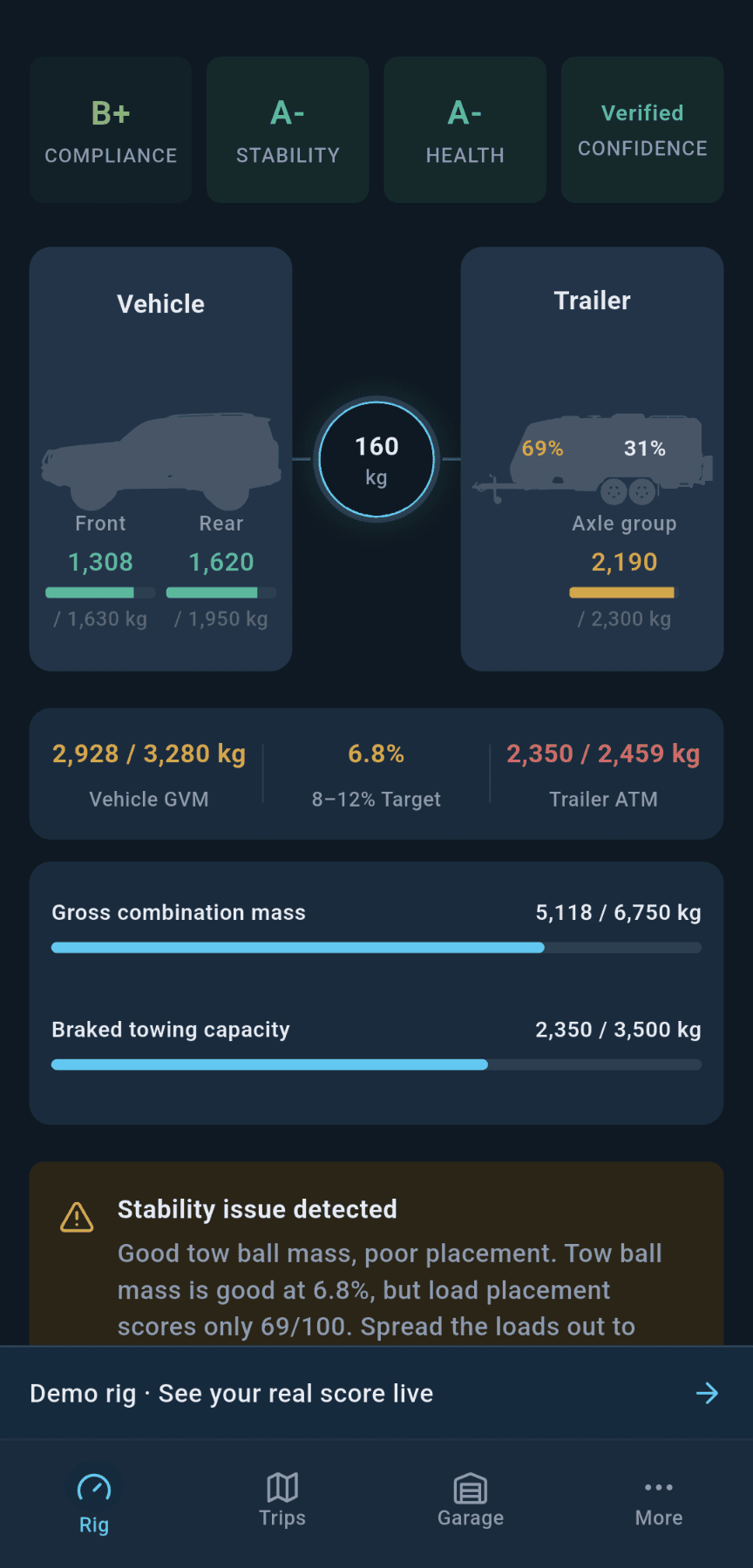
Start the axle track from a measured ticket
At Performance's full rating, GVM and GCM both cap the ute at 3,150 kg; the rear axle does not follow that tie. Begin with a hitched axle-by-axle weighbridge ticket, then loadmate projects how later packing changes all three margins. A free account includes the populated demo rig; reweigh after a material configuration change.


Common questions
- Can I tow a caravan with a BYD Shark 6?
Yes, if the loaded caravan and hardware meet every limit. At full GVM, BYD Shark 6 Premium may hitch 2,250 kg and Performance 3,150 kg. At full tow, Shark 6 Premium leaves 540 kg and Performance 375 kg for people, hardware and cargo. Measure loaded ATM, ball mass and both vehicle axles rather than estimating them from a percentage.
- Is the BYD Shark 6 good for towing?
Inside its rating, the dated evidence is positive to about 2,800 kg: a 2,400 kg van ran at 100 km/h without sway, and 2.6 to 2.8 tonnes hauled and braked straight at launch. BYD Shark 6 Premium stops at 2,500/250 kg; Performance is 3,500/350. Plan around the 60-litre tank and payload left at full tow: 540 kg on Shark 6 Premium, 375 kg on Performance.
- Which PHEV can tow 3,500 kg in Australia?
BYD Shark 6 Performance is rated 3,500 kg braked with a 350 kg ball and 6,650 kg GCM. BYD Shark 6 Premium and Dynamic Cab Chassis are 2,500/250 kg, so the engine and grade matter. The brochure's cover figures belong to Performance, while its 1.3 L/100 km claim also assumes a charged battery; BYD footnotes both conditions.
- Do I need a GVM upgrade to tow with a BYD Shark 6?
Usually not. Ironman 4x4 lists an upgrade to 3,850 kg GVM for the 1.5-litre application; its table retains 2,500 kg tow and 5,750 kg GCM. On those kit-specific figures, trailer allowance at full upgraded GVM is 1,900 kg, versus 2,250 kg at standard GVM. Nothing published covers Performance. Read the exact engineering certificate and state approval before ordering; do not assume any GCM or tow change beyond what it certifies.
- Does a BYD Shark 6 restrict speed or driver assistance when a trailer is connected?
Early cars did. A February 2025 test recorded a 110 km/h cap, NORMAL mode and some driver-assistance functions disabled when a trailer plug was connected. Later owner reports on software v2.1.2 show trailer-weight profiles and cruise control on some cars, while other cars displaying the same version lack them; BYD's linked Australian handbook is still the old 2,500 kg document. The current Performance behaviour is therefore not publicly settled. Have the actual car demonstrated while parked with a plug connected, including trailer profile, drive modes, cruise and warning screens; the version number alone is not enough.
- What is a BYD Shark 6 like towing a 1.7 tonne trailer or boat?
It is within either dual cab's 2,500 kg-or-higher rating, but comfort still depends on shape, ball mass and loading. A 1,700 kg trailer leaves 4,050 kg under the 1.5-litre GCM, so the ute's 3,500 kg GVM binds first. Its measured ball mass must remain under 250 kg, and the loaded combination and both axles still need checking. The standard 230-volt vehicle-to-load outlets can power campsite equipment without changing any towing limit.
Understand the weight limits
Every figure above is governed by a manufacturer-set limit. These guides explain what each term means and how they fit together.
- Caravan & towing weights explainedThe master glossary: GVM, ATM, GTM, TBM and GCM in one place.
- Gross Combination Mass (GCM)The combined vehicle-plus-trailer ceiling that usually bites first.
- Aggregate Trailer Mass (ATM)What your caravan is legally allowed to weigh, fully loaded.
- Braked towing capacityWhy a 3,500 kg rating rarely means you can tow 3,500 kg.
Sources and review
Specifications checked
Page reviewed
- BYD Australia — Shark 6 spec sheet (PDF, document version 260525, 25 May 2026)
Per-variant kerb, GVM, GCM, payload, front and rear axle limits, braked and unbraked towing, tow-ball download, wheelbase, engine and motor outputs, battery and fuel-tank capacity, suspension type, and BYD's own towing notice
- carsales — BYD Shark 6 2025 tow test (3 May 2025)
Measured 17.4 L/100 km behind a 2,400 kg caravan at about 200 kg of tow-ball mass, 20 mm rear droop and 5 mm front rise, stability at 100 km/h, usable range between fills, charge-holding behaviour under tow
- caravancampingsales — BYD Shark 6 2025 tow test (6 May 2025)
Republished tow test adding the into-reserve range figure on the 60-litre tank
- CarsGuide — BYD Shark 6 GVM test (27 Apr 2025)
650 kg tub load near the payload limit, about 60 mm rear compression with no bottoming out, 6.6 L/100 km unladen over 522 km, minimal engine braking under regeneration, and the pre-May-2026 absence of a published GCM
- caravancampingsales — BYD Shark 6 towing issues addressed (5 Feb 2025)
The three tow-mode restrictions reported by early owners — 110 km/h cap on a connected trailer plug, driver-assistance deactivation in tow mode, forced standard drive mode — and the promised over-the-air fix
- CarExpert — BYD Shark 6 payload and towing upgrades on the way if owners want them (14 Mar 2025)
BYD Australia emailing Shark 6 owners about a factory-backed payload and towing upgrade, and the October 2024 executive statement flagging a 3.5 tonne version
- CarExpert — BYD offers full customer refunds after build-year error (2026)
More than 1,200 Australian customers refunded over 2025-built cars described as 2026 models, and why the compliance-plate build date is the reliable label
- carsales — 2025 BYD Shark 6 off-road review
Independent coil-sprung rear suspension in a class of leaf-sprung utes, and the loaded and off-road trade-off that comes with it
- OzBargain — BYD Shark 6 owner discussion thread
Two independent Australian owners' unladen consumption figures (9 to 11 L/100 km once the battery is depleted), home-charging times on the supplied portable charger, and vehicle-to-load use at camp
- Chasing Cars — 2026 BYD Shark 6 Performance review (27 May 2026)
Chasing Cars' identification of the 70 kW / 90 kW hybrid-system feed and long-climb battery behaviour as a limiting factor, plus identical spring rates with revised damping; this source does not establish that the feed change was the sole cause of the 1,000 kg rating increase
- CarExpert — 2026 BYD Shark 6 Performance quick drive (27 May 2026)
The upgraded brakes and revalved dampers, larger front discs and pads, and the 2.8-tonne caravan / 2.6-tonne excavator stopping exercise. The journalist-relayed BYD claim that the frame needed no changes is quarantined from the release article and is not treated as independently established fact
- RACV — 2026 BYD Shark 6 Performance review (28 May 2026)
18 L/100 km measured towing a caravan at the full 3,500 kg in controlled proving-ground conditions, with the reviewer's own caveat that a public-road towing test is still needed
- CarExpert — BYD Shark 6 gets higher payload thanks to GVM upgrade (12 Sep 2025)
The Ironman 4x4 second-stage GVM upgrade from 3,500 kg to 3,850 kg on IM2.5 monotube shocks, and the statement that braked towing capacity remains unchanged at 2,500 kg with it fitted
- X-Bar — BYD Shark 6 10/2024-on fitment sheet (PDF)
The component-specific X-Bar 03530XW listing states only 'Up to 2,500 Kg' and publishes no ball-mass rating. It cannot establish or replace the factory Performance receiver rating; owners inspect the installed labels and have BYD match the VIN-installed part to the 3,500/350 kg vehicle limits
- Australian Government ROVER — BYD Shark 6 approval VTA-064508
The current Australian vehicle approval and linked variant records, including the Performance vehicle's 3,500 kg tow rating and ADR 62/02 compliance. Vehicle approval does not by itself supply the installed receiver's load label
- BYD Australia — current Shark 6 configurator
Current grade and accessory availability: the optional rear bar is unavailable on Performance, while the vehicle remains certified at 3,500/350 kg; the surface does not publish a receiver load label
- BYD Shark Australia owner — Performance delivered with factory receiver (May 2026)
A single current Australian owner's delivery report that the Performance arrived with a factory receiver. Low-confidence fitment context only: it does not establish the receiver or ball-mount load label, which must still be checked on the individual vehicle
- X-Bar — BYD Shark 6 03530XW installation instructions (25 February 2025)
The installation drawing for the pre-Performance 03530XW component, retained to identify its exact scope rather than transfer its rating to the factory Performance receiver
- BYD Shark Australia owners — towing with software v2.1.2
Dated owner reports that some v2.1.2 cars expose trailer profiles and cruise control while others displaying the same version do not; supports demonstrating the actual car with a trailer plug rather than relying on the version number
- BYD Shark Australia owners — May 2026 software and towing discussion
Additional current owner reports on inconsistent trailer-profile and assistance behaviour, used only as low-confidence operating context
- BYD Shark Australia owner — Performance towing real-world figures (17 July 2026)
A dated Performance owner's 186 litres over 1,087 km towing a 2.2-tonne camper, 17.1 L/100 km by the reported totals, and a personal 200–220 km fuel-stop practice; single-owner experience, not a controlled test