How much can the Kia Carnival tow?
| Variant | Braked towing capacity | GVM | GCM | Kerb weight | Payload at full tow | Tow ball rating | Rear axle limit | Unbraked towing | Front axle limit |
|---|---|---|---|---|---|---|---|---|---|
| 2.2 dieselMY27Med | 2,000 kg | 2,970 kg | Unconfirmed | 2,245 kg | Unconfirmed | 200 kg | Unconfirmed | 750 kg | Unconfirmed |
| 1.6 turbo hybridMY27Med | 1,000 kg | 2,980 kg | Unconfirmed | 2,334 kg | Unconfirmed | 100 kg | Unconfirmed | 750 kg | Unconfirmed |
2 variants
| Braked towing capacity | 2,000 kg |
|---|---|
| GVM | 2,970 kg |
| Kerb weight | 2,245 kg |
| Tow ball rating | 200 kg |
Start with who's travelling
The Carnival makes sense when a household needs several child seats, room for passengers and space for holiday bags. So start the towing decision with those people. A car can have eight seats and still run out of carrying weight once the towbar, luggage and ball load go on.
In the current Australian MY27 range, the first split is a big one: the diesel takes a 2,000 kg braked trailer and the hybrid 1,000 kg. A trailer packed to 1,600 kg rules out the hybrid before you count a single passenger. A genuinely light folding camper may suit both, but you still need the family-load check.
This guide works from the MY27 Australian brochure and the matching Australian manuals, checked on 16 October 2026.
The MY27 diesel and hybrid have different trailer jobs
Kia's current table lists the 2.2 diesel and the 1.6 turbo petrol hybrid across S, Sport+ and GT-Line. GVM is 2,970 kg for the diesel and 2,980 kg for the hybrid, and both allow 750 kg unbraked. The Australian and New Zealand tables in the diesel-compatible ICE manual and hybrid manual set the 200 kg and 100 kg ball limits.
A higher-rated towbar won't get around that gap. The car, the coupling and the fitted towing equipment each have a limit, and the lowest one applies. Trailer brakes are part of the match too: a 900 kg trailer is over the unbraked rating of either current Carnival, even though it's under both braked limits.
Older Australian V6 Carnivals still matter if you're buying used, but check their engine, weights and handbook separately. The current type-approval record includes a V6 variant while the MY27 retail brochure lists diesel and hybrid, and that record won't tell you what a dealer has to sell.
Plan from maximum kerb, then weigh the car
The brochure gives maximum kerb weights of 2,245 kg for the diesel and 2,334 kg for the hybrid. Take those from GVM and you get 725 kg and 646 kg of carrying room on paper. Using maximum kerb means you aren't assuming every trim is the lightest one, but it still misses whatever is fitted to your own car.
Take off the maximum ball loads and that drops to 525 kg for the diesel and 546 kg for the hybrid. People, child restraints, extra equipment and luggage all share it. The hybrid comes out slightly ahead here only because its maximum ball load is 100 kg lower; it still can't pull the diesel's trailer.
Those are GVM-only figures. Kia's Australian brochure, manuals and public type-approval pages don't list a numeric GCM or axle limits, so nobody can tell you from them how much payload is left at full tow. Ask Kia for the combination limit for your build. The GVM guide covers the car-side limit, and the GCM guide explains why the car and trailer together must also fit a combined limit.
A loaded weigh-in replaces that estimate. If the weighed car already included the towbar, fuel and fitted gear, don't add them again. Note who was aboard and what luggage was in the car when the ticket was printed.
A 1,800 kg camper leaves 85 kg below GVM
Here's one example family in a MY27 diesel at the published 2,245 kg maximum kerb. Add 40 kg of towing equipment, 340 kg of occupants and 80 kg of luggage and camping gear, and the unhitched car weighs 2,705 kg. Those three extras are placeholders for your own family's numbers.
Hitch a fully loaded 1,800 kg camper with 180 kg measured on the ball. The car now carries 2,885 kg, 85 kg under its 2,970 kg GVM. The trailer and ball are inside the diesel's 2,000 kg and 200 kg ratings, and the trailer axles carry the other 1,620 kg.
The whole rig weighs 4,505 kg: 2,705 kg of unhitched car plus the complete 1,800 kg trailer, or 2,885 kg of hitched car plus 1,620 kg on the trailer axles. Adding the complete trailer to the hitched car would count the 180 kg ball twice.
That's as far as these numbers go. You'd still need a GCM to compare 4,505 kg with, and measured front and rear axle loads to check against their limits. And 85 kg isn't much room for anything left off the list.
That 85 kg also starts from a maximum-kerb estimate. Link a representative weigh-in to the Carnival and camper in the loadmate app, noting which passengers, restraints and gear were aboard. The measured loads replace the brochure estimate and give the next family trip a baseline to update when the kids, luggage or camping gear change.
Count the real passengers, then where their weight sits
The two adults, two children and two dogs in a 2023 Carnival owner's February 2024 caravan question make a better starting list than an assumed average payload. Add the people actually travelling, their restraints or pet gear, and whatever has to stay in the car. Then add the trailer's measured ball load.
Position matters as well as total weight. The ball load sits behind the rear axle, so its effect on that axle isn't simply the number on a ball scale. Kia's MY27 AU/NZ manual gives a recommended rear-wheel-centre to coupling distance of 1,205 mm. That's one reason to get separate axle readings instead of treating spare GVM as spare capacity on every axle.
Secure heavy cargo where Kia says it can go, and follow the trailer's loading instructions. Shifting heavy gear to the back of a caravan just to cut the ball load can create a different problem. Suspension changes and weight-distribution hitches need specific approval from Kia and the equipment maker, and neither one gives you a missing combination rating.
Choose sleeping space by loaded mass
A family planning an Australian big lap in August 2023 asked whether a Carnival could pull a caravan big enough for two adults and three young children, or whether they needed a folding camper. Compare complete travelling setups: beds, water, cooking gear, batteries, bedding and luggage all change what ends up on the coupling.
An advertised tare is the trailer empty, before you pack it. Ask for its current plate limits and weigh it loaded the way you'd travel before you commit. A camper with plenty of rated payload can still go over the Carnival's trailer or ball limit once you actually use that payload.
The same everyday-space trade-off came up in a 2014 Grand Carnival buyer discussion, where a fourth child on the way made access and luggage room important. For a MY27, check the family's needs and the trailer together, while you can still change either.
Plan the site access and the towing equipment
In the February 2024 discussion, an owner of an earlier Carnival reported good Jayco Swan trips but occasional front-wheel slip on gravel. In the 2014 Grand Carnival thread, another owner towed a boat and took care on steep ramps with a low hitch. Those are individual, older accounts, and nobody was testing MY27 traction or clearance.
They still raise good questions about your campsite: what's the surface, how steep is the access, and is there room to turn without grounding the coupling? A good result on a level weighbridge won't answer those. Check your actual car and trailer setup for the route.
The MY27 manuals also call for suitable hitch equipment, safety chains, trailer lighting and brakes. Have the installer specify the right harness and brake controller for an Australian car and trailer. Overseas Carnival threads about American sockets, towing packages or pound ratings won't tell you the right Australian installation.
Fuel planning and the first towing trip
An Australian V6 owner's January 2019 question was about fuel use with a 1.5-tonne camper on occasional school-holiday trips. It's a good prompt to budget for towing fuel, but answers about that older V6 can't forecast consumption for the MY27 diesel or hybrid. Record your actual consumption with the loaded rig on the route you plan to drive.
Kia's current manuals rule out towing for the first 2,000 km. They also say to tow below 100 km/h, and no faster than 70 km/h on a long uphill grade or the lower posted limit. Put those in the departure plan along with the load check, servicing and trailer preparation.
For a used Carnival, check the VIN for outstanding recall work. The regulator's 6 March 2026 notice REC-006557 includes some 2025 KA4 Carnivals in a multi-model Kia instrument-cluster software recall. It doesn't cover every MY27 Carnival, so match your VIN and have Kia's remedy done if it applies.
What to get before you pay for the camper
For the diesel example, the next things you need are the combination limit and both axle limits, then a representative loaded weigh-in. Kia's online MY27 axle-weight instructions point owners to the certification label for each axle rating. Read the label on your car, then ask Kia for any missing figures and for the combination limit or approval conditions for your exact build. The public KA4 type-approval descriptor backs up the current towing and GVM figures but doesn't fill those gaps.
A trailer over 1,000 kg fully loaded rules out the MY27 hybrid; over 2,000 kg, it rules out the current diesel too. Under the relevant limit, check ball load, the occupied car's weight, axles and combination mass before you decide. No caravan length or berth count tells you it's a match on its own.
If the sleeping space you need pushes the trailer past the Carnival's limits, compare another family tow vehicle with the same passenger and luggage list. The Ford Everest guide gives you another set of figures to start from.
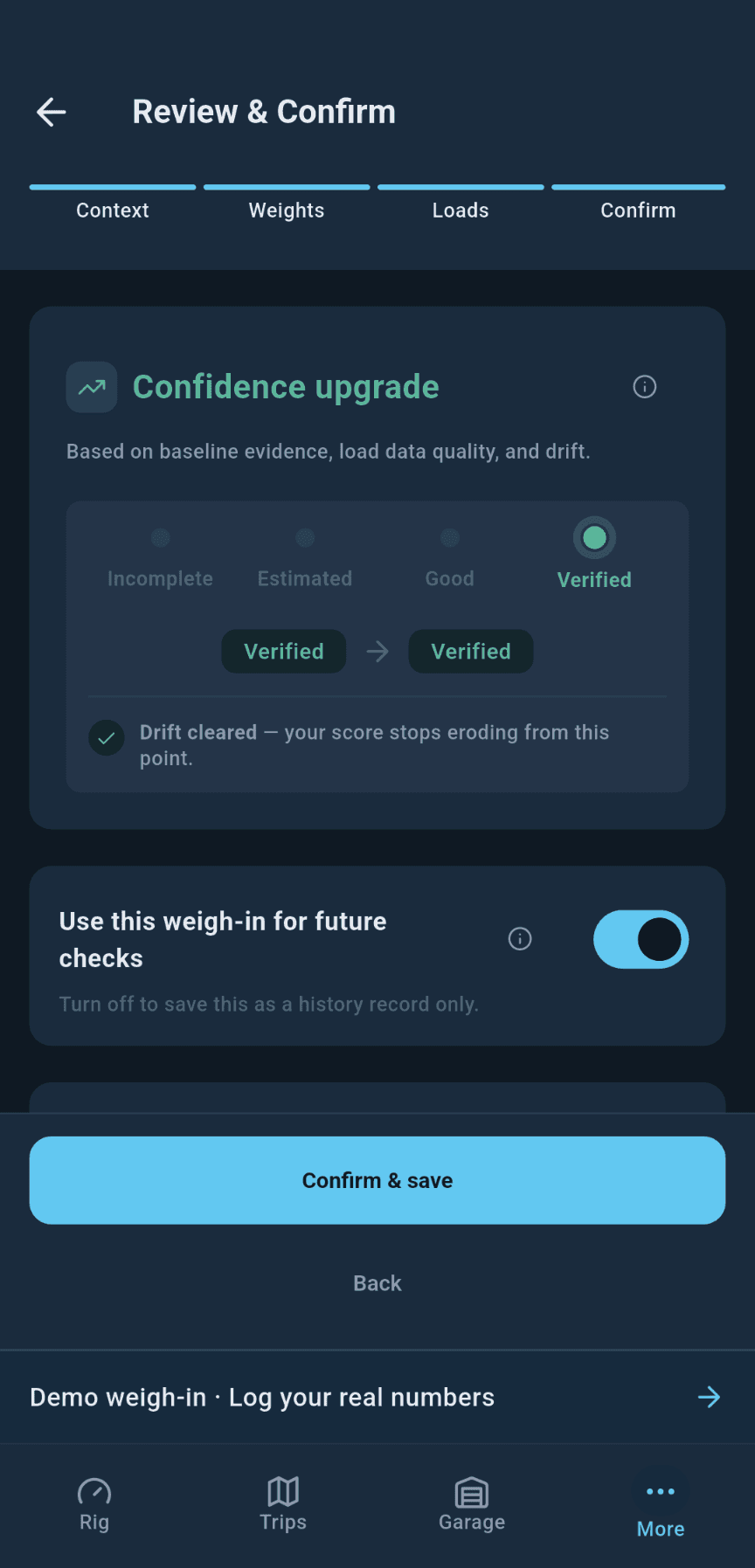
Weigh the Carnival with the family it carries
Eight seats tell you who fits, not what they weigh with their restraints and luggage. Link a representative Carnival and camper weigh-in in loadmate and record who and what was aboard. The screen shows a demo summary of the measured baseline that later family and camping changes are compared with.


Common questions
- Can a Kia Carnival tow a caravan with the whole family aboard?
Yes, if the caravan's loaded weight and ball load, the occupied car and the whole rig all fit inside every limit. The MY27 diesel allows 2,000 kg braked and 200 kg on the ball; the hybrid allows 1,000 kg and 100 kg. From Kia's maximum kerb figures, 525 kg (diesel) or 546 kg (hybrid) is left under GVM after a maximum ball load. Confirm the GCM and your axle limits with Kia before you rely on that.
- Does the eight-seat Carnival have enough payload to tow with every seat occupied?
Eight seats tell you how many people fit, not what they and their luggage weigh. Add the actual people, restraints, gear and ball load, then compare the weighed car with its GVM and axle limits. The MY27 diesel GVM is 2,970 kg and the hybrid's is 2,980 kg.
- Can the Carnival hybrid tow the same camper as the diesel?
Only if that camper also fits the hybrid's lower limits. The Australian MY27 hybrid is rated to 1,000 kg braked and a 100 kg maximum ball load, against 2,000 kg and 200 kg for the diesel. A higher-rated towbar won't make a heavier camper acceptable.
- Is the Carnival's front-wheel drive a problem on a campsite?
Some owners of older Carnivals report wheelspin on loose surfaces or take care on steep ramps. Those are anecdotes, not a MY27 test. Check the site's slope, surface and access, follow Kia's operating instructions and check coupling clearance. A towing rating on its own won't guarantee you can get in on every surface.
- What is the Carnival's GCM?
Kia's current Australian MY27 brochure, owner's manuals and public KA4 type-approval pages don't list a numeric GCM. Ask Kia for the combination limit or approval conditions for your exact build. Don't make one up by adding the published GVM to the towing capacity.
- Can I use older V6 towing fuel figures to compare the current diesel and hybrid?
No. An older V6 owner's consumption won't forecast MY27 towing fuel use. Start from the current car's limits, then measure fuel use with your loaded trailer on the route you plan. Brochure consumption is measured without a trailer.
Understand the weight limits
Every figure above is governed by a manufacturer-set limit. These guides explain what each term means and how they fit together.
- Caravan & towing weights explainedThe master glossary: GVM, ATM, GTM, TBM and GCM in one place.
- Gross Combination Mass (GCM)The combined vehicle-plus-trailer ceiling that usually bites first.
- Aggregate Trailer Mass (ATM)What your caravan is legally allowed to weigh, fully loaded.
- Braked towing capacityWhy a 3,500 kg rating rarely means you can tow 3,500 kg.
Sources and review
Specifications checked
Page reviewed