How much can the GWM Tank 500 tow?
| Variant | Braked towing capacity | GVM | GCM | Kerb weight | Payload at full tow | Tow ball rating | Rear axle limit |
|---|---|---|---|---|---|---|---|
| Lux / Ultra / Vanta HEV (shared brochure mass group)MY25Med | 3,000 kg | 3,395 kg | 6,705 kg | 2,605 kg | Not published | Not published | 2,180 kg |
| Ultra PHEVMY26Med | 3,000 kg | 3,430 kg | 6,430 kg | 2,820 kg | Not published | Not published | 2,000 kg |
2 variants
| Braked towing capacity | 3,000 kg |
|---|---|
| GCM | 6,705 kg |
| GVM | 3,395 kg |
| Kerb weight | 2,605 kg |
| Front axle limit | 1,430 kg |
| Rear axle limit | 2,180 kg |
| ATM planning ceiling | 2,400 kg |
| Wheelbase | 2,850 mm |
Tank 500 tow-ball approval: what the brochure and component stamps do not settle
Start at the van end. A loaded caravan often carries ball download near a tenth of its mass, so a 3,000 kg example may present roughly 300 kg at the coupling, but that is a planning heuristic rather than a substitute for measuring the particular van. The caravan weights guide sets ball mass beside ATM and GTM. The current Tank 500 hybrid and plug-in hybrid are each rated to tow 3,000 kg braked and 750 kg unbraked. GWM's current brochure does not state how much vertical download the vehicle itself is approved to accept.
GWM Australia's accessory page publishes 240 kg for Tow Bar Assembly AGP1703021A. That is the rating of an accessory component. BTA's GW05H is also listed at 240 kg, while Hayman Reese's 03522RW component is rated to 300 kg. Those labels establish ceilings for the bars themselves. They do not establish that the Tank 500 vehicle is approved to accept 240 kg or 300 kg, and fitting the higher-rated component does not increase or prove a vehicle-side allowance.
GWM's March 2026 brochure, live model page and current ROVER RVD do not state the vehicle's maximum tow-ball download. Until GWM or the selling dealer confirms that limit for the VIN in writing, neither the 240 kg nor 300 kg example is a suitability verdict. Check the manual and plates supplied with the vehicle, inspect the towbar and coupling stamps, follow the trailer maker's instructions and use the lowest documented limit. The braked towing capacity guide explains why a headline braked rating does not override a lower limit.
A measured 240 kg or 300 kg ball load can still be used for payload arithmetic, provided it is within every confirmed limit. A 240 kg-rated bar cannot accept a measured 300 kg download. A 300 kg-rated bar only removes that component as the 240 kg bottleneck; it does not approve 300 kg on the wagon. A weight-distribution hitch likewise does not turn a component rating into vehicle approval, and it must only be configured in accordance with the vehicle, hitch and trailer manufacturers' instructions.
Tank 500 payload at an actual 240 kg ball load: 550 kg or 370 kg
Start from what GWM prints. The brochure's HEV column — shared by Lux, Ultra and Vanta — weighs 2,605 kg at kerb, carries a 3,395 kg GVM and 6,705 kg GCM, and has 790 kg of payload across seven seats. The live model page now displays Vanta HEV as the HEV grade. Ultra Hi4-T PHEV weighs 2,820 kg against a 3,430 kg GVM and 6,430 kg GCM, leaving 610 kg across five seats. Those payloads are before a trailer is hitched.
Hitch a full van and its actual ball load comes out of that budget first. The sum is the lower of two ceilings — the GVM less the measured ball load, and the combined mass less the whole trailer. Deduct the ball on the vehicle side only: the trailer mass in the other half of the sum already includes it, so taking it twice would count the same kilograms twice. The gross combination mass guide walks through the method. At an actual 240 kg, the hybrid has 3,395 - 240 - 2,605 = 550 kg left; the plug-in has 3,430 - 240 - 2,820 = 370 kg. Both are GVM-bound.
At an actual 300 kg ball load, the same arithmetic leaves 490 kg in the hybrid and 310 kg in the plug-in. That explains the 490 kg adjusted-payload figure reported since launch, but it is an actual-load scenario, not a benefit created by selecting a 300 kg-rated bar. The vehicle-side 300 kg approval must first be confirmed, and every bar, coupling and trailer limit must also allow it. If the measured download is 260 kg, payload falls by 260 kg; an unused 40 kg of component capacity is not mass carried by the wagon.
The 550 kg and 370 kg figures are ceilings, not assumed family payloads. Deduct the actual masses of every occupant, their luggage, water, recovery gear, fridge and electric trailer brake controller. Accessories come out of the same budget before anything is packed into them: a roof platform, a set of drawers and a second battery are payload in their own right. Use GWM's 3,395 kg or 3,430 kg GVM until a VIN-matched second-stage approval is accompanied by a replacement plate.
Where the tow ball lands: 875 kg of rear-axle headroom on the hybrid, 520 kg on the plug-in
GWM prints both maximum axle loads and axle loads at kerb for the Tank 500. The maximum front axle load is 1,430 kg on both columns; the maximum rear is 2,180 kg on the hybrid and 2,000 kg on the plug-in. At the kerb the hybrid sits 1,300 kg on the front and 1,305 kg on the rear, and the plug-in 1,340 kg and 1,480 kg — each pair adding up to that column's kerb weight exactly, so the two halves of the table agree with one another. Subtract, and the rear axle of a hybrid arrives at the towbar with 875 kg spare, and the plug-in's with 520 kg, before anybody gets in.
That is the axle the ball loads. Because the coupling is aft of the rear axle, the geometry puts more than the ball's own mass onto that axle. How much more cannot be worked out from GWM's figures: the brochure gives no rear overhang, and length minus wheelbase, 5,078 mm less 2,850 mm, is the front and rear overhang together and cannot be split between them. What the published numbers do give is a floor. If the actual ball load is 240 kg, it consumes at least 27 per cent of the hybrid's rear-axle headroom and at least 46 per cent of the plug-in's before passengers, boot cargo or roof load. The front axle moves the other way under tow and must also remain within its limit.
Do not chase a lower ball reading by moving heavy items rearward. Follow the caravan manufacturer's loading instructions, maintain the specified stable download, measure the loaded ball and axle loads, and get professional or engineering advice when the approved limits or loading method are unclear. loadmate can map how an item changes the estimated ball and axle loads, but it cannot supply the Tank 500's missing vehicle-side approval or certify a loading arrangement. Recording the weight and position of each change helps keep the loading guidance tied to the rig you are preparing for the next trip.
Hybrid or PHEV: a 7 seater with 310 kg of spare combined mass, or five seats and none
GWM's March 2026 brochure prints four grades but only two weight columns: Lux, Ultra and Vanta HEV share one, and Ultra Hi4-T PHEV has the other. The live model page currently displays Vanta HEV and Ultra PHEV. The HEV combines 255 kW/648 Nm, a 1.76 kWh pack and seven seats; the PHEV combines 300 kW/750 Nm, a 37.11 kWh battery, 120 km NEDC range and five seats. Both mass groups tow 3,000 kg braked, and neither the brochure nor the live page publishes a vehicle-side ball maximum.
The published axle numbers show the result without assigning every kilogram to one component. The plug-in carries 215 kg more kerb weight than a hybrid, and 175 kg of that lands on the rear axle, taking it from 1,305 kg to 1,480 kg at rest. GWM rates that axle 180 kg lower, at 2,000 kg against 2,180. Rear-axle headroom at the kerb therefore falls from 875 kg to 520 kg, a 355 kg swing on the axle the coupling loads, along with the back seat and the boot. GVM rises only 35 kg, so payload drops 180 kg, and the combined ceiling falls 275 kg.
Do the combined-mass sum on each and they land in different places. The plug-in's GVM plus its braked rating is 3,430 plus 3,000, which is 6,430 — its combined ceiling, exactly. With the two budgets running out at the same instant, the only thing that reduces what the wagon may carry is the ball itself, one kilogram for one kilogram, so 610 kg of payload becomes 370 kg and stops there. Run the hybrid's version and the sum comes out the other side. 3,395 plus 3,000 is 6,395 against a 6,705 kg ceiling, so 310 kg of combined mass is never called on at all, and the hybrid is stopped by its GVM with room to spare above it.
Read from the trailer end and the hybrid has the more useful shape. At full GVM it has 3,310 kg of combined mass available for a trailer, so its own 3,000 kg rating stops it before the combined ceiling gets a say. Either way, GVM and actual ball download bind before combined mass. The last piece is at the axles: the hybrid's front and rear headroom at kerb add up to 1,005 kg against a 790 kg payload, 215 kg of slack, while the plug-in's add up to 610 kg against a 610 kg payload. On the plug-in every kilogram of payload must fit within one of those two axle ceilings.
What Australian road tests measured — and what they did not
RV Daily said in October 2025 that it could not answer how the PHEV performs with two or three tonnes without a test vehicle. The CarsGuide and Chasing Cars reports below are unladen, and none supplies loaded ball mass, suspension drop, axle weights and towing fuel consumption for one Tank 500 setup. Owners may hold their own records; a buying decision still needs those values measured on the actual wagon and caravan.
What has been measured is unladen, and it is worth knowing before a van is added to it. CarsGuide's long-term hybrid covered 2,721 km, and the third part of that test, published on 29 June 2025, recorded 15.1 to 17.6 L/100 km against a claimed 8.5, finishing on 16.8 at the pump, with firm suspension, intrusive driver alerts and a side-hinged tailgate that cannot open with a car parked behind it. That car towed nothing. On the plug-in, CarsGuide measured 10.2 L/100 km in its low-charge test against a claimed 8.4 in that state, and Chasing Cars landed independently at about 10.0 with roughly 102 km of real electric range. Its early test car also prompted a note that the 180 kW petrol engine may feel stretched on long uphill stretches and that local shock and steering work was still pending. GWM-attributed reporting in May and June 2026 says PHEVs built from March received the Australian AT-1 suspension and steering tune, reaching showrooms from May. Confirm the build because earlier stock can overlap. Neither version supplies a measured towing result.
Outback Travel Australia's June 2025 buyer's guide approaches the planning range from dynamics: it argues that under three tonnes is better behind wagons of this type and puts the plug-in around 2.5 tonnes because performance reduces once usable battery charge is low. Separately, a 2,400 kg van may measure near 240 kg at the ball, but that conditional example does not establish the Tank 500's missing vehicle-side approval. One published figure needs care while reading around: the plug-in's 2,775 kg is its tare weight, its kerb weight is 2,820 kg, and at least one review has quoted the first as the second. Every sum here uses the kerb figure.
Sizing a van while the vehicle-side ball limit remains open
The 1,800 to 2,400 kg ATM band is a planning range, not a vehicle approval. A 2,400 kg van may measure near 240 kg on the ball, leaving about 550 kg in the hybrid or 370 kg in the plug-in; a 1,800 kg van may measure near 180 kg, leaving about 610 kg and 430 kg. The caravan's manufacturer instructions and a scale reading, rather than a percentage assumption, must establish the actual download. Every kilogram measured at the coupling comes out of what the wagon may carry, and the result must sit below the still-to-be-confirmed vehicle limit and every component limit.
A Tank 500's passengers, touring accessories and caravan ball load all share its remaining carrying capacity. Get the loadmate app to see how those recorded loads fit against the ratings you have confirmed. The app cannot supply a limit GWM has not published. Treat any loading assessment as incomplete until GWM confirms the vehicle-side maximum by VIN and the towbar, coupling and trailer ratings have been checked.
A weighbridge is where load guessing ends, not where vehicle approval is created. Roll onto the scales with the family, water and gear aboard and the van on the back, and the ticket reads what each axle is carrying against the axle limits GWM publishes. It does not supply the missing vehicle-side ball maximum. What loadmate makes of that ticket is decision support for a loading decision, not weight certification, and the tow remains the driver's responsibility: the safety disclaimer sets that out.
One dated change is on the way. GWM's own site lists a 3.0-litre turbo-diesel arriving in September 2026 with 170 kW and 620 Nm. The current ROVER applicant record gives it 2,578 kg tare, 3,395 kg GVM, 3,500 kg braked and 750 kg unbraked, but leaves GCM, vehicle-side ball and axle limits blank. Do not apply the current hybrid or plug-in GCM and payload calculations to the diesel, and do not carry either accessory bar rating across.
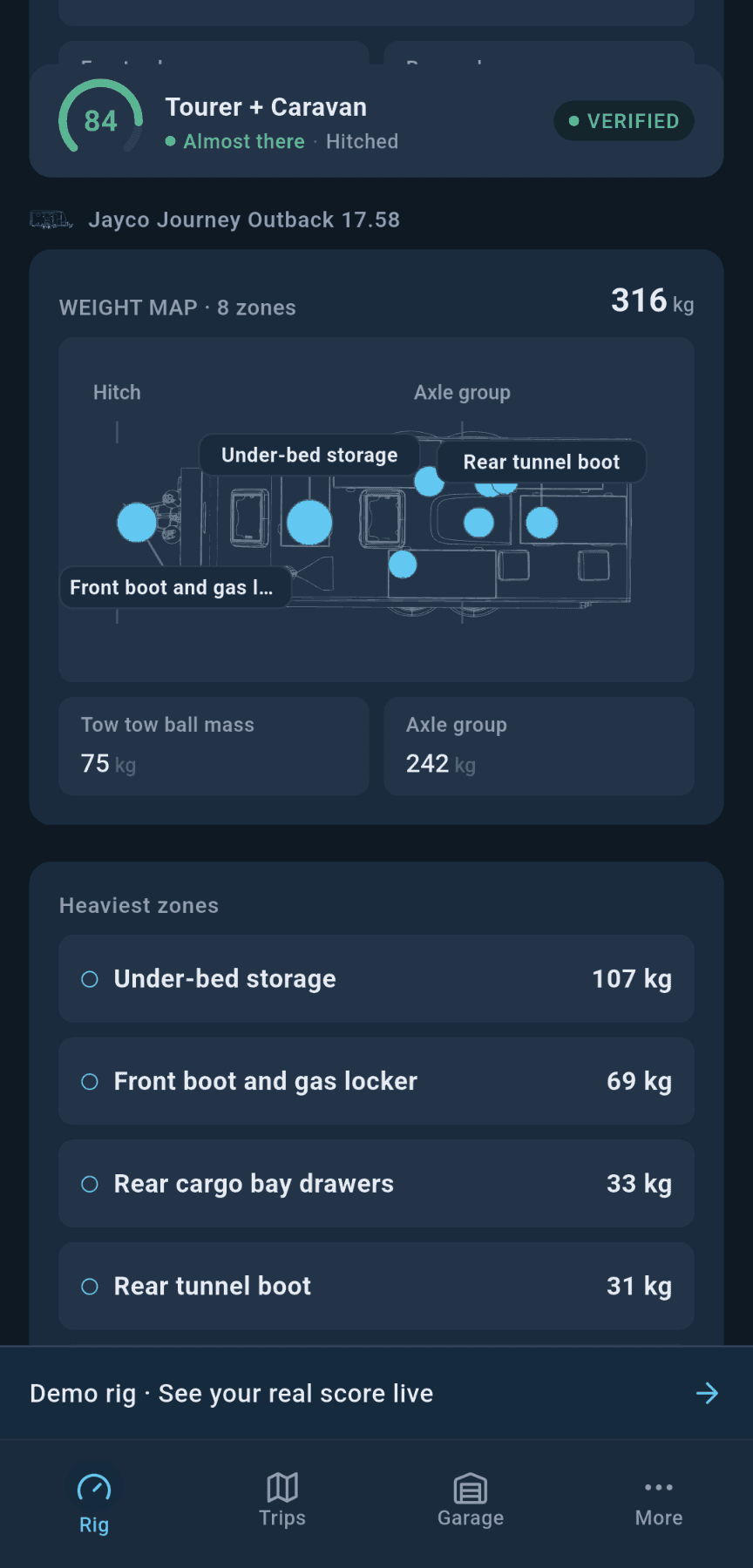
Map the load after the limit is confirmed
GWM's accessory bar is rated to 240 kg and another component to 300 kg, but neither label establishes the Tank 500 vehicle's maximum download. Get that limit confirmed by VIN, follow the caravan maker's loading instructions and measure the loaded ball. loadmate can then show how a proposed item changes the estimated coupling and axle loads; it cannot approve the vehicle or certify the arrangement. Explore how the load placement changes the estimate in the app.


Common questions
- What is the tow ball weight on a GWM Tank 500?
GWM's March 2026 brochure and current ROVER RVD do not publish a vehicle-side maximum. GWM's own Tow Bar Assembly, part AGP1703021A, and BTA's GW05H are rated to 240 kg, while Hayman Reese's 03522RW component is rated to 300 kg. Those are towbar ceilings, not proof that the vehicle accepts the same download. Ask GWM to confirm the vehicle limit by VIN in writing, then check the towbar, coupling and trailer and use the lowest confirmed figure.
- Can a GWM Tank 500 tow a 3 tonne caravan?
The hybrid and Hi4-T plug-in have a 3,000 kg braked rating, but that headline alone does not clear a three-tonne caravan. GWM's brochure omits the vehicle-side maximum ball download, and a 300 kg-rated aftermarket bar does not prove the wagon accepts 300 kg. Confirm that vehicle limit by VIN, measure the loaded van in accordance with its manufacturer's instructions, and clear GVM, GCM, axles, vehicle, towbar, coupling and trailer limits. At an actual 300 kg ball load, 490 kg or 310 kg of vehicle payload remains.
- What is the difference between the Tank 500 hybrid and the Hi4-T PHEV for towing?
They share a 3,000 kg braked rating and the same unresolved vehicle-side ball limit. The plug-in gives up two seats and 180 kg of published payload, carries 175 kg more on its rear axle at kerb, has a rear-axle limit 180 kg lower, and loses the hybrid's 310 kg of spare combined mass. At an actual 240 kg ball load, remaining payload is 550 kg in the hybrid and 370 kg in the plug-in. The plug-in instead gains 300 kW, 750 Nm, 120 km of NEDC electric range and 6 kW vehicle-to-load output.
- Is the GWM Tank 500 getting a diesel, and will it tow more?
Yes. GWM's upcoming-model page says the 3.0-litre turbo-diesel arrives in September 2026 with 170 kW and 620 Nm. The current ROVER applicant record lists 2,578 kg tare, 3,395 kg GVM, 3,500 kg braked and 750 kg unbraked, but no GCM, vehicle-side ball or axle limits. Treat that as an incomplete approval descriptor until GWM publishes the retail sheet, and do not carry hybrid or PHEV component ratings across.
- Are there any known GWM Tank 500 problems that affect towing?
The federal notice for REC-006516 was published on 24 December 2025. Its population of 1,445 MY25 GWM vehicles includes the Tank 500 HEV and PHEV. If the high-voltage harness shielding ring is grounded incorrectly, warning lights, reduced torque and impaired hybrid cooling can follow; the regulator says affected vehicles receive a free dealer repair. Check the VIN in the national recall register. RV Daily's October 2025 report contains no two- or three-tonne test, while the CarsGuide and Chasing Cars figures here are unladen. GWM's vehicle-side ball limit also remains unpublished, so payload examples must use actual measured download and cannot become a suitability pass.
Understand the weight limits
Every figure above is governed by a manufacturer-set limit. These guides explain what each term means and how they fit together.
- Caravan & towing weights explainedThe master glossary: GVM, ATM, GTM, TBM and GCM in one place.
- Gross Combination Mass (GCM)The combined vehicle-plus-trailer ceiling that usually bites first.
- Aggregate Trailer Mass (ATM)What your caravan is legally allowed to weigh, fully loaded.
- Braked towing capacityWhy a 3,500 kg rating rarely means you can tow 3,500 kg.
Sources and review
Specifications checked
Page reviewed
- GWM Australia — current Tank 500 model page
Current live orderability: Vanta HEV and Ultra PHEV are displayed. The March 2026 brochure also records Lux and Ultra HEV columns, which are retained as dated brochure coverage rather than described as currently orderable
- GWM Australia — Tank 500 brochure (PDF, current as at 25 March 2026, Edition Code GWMAU 20260325)
The two mass groups represented across the brochure's Lux, Ultra and Vanta HEV columns and Ultra PHEV column — kerb and tare weight, GVM, GCM, payload, braked and unbraked towing, maximum front and rear axle loads, front and rear axle loads at kerb, seating capacity, wheelbase, fuel and battery capacity — and the absence of any tow-ball or rear-overhang row in the same table
- GWM Australia — Tank 500 accessories: Tow Bar Assembly (AGP1703021A)
GWM's accessory towbar component is rated to 240 kg download alongside 3,000 kg braked and 750 kg unbraked. This component rating does not establish the Tank 500 vehicle-side maximum, which the current brochure omits
- Hayman Reese — Tank 500 P03 towbar 03522RW
A 3,000 kg / 300 kg-rated towbar component for the Tank 500 fitment. The component ceiling does not prove or increase the vehicle's approved maximum download
- BTA Towbars — GWM Tank 500 towbar GW05H
A 3,000 kg / 240 kg-rated towbar component for the Tank 500 fitment, corroborating the accessory-component range without establishing the vehicle-side maximum
- GWM Australia — TANK 500 3.0L Diesel, register your interest
GWM's own statement that a 3.0-litre turbo-diesel Tank 500 arrives in September 2026 with 170 kW and 620 Nm after local testing including towing scenarios, and the absence of any tow rating, GVM, GCM or tow-ball figure for it
- Australian Government ROVER — current Tank 500 approval
The current Australian vehicle approval and provenance route for the applicable RVD
- Australian Government ROVER — Tank 500 RVD issued 20 May 2026
The upcoming diesel descriptor: applicant-supplied tare 2,578 kg, GVM 3,395 kg and 3,500/750 kg towing, with GCM, vehicle ball and axle fields blank. It is an incomplete approval descriptor, not a retail mass sheet
- Vehicle Recalls Australia — REC-006516, GWM high-voltage wiring-harness shielding
The federal notice published 24 December 2025 covering 1,445 MY25 GWM vehicles including Tank 500 HEV and PHEV, the grounding/shielding defect, reduced-torque and cooling risks, and free dealer repair
- 4X4 Australia — 2024 GWM Tank 500 review (28 March 2024)
Independent confirmation of the hybrid's 2,605 kg kerb weight, 3,395 kg GVM, 6,705 kg GCM, 790 kg payload and 3,000 kg braked rating at Australian launch
- carsales — GWM Tank 500 2024 Review (Bruce Newton, 28 March 2024)
The widely repeated adjusted payload of 490 kg behind a full 3,000 kg trailer, arrived at without a stated tow-ball figure, plus the same four masses as the brochure
- CarsGuide — GWM Tank 500 Ultra PHEV off-road test (Marcus Craft, 4 January 2026)
Independent confirmation of the plug-in hybrid's 2,820 kg kerb weight, 3,430 kg GVM, 6,430 kg GCM, 610 kg payload and five-seat layout, and a measured 10.2 L/100 km on a depleted battery against GWM's 8.4 L/100 km low-charge figure
- CarsGuide — GWM Tank 500 Ultra Hybrid long-term, part 3 (Laura Berry, 29 June 2025)
Measured unladen fuel use of 15.1 to 17.6 L/100 km over 2,721 km against a claimed 8.5, plus firm suspension and the side-hinged tailgate, on a car that towed nothing during the test
- Chasing Cars — GWM Tank 500 Ultra Hi4-T PHEV 2026 review (Tom Baker)
A second independent plug-in petrol figure of about 10.0 L/100 km with roughly 102 km of real electric range, plus an early-test-vehicle observation that the 180 kW petrol engine may feel stretched on long climbs. Its pending suspension/steering comment predates the March-2026-build AT-1 update and is not presented as current
- CarExpert — Tank 500 PHEV receives Australian chassis tune (7 June 2026)
GWM-attributed current reporting that Tank 500 Hi4-T PHEVs built from March 2026 received the Australian/New Zealand AT-1 suspension and steering tune and reached showrooms in May/June; earlier-tune stock may coexist, so build/VIN confirmation matters
- 4X4 Australia — Tank 500 Hi4-T PHEV Australian tuning update (20 May 2026)
Independent dated corroboration of the local AT-1 suspension and steering update for March-2026-build PHEVs and the need to distinguish earlier stock
- Outback Travel Australia — GWM Tank 500 buyers guide (Allan Whiting, 2 June 2025)
An independent recommendation to stay under three tonnes of trailer behind wagons of this type, and around 2.5 tonnes behind the plug-in hybrid because performance falls away once the battery is exhausted
- RV Daily — GWM Tank 500 Hi4-T PHEV and caravan towing (8 October 2025)
The caravan press stating in print that no measured answer exists yet for how the plug-in hybrid performs hitched to two or three tonnes on Australian roads, and that the 6 kW vehicle-to-load output may need a soft-start device for a van air-conditioner