How much can the Ford Ranger Raptor tow?
| Variant | Braked towing capacity | GVM | GCM | Kerb weight | Payload at full tow | Tow ball rating | Rear axle limit |
|---|---|---|---|---|---|---|---|
| Raptor 3.0 V6 petrolMY26 | 2,500 kg | 3,130 kg | 5,370 kg | 2,413 kg | 367 kg | 350 kg | 1,700 kg |
1 variant
| Braked towing capacity | 2,500 kg |
|---|---|
| GCM | 5,370 kg |
| GVM | 3,130 kg |
| Kerb weight | 2,413 kg |
| Front axle limit | 1,520 kg |
| Rear axle limit | 1,700 kg |
| Tow ball rating | 350 kg |
| ATM planning ceiling | 2,000 kg |
| Wheelbase | 3,270 mm |
| Rear overhang | 1,225 mm |
The assumption that catches buyers out
Walk into a Ford dealer and the logic feels airtight: the Ranger Raptor is the most expensive, most muscled-up ute in the range, with a 3.0-litre twin-turbo V6 making 292 kW, so surely it tows more than the workaday Rangers parked next to it. It does not. The Raptor is rated to pull 2,500 kg braked, while an ordinary V6 Ranger XLT or Wildtrak is rated to 3,500 kg. The flagship tows a full tonne less than the ute it shares a badge with.
That is the surprise worth sitting with before you put a deposit on one as a tow vehicle. Everything else on the Raptor reads like more: more power, more track, more travel, a higher price. The towing number is the one spec that goes the other way, and the reason is no typo or soft derating you can engineer around, but something built into the hardware bolted under the back of the truck.
The numbers behind the 2,500 kg rating
Here are the MY26 Raptor figures that matter for a tow, from the current Australian spec data. Braked towing is 2,500 kg. Gross vehicle mass (GVM) is 3,130 kg. Gross combination mass (GCM) is 5,370 kg. Kerb weight on the brochure is 2,413 kg, and every payload number on this page is worked from that brochure kerb so they stay consistent; one independent road test weighed a real example heavier, at 2,475 kg, which is the kind of as-tested gap worth allowing for. Tow ball download is 350 kg, the front axle is rated to 1,520 kg, and the rear axle is rated to 1,700 kg. These current figures sit on the loadmate towing capacity hub alongside the rest of the range.
The headline figure that does the damage is the 1,000 kg gap to the rest of the range. A V6 Ranger gives you 3,500 kg of braked towing and a 6,400 kg GCM. The Raptor gives you 2,500 kg and 5,370 kg. Same nameplate, same showroom, a tonne of towing rating and over a tonne of combination mass apart. If you have cross-shopped them on tow capacity alone, the Raptor is the wrong half of the family.
Why a soft coil rear costs you a tonne of rating
The rest of the Ranger range carries its loads on leaf springs at the back, the simple, stiff, stackable arrangement utes have used for a century because leaves carry weight well. The Raptor throws that out. It runs a long-travel coil-sprung rear with Fox dampers, the same philosophy as a desert race truck, tuned to soak up high-speed whoops and big landings rather than to sit a heavy tow ball without sagging.
That is the trade in one line: this is desert hardware, not towbar hardware. A coil tuned soft enough to fly over corrugations is, by definition, tuned soft for carrying a static load. Ford did not derate the Raptor's tow figure to be cautious; it set the rear up to do a different job, and a 2,500 kg rating is the honest consequence. As one expert explainer put it, tow capacities come down to more than power, and the Raptor's rear is the proof.
Power is not the bottleneck either. The Raptor's V6 petrol makes 583 Nm, which is actually less than the 600 Nm of the V6 diesel that Ranger tows 3,500 kg with. So the missing tonne was never lost in the engine bay; it went out the back, in the springs.
The payload pinch is the real bite, not the tow number
The 2,500 kg figure gets the headlines, yet the limit that actually catches Raptor owners is payload, squeezed from two directions at once. The 5,370 kg GCM has to cover both the trailer and the loaded truck, so at the full 2,500 kg tow the truck itself can weigh no more than 2,870 kg all up, about 457 kg over the 2,413 kg brochure kerb; the 350 kg ball does not come off that side again, because it already rides inside the trailer's 2,500 kg. The tighter squeeze is the 3,130 kg GVM, where the ball download does land: 350 kg off the 3,130 kg leaves 2,780 kg for the truck and everything in it, and clearing the 2,413 kg kerb leaves about 367 kg for people, fuel, the dog, the camping fridge and the recovery gear. That is the number that bites, and it is the same kerb basis used everywhere on this page.
Two adults, full fuel and a weekend's gear fit inside 367 kg, but a family of four with camping kit blows through it. The Raptor is not always this tight: hold the trailer under the full rating and the squeeze eases from both ends, a lighter ball on the GVM side and more combination headroom under the GCM, which is why an Australian GVM and payload test of the Raptor, which measured a real payload of 717 kg at the kerb, recommended limiting the trailer to around 2,240 kg, the legal trailer mass at full GVM, to keep that carrying capacity available. You run out of room to put things long before you run out of towing number. The Raptor against a heavy van is a payload problem wearing a towing problem's clothes.
The Raptor's recovery gear, fridge and passengers share a small payload budget with the trailer's ball weight. Get the loadmate app to see how your recorded accessories and travel load use that margin, and what changes when you pack for a longer trip.
The back end squats, and owners notice
Soft coils chosen for travel do something predictable when you put weight on the tow ball: they compress, and they compress a lot. An Australian load test measured the Raptor's rear sinking more than 90 mm under load without bottoming out, and owners on the model's own forums report 60-80 mm of squat with only about 250 kg on the ball. That is the rear of the truck visibly dropping, the nose lifting, and the headlights aiming at the treetops.
The common fix is a set of load-assist airbags fitted inside the rear coils, roughly a three-hour job on a recent Raptor, to hold the back end level under a load the springs were never tuned to sit on. It works, but it is a workaround, and in Victoria anything that touches the suspension sits in an engineering-certificate grey area worth checking before you commit. The point stands either way: the squat is real, it is a direct result of the desert suspension, and it is the first thing a Raptor owner who tows tends to deal with.
How the tow ball loads this particular rear
The tow ball download is rated to a healthy 350 kg, the same as the rest of the Ranger range, so the ball limit itself is not where the Raptor runs out. The difference is what 350 kg does to a soft coil rear versus a stiff leaf one. The ball sits behind the rear axle, on a 1,225 mm overhang plus about 150 mm of hitch arm, against a 3,270 mm wheelbase, so it works as a lever: that 350 kg lands as roughly 495 kg on the rear axle while lifting about 145 kg off the front. On the Raptor those numbers press straight onto springs tuned to move, so the back squats and the steering goes light exactly as you load the coupling.
A weight distribution hitch can pull some of that load back toward the front axle and the trailer's own axles by tensioning spring bars between the truck and the van, which helps restore the steering feel the squat takes away. It does not change the 2,500 kg rating or add a gram of GCM, and on a coil rear it has to be set carefully because the suspension reacts more than a leaf rear would. As ever, the only honest confirmation is a pair of weighbridge tickets, truck alone then truck hitched, so you can see what the front axle has lost and the rear axle has gained rather than guessing from how level it looks.
What it tows happily, and what it does not
None of this makes the Raptor useless behind a trailer. Up to around 1,500-2,000 kg of well-balanced load, a boat on a tandem trailer, a light camper, a couple of trail bikes, it is genuinely capable and the soft rear actually rides nicely over rough tracks to the launch ramp or the campsite. Within that band the Raptor's strengths show up and the payload maths still leaves room for people and gear.
Where it falls down is the job a 3,500 kg Ranger is bought for: a 2.5-tonne family caravan with the whole family and a loaded tray aboard. That is the moment the coil rear and the 5,370 kg GCM both bite, the back end sits low, and the payload runs out. The honest read is that the Raptor is a sport and off-road truck that can tow, not a tow truck that happens to be sporty. If you point it at the wrong load it will tell you, usually by squatting onto its bump stops on the first big hill.
The Wildtrak or Tremor V6 is the same nameplate, done for towing
If your main job is towing and you were drawn to the V6, the better Ranger is sitting in the same showroom for less money. A Ford Ranger Wildtrak or XLT V6 keeps the leaf-sprung rear, tows the full 3,500 kg, runs a 6,400 kg GCM and a higher 3,350 kg GVM, and gives you the V6 diesel's 600 Nm into the bargain. It will not fly over a desert track the way the Raptor will, but it will sit a heavy van level and carry the family with margin to spare.
This is the cleaner way to think about the choice. The Raptor and the Wildtrak are not better and worse versions of the same tool; they are two different tools that happen to share a body. One is built to go fast over rough ground and tow light. The other is built to haul. Buy the one that matches the trailer you actually own, not the badge.
What it really uses when it tows
One more cost belongs on the ledger, because it lands every tank. The Raptor is petrol-only, and the 3.0 V6 is thirsty in the real world before you hang anything off the back. Owners logging long-term averages report around 14.8 L/100km over 20,000 km against an official 11.5 figure, and that is unhitched. Put a trailer on a petrol V6 and the consumption climbs further, with one Australian owner summing it up as a truck that overtakes everything except a petrol station.
That alone is no reason to rule the Raptor out, but it is a real number to plan around if you tow regularly. The diesel Rangers in the rest of the range will be noticeably cheaper to feed on a long haul, which compounds the towing case for stepping across to a leaf-sprung V6 if fuel stops and range are part of how you travel.
Modelling the trade before you hitch
The Raptor's tow story turns on a hitch lever, not on grunt. That 350 kg ball lands as roughly 495 kg on the rear axle and lifts about 145 kg off the front, and the more than 90 mm of squat is the lever at work. loadmate models that coupling effect from your ball mass, showing how much it loads the soft rear axle and lightens the steer axle before you hitch up. Read against the 3,130 kg GVM that ball counts toward and the roughly 367 kg of payload left at full tow on the brochure kerb, a trailer reads as pass (well matched), caution (careful) or fail (no) here, decision support well before a red weighbridge ticket.
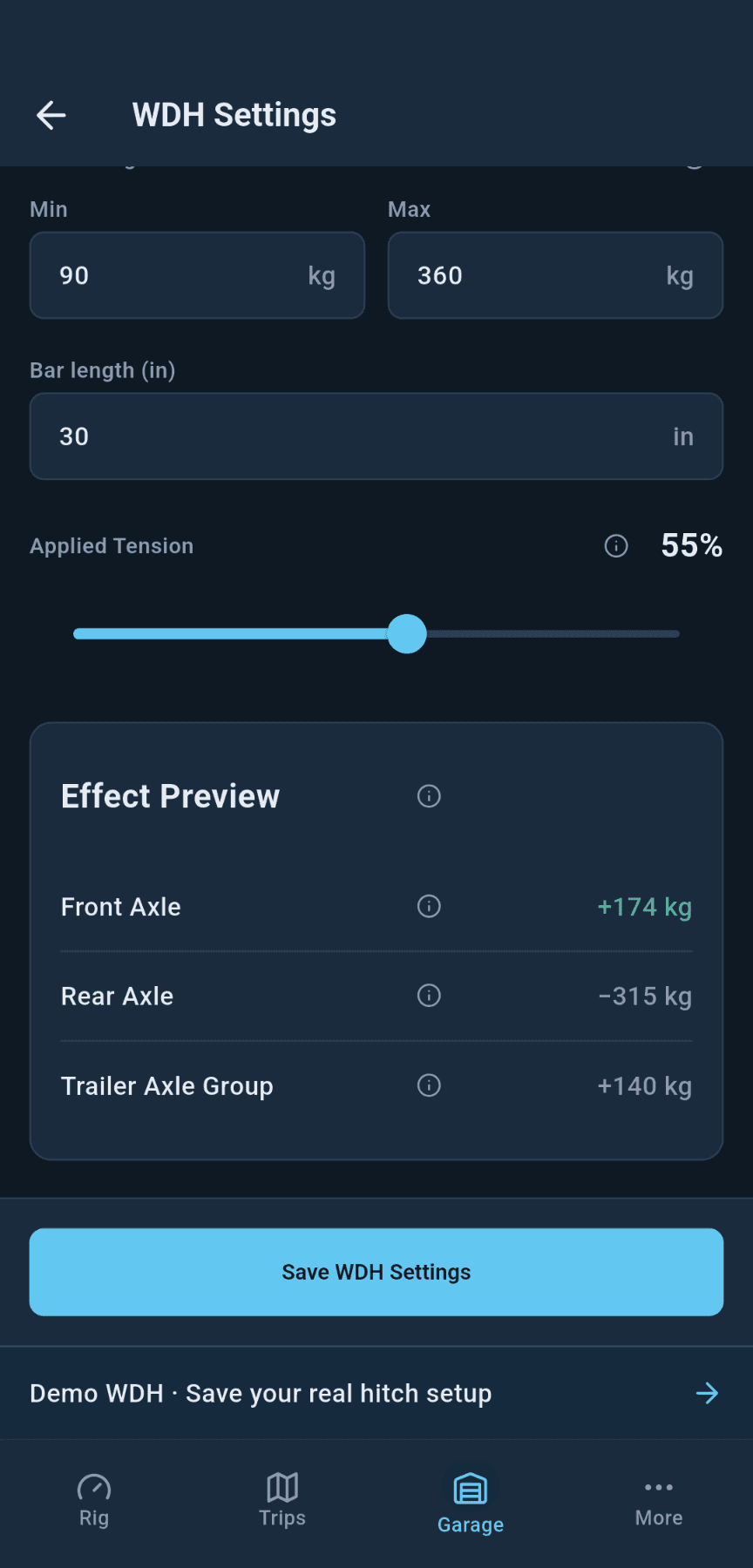
Tune the hitch for this load
loadmate models your weight distribution hitch, spring-bar or FALR, and shows the load coming back onto the steer axle. A tension set for one load is wrong for the next, so the model moves when the load does. Create a free account to explore it on a populated demo rig in the app.


Common questions
- Why does the Raptor only tow 2,500 kg when a cheaper Ranger tows 3,500 kg?
Because the Raptor's rear suspension is built for speed over rough ground, not for carrying load. The rest of the Ranger range uses leaf springs that carry weight well; the Raptor swaps them for soft, long-travel coils with Fox dampers tuned for desert work. A 2,500 kg rating is the honest result of that hardware. The engine is not the constraint, the V6 petrol's 583 Nm is plenty; the springs are.
- Can I tow a 2-tonne caravan with the Raptor and still fit the family and gear?
It will tow it, but the carrying capacity gets tight fast. At the full 2,500 kg, the 5,370 kg GCM caps the truck at about 457 kg over its 2,413 kg brochure kerb, and the 3,130 kg GVM is tighter still once the 350 kg ball is aboard, leaving about 367 kg of payload for people, fuel and gear. A 2-tonne van runs a lighter ball and wins some of that back, but a family of four with gear will still crowd the margin. If you want both a heavy van and a full family load, the Raptor is the wrong tool; a leaf-sprung V6 Ranger has the payload and GCM to do both.
- Does the Raptor's back end sag on the tow ball, and do I need airbags?
Yes, it sags noticeably. The soft coil rear compresses more than 90 mm under load on test, and owners report 60-80 mm of squat with around 250 kg on the ball. Load-assist airbags fitted inside the rear coils are the common fix and take roughly three hours, though anything touching the suspension can sit in an engineering-certificate grey area in some states, so check your local rules first.
- Is the V6 petrol really that thirsty when towing?
It is thirsty even unhitched. Owners logging long-term averages report around 14.8 L/100km over 20,000 km against an official 11.5 figure, and towing pushes it higher. The Raptor is petrol-only, so there is no diesel option to soften the running cost. If you tow long distances regularly, a diesel V6 Ranger will be meaningfully cheaper to feed.
- Should I just buy a Wildtrak V6 instead if I mainly want to tow?
If towing is the main job, yes, and it costs less. A Wildtrak or XLT V6 keeps the leaf rear, tows the full 3,500 kg, runs a 6,400 kg GCM and a 3,350 kg GVM, and gets the V6 diesel's 600 Nm. It will not match the Raptor off-road, but it sits a heavy van level and carries the family with margin. Buy the Raptor for the desert suspension, not for towing heavy.
Understand the weight limits
Every figure above is governed by a manufacturer-set limit. These guides explain what each term means and how they fit together.
- Caravan & towing weights explainedThe master glossary: GVM, ATM, GTM, TBM and GCM in one place.
- Gross Combination Mass (GCM)The combined vehicle-plus-trailer ceiling that usually bites first.
- Aggregate Trailer Mass (ATM)What your caravan is legally allowed to weigh, fully loaded.
- Braked towing capacityWhy a 3,500 kg rating rarely means you can tow 3,500 kg.
Sources and review
Specifications checked
Page reviewed
- Ford Australia — Ranger 2026.50MY spec brochure
Raptor GVM, GCM, kerb, axle limits and braked towing
- Ford Australia — towing guidance
Tow pack requirement and tow ball mass