By loadmate Editorial · Towing & compliance desk
How much can the Mitsubishi Pajero Sport tow?
| Variant | Braked towing capacity | GVM | GCM | Kerb weight | Payload at full tow | Tow ball rating | Rear axle limit |
|---|---|---|---|---|---|---|---|
| GLS 4WD25MY (run-out) | 3,100 kg | 2,775 kg | 5,565 kg | 2,130 kg | 335 kg | 310 kg | 1,600 kg |
| Exceed 4WD25MY (run-out) | 3,100 kg | 2,775 kg | 5,565 kg | 2,130 kg | 335 kg | 310 kg | 1,600 kg |
2 variants
| Braked towing capacity | 3,100 kg |
|---|---|
| GCM | 5,565 kg |
| GVM | 2,775 kg |
| Kerb weight | 2,130 kg |
| Front axle limit | 1,360 kg |
| Rear axle limit | 1,600 kg |
| Tow ball rating | 310 kg |
| ATM planning ceiling | 2,500 kg |
| Wheelbase | 2,800 mm |
| Rear overhang | 1,125 mm |
The run-out price tag and the number it hides
Walk onto a dealer lot in 2026 and the run-out Pajero Sport is the cheap 4WD wagon in the corner, marked down because Mitsubishi stopped building it on 1 March 2025. The 25MY car failed the new ADR 98/00 mandatory autonomous emergency braking rule, and the company judged re-engineering it commercially unviable, so the ASX and Eclipse Cross were dropped the same day. What is left is dealer stock at a discount, and a discount is good at hiding which limit you are actually buying.
The badge says 3,100 kg braked, which reads like plenty — but the number that governs your trip is the gross combination mass (GCM): 5,565 kg, the most the car and the loaded van are allowed to weigh together. That figure sits only 310 kg short of the obvious sum, and that small shortfall is the whole story of this vehicle as a tow car.
Where the 310 kg goes: the GCM maths
Here is the sum that decides it. The Pajero Sport's gross vehicle mass (GVM) is 2,775 kg. Add the rated 3,100 kg van and you get 5,875 kg. The GCM ceiling is 5,565 kg. That leaves you 310 kg over the combined limit before a single passenger or bag is aboard.
Put another way, towing 3,100 kg legally means the car itself can weigh no more than 2,465 kg, which is 5,565 minus 3,100 — and that 3,100 kg is the van's full ATM, tow-ball download included, so the ball is already counted on the van's side of the sum. Kerb weight is 2,130 kg, which leaves about 335 kg for the people, the towbar and every bag. The car's own GVM lands in exactly the same place: 2,775 kg minus the 310 kg on the ball leaves 2,465 kg for the car and everything in it, the same 335 kg over kerb. So 335 kg is the real budget at the full rating, and a family of four plus a towbar takes nearly all of it before the first bag goes in. The 3,100 kg rating is genuine, it just assumes a car packed with little more than its passengers.
This is a GCM-and-payload squeeze, not a hidden tow-ball derate. Unlike some big wagons, the Pajero Sport does not quietly drop its ball rating above a trailer-weight threshold. The bite here is simpler and harder to dodge: combined mass and what is left for the car.
Payload is the first thing to run out
Before the GCM even comes into play, the car has its own ceiling. Payload is GVM minus kerb: 2,775 minus 2,130, or 645 kg. That has to cover passengers, luggage, a towbar, the tow-ball download and any accessories you have bolted on.
A family of four with bags is most of that 645 kg gone on its own. Add a bull bar, a second battery or a roof platform and the figure shrinks fast. The 310 kg tow-ball mass alone is a chunk of it, because tow-ball download counts as load on the car, not on the van. So the payload number that looked generous on the brochure is mostly spoken for before you hitch up, which is exactly why owners settle where they do.
The rear axle and the renowned sag
The Pajero Sport's tow-ball rating is 310 kg, which is high for a wagon this size, and that load lands behind the rear axle. With a 2,800 mm wheelbase and a 1,125 mm rear overhang, the hitch sits about 1,275 mm behind the axle line, so a 310 kg ball lands roughly 450 kg on the rear axle and lifts about 140 kg off the front. The rear axle is rated to 1,600 kg, and a heavy ball plus a loaded boot is what brings it close.
Rear-end sag under load is the car's best-known towing trait, and owner forums are full of the fix: airbags, a weight-distribution hitch, or stiffer springs. Pedders cone springs and a Mr Hitches WDH come up by name. Owners who fit them report the rig finally sits level and tows happily. The catch they pass on is the important part: the springs cured how the car looked, but the GCM and rear-axle ratings did not move a kilogram. Suspension fixes the attitude, not the legal limit.
Does a WDH let you tow a heavier van?
A weight-distribution hitch is worth fitting on a heavy van, because the 310 kg ball loaded behind the rear axle drags the nose up and the tail down. A WDH transfers some of that coupling load back onto the front axle and onto the van's own axles, so the car sits level and steers properly. On a 2.2-2.5 t van with a real ball mass, that is a sensible setup.
What it does not do is raise any rating. The GVM, GCM, tow-ball limit and axle figures are fixed by Mitsubishi, and no hitch or airbag changes them. A WDH and airbags make a legal load behave; they do not make an illegal load legal. The combined-mass sum is the same after you fit them as before. Treat them as handling tools, then keep the van inside the numbers anyway.
The engine works hard on hills, but tows stably
The run-out car's 2.4 litre 4N15 diesel makes 133 kW and 430 Nm, and on a long climb under load you feel it. Tow tests and owners agree it has to work to hold speed on grades, dropping gears and using its 8-speed auto often. There is no substitute for capacity here, and this is the weak point the late-2026 successor's 150 kW / 470 Nm unit is meant to fix.
What surprises people is how settled it is otherwise. Tow tests over 1,000-plus km call the handling impressively stable, barely troubled by passing trucks, with no need for trailer-stability intervention. Fuel use is good for the class too, around 13 L/100 km towing a 1.75 t van. So the limit is grunt on grades and combined mass, not composure. Within its weight it is one of the more relaxed tugs at its price, which is the case for buying the run-out car at all.
New vs run-out vs used: which one, and when
Because the car is discontinued, there is no 'new' anymore, only run-out stock and the late-2026 successor to wait for. The successor returns badged simply 'Pajero', built on the Triton ladder frame, with the stronger 150 kW / 470 Nm twin-turbo diesel and Super Select II. It directly addresses the run-out car's two real gripes: the hard-working engine and the dated cabin. If you want a 3,500 kg-class wagon and can wait, that is the one to wait for, and the related Mitsubishi Triton guide shows the platform it borrows.
Run-out stock makes sense if the discount is genuine and you are matching it to a 2.2-2.5 t van. Reviewers note the loaded GSR and Exceed are not especially cheap; the value is at the base end of the range, where the towing numbers are identical. Buy the cheapest variant that tows the same and put the saving toward the van.
Used, the same maths applies, plus due diligence. The 2.4 diesel has recurring DPF and EGR niggles and a light-throttle transmission shudder dealers call normal, and there are reports of false AEB braking that worsen when towing, which is a quiet irony given AEB is why the car was discontinued. The 10-year, 200,000 km conditional warranty only holds if it has been serviced through Mitsubishi, so check the book. If you are cross-shopping older wagons, the Mitsubishi Pajero has a different trap again on heavy trailers.
A worked example, and the weighbridge routine that proves it
Take a real setup. A GLS with two adults (about 160 kg), a teenager and a dog (90 kg), camping gear and a full tank (150 kg) and a towbar (30 kg) is roughly 430 kg of payload used before the van. That leaves about 215 kg of the 645 kg payload for the tow-ball download. A 2,400 kg van with a 10 per cent ball mass puts 240 kg on the towbar, which already nudges past that remaining payload. So even a sensible 2.4 t van wants the car packed with discipline, and a 2.2 t van with a 200 kg ball is the more comfortable match.
The only way to know your real numbers is to weigh. Run the car over a weighbridge first, fully loaded for the trip but without the van: record front axle, rear axle and total against the 2,775 kg GVM and the 1,600 kg rear-axle limit. That tells you how much of the 645 kg payload is genuinely left. Then hitch the loaded van and weigh again for the combined mass against the 5,565 kg GCM, plus the rear axle a second time with the ball aboard. The single combined total cannot tell you which rating is tight, and on this car the payload and GVM usually go first — the GCM only draws level at the full 3,100 kg rating — while the rear axle still has a little room. If the combined mass is over, the fix is a lighter van or less in the car, because no accessory moves the rating.
The dated cabin is real, and stayed that way
One run-out caveat to be honest about: the cabin is old. The final 25MY car kept an 8.0 inch screen with dated TomTom navigation, wired-only Apple CarPlay and Android Auto, and red-backlit climate controls that feel a generation behind an Everest or Prado. A 2025 review put it bluntly as 'every bit of the 10-year age gap'.
The often-repeated rumour of a 9.0 inch screen upgrade for 2025 never happened; the run-out car carried the 8.0 inch unit to the end. If a listing claims a bigger screen, it is wrong. None of this affects what the car tows, but it is the kind of thing a value buyer should price in honestly rather than discover later.
Working the run-out discount into a real van choice
Put it all together and the discount is only smart if it buys you the right van. The car is a genuinely good tow vehicle up to about 2.5 t, where it is stable, efficient and well within its combined-mass ceiling. Above that, the ball download grows with the van and comes straight out of the car's own payload, until at the full 3,100 kg rating the GVM and the GCM converge on the same 335 kg left in the car.
If you are weighing a run-out Pajero Sport, the question worth answering before the price tag tempts you is which limit you are buying into. A bullbar, roof rack and drawers reduce what is left for passengers before the caravan takes its share. Get the loadmate app to see how those recorded loads fit against GVM, GCM and the rear axle together. Build from measured weights, then check what changes when you add the family, fill the tanks or pack for a longer trip. The towing-capacity hub covers the wider field if you are still cross-shopping. Either way, weigh the loaded rig on a weighbridge before any long trip.
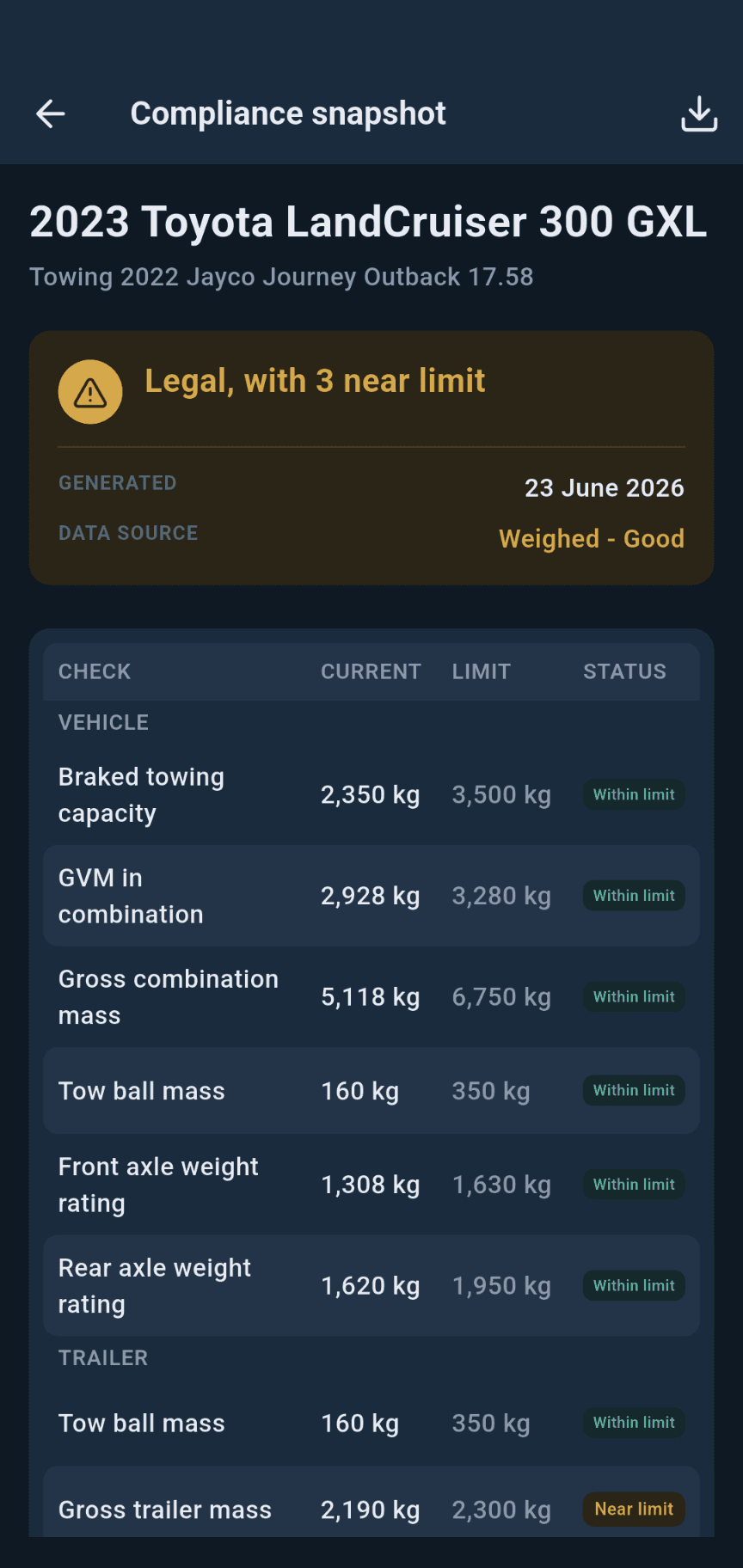
Turn a possible match into a clear packing plan
The van that suits an empty wagon may leave less room once your touring gear is aboard. loadmate brings the vehicle, caravan and loads into one picture, so you can work through changes before you head away.


Common questions
- Can a Pajero Sport really tow 3,100 kg, or is that just a number on paper?
It is a real braked rating, but it assumes a lightly packed car. The 5,565 kg GCM means towing 3,100 kg legally leaves the car itself at no more than 2,465 kg, which is about 335 kg of mass headroom over its 2,130 kg kerb weight. That whole 335 kg is available for the people, the towbar and the gear, because the 310 kg tow-ball download is already counted inside the van's 3,100 kg ATM. A family of four and a towbar takes nearly all of it, so the figure is genuine; the configuration that achieves it carries almost no luggage.
- How heavy a caravan can I tow with a Pajero Sport and still fit the family and gear?
Plan around 2,200-2,500 kg ATM for a loaded family setup. That keeps you inside the 645 kg payload and the 5,565 kg combined-mass ceiling with room for passengers, the tow-ball download and luggage. Owners who tow regularly tend to cap themselves near 2.5 t, roughly 600 kg under the brochure rating, for exactly this reason.
- Will airbags or a weight-distribution hitch let me tow a heavier van legally?
No. Airbags and a WDH fix how the car sits and steers under a heavy ball, and they are worth fitting on a 2.2-2.5 t van. But they do not change the GVM, GCM, tow-ball or axle ratings, which Mitsubishi sets. They make a legal load behave better; they do not make an over-GCM load legal. Keep the van inside the numbers regardless.
- Is it worth buying a run-out Pajero Sport now, or waiting for the new Pajero in late 2026?
It depends on the van. If you want a 2.2-2.5 t tourer at a genuine discount, run-out stock at the base end of the range is a sound buy. If you want a 3,500 kg-class wagon with a stronger engine and modern cabin, wait for the late-2026 successor, which is Triton-based with a 150 kW / 470 Nm diesel and fixes the run-out car's two main gripes.
- Now that it is discontinued, will I still get parts, servicing and warranty?
Yes. Mitsubishi continues to service and support the car through its dealer network, and the up-to-10-year, 200,000 km conditional warranty stays valid as long as the vehicle is serviced through Mitsubishi on schedule. On a used example, check the service book is complete, because the warranty depends on it. The shared Triton mechanicals also keep the 2.4 diesel well supported.
Understand the weight limits
Every figure above is governed by a manufacturer-set limit. These guides explain what each term means and how they fit together.
- Caravan & towing weights explainedThe master glossary: GVM, ATM, GTM, TBM and GCM in one place.
- Gross Combination Mass (GCM)The combined vehicle-plus-trailer ceiling that usually bites first.
- Aggregate Trailer Mass (ATM)What your caravan is legally allowed to weigh, fully loaded.
- Braked towing capacityWhy a 3,500 kg rating rarely means you can tow 3,500 kg.
Sources and review
Specifications checked
Page reviewed
- Mitsubishi Australia — 25MY Pajero Sport brochure
GVM, GCM, kerb, axle limits and braked towing
- Mitsubishi Australia — Pajero Sport range specifications
Variant range and tow ball mass