Grand Cherokee towing at a glance
- The fork the tow package makes
- 3,500 lb of trailer and 350 lb of tongue without the Trailer Tow Prep Group, 6,200 lb and 620 lb with it. Same figures on both 2026 engines
- The rule the tables do not carry
- At 5,000 lb of gross trailer weight or more a weight-distributing hitch is required, which puts the top 1,200 lb of the 6,200 lb rating above the line
- Where that sentence is printed
- The 376-page owner's manual, pages 190 and 191, twice. Nowhere else in Jeep's 2026 document set for this vehicle
- What the glovebox book points at
- Its note under the towing tables says to refer to Weight-Distributing Hitch, and the 92-page 2026 Owner Handbook has no such section and no page reference
- Which book carries the weights
- The media specification sheet: GVWR 6,050 lb on every two-row trim, plus curb weights. The owner's manual defines GVWR, curb weight and payload and publishes none of the three
- The engine the towing tables name
- Every engine cell in Jeep's 2026 towing tables reads "2.0L Hurricane-4 Engine". Jeep's spec sheets list the 3.6L Pentastar V-6 as standard, and it is named zero times in the manual
- Tongue weight, and the figure on the car
- 620 lb with the package and 350 lb without, and never more than the maximum stamped on your own fascia, bumper or hitch
- How much trailer face Jeep allows
- 55 sq ft with the package and 30 sq ft without. The 2026 figure rose from 40 sq ft, and a two-row Grand Cherokee's own frontal area is 31.7 sq ft
- The three-row Grand Cherokee L
- The same 6,200 lb and 620 lb, on a GCWR of 11,700 lb and a GVWR of 6,500 lb, or 6,700 lb on the 4WD Summit
- The two labels the manual defers to
- The certification label in the driver's door frame for GVWR and both axle ratings, and the tire and loading information placard for occupants and cargo
The book that rides in a Grand Cherokee's glovebox reprints Jeep's towing tables figure for figure, and underneath them it prints a note: for gross trailer weight of 5,000 lb or more, refer to Weight-Distributing Hitch. Read the other 91 pages of that book looking for a Weight-Distributing Hitch section and you will not find one. The phrase occurs once in it, in the note pointing at it.
The section is real. It sits in the owner's manual, which runs to 376 pages and does not ride in the car. And that manual is one of five Jeep documents covering this vehicle, no two of which describe the same Grand Cherokee. The manual holds every rule and every combined figure and prints no vehicle weight at all. The media specification sheets hold GVWR, curb weight and axle ratio, and their whole towing section is one line. The engine cell on every towing row in both books names the 2.0-liter Hurricane, while the specification sheets make the 3.6-liter Pentastar V-6 standard. The tongue weight your hardware is good for is stamped on the fascia. The GVWR your car was actually built to is on a label in the door frame.
So the two questions an owner arrives with land in different places. How much can it tow is in the tables, which both books carry, and the answer is 3,500 lb or 6,200 lb depending on one factory option. What has to be fitted to tow the higher figure is one sentence: at 5,000 lb of gross trailer weight or more, Jeep requires a weight-distributing hitch, which puts the top 1,200 lb of that 6,200 lb rating above the line. The rating is printed in two books, on Jeep's marketing pages and on the window sticker. The sentence that qualifies it is printed on two pages of one book, and the copy in the glovebox points at it without holding it.
How much can a Jeep Grand Cherokee tow?
A 2026 Jeep Grand Cherokee is rated to tow 6,200 lb with the factory Trailer Tow Prep Group and 3,500 lb without it, and that single option moves the number further than everything else on the order sheet put together. For 2026 the engine is not one of the variables at all. Jeep's own specification sheets rate the 3.6-liter Pentastar V-6 and the 2.0-liter Hurricane Turbo 4 at 6,200 lb each, in 2WD and 4WD, on the one 3.45 axle ratio the whole range shares.
| 2026 Grand Cherokee, two rows | Trailer Tow Prep Group | Maximum trailer weight | Maximum trailer tongue weight | GCWR | Trailer frontal area |
|---|---|---|---|---|---|
| AWD | Fitted | 6,200 lb | 620 lb | 11,300 lb | 55 sq ft |
| AWD | Not fitted | 3,500 lb | 350 lb | 8,600 lb | 30 sq ft |
| RWD | Fitted | 6,200 lb | 620 lb | 11,200 lb | 55 sq ft |
| RWD | Not fitted | 3,500 lb | 350 lb | 8,500 lb | 30 sq ft |
Everything else on the car moves the answer by a rounding error or not at all. Rear-wheel drive costs 100 lb of combined rating and nothing on the trailer figure. Trim moves neither: Jeep prints 6,050 lb of GVWR on every two-row Grand Cherokee, Laredo through Summit. There is one axle ratio, so there is no axle question to ask. The US towing capacity chart puts both ends of the range beside the rest of the midsize SUV field.
Two figures in circulation need a date attached to them. A 7,200 lb Grand Cherokee is a 2024 or older one with the 5.7-liter HEMI V8, which left after that model year and took the rating with it. And 6,200 lb is regularly credited to the Hurricane alone, including on Jeep's own marketing pages, when both 2026 engines carry it and the Grand Cherokee L's spec sheet hands its towing table to the V-6 by name.
How do I know if my Grand Cherokee has the tow package?
The window sticker is the only document that lists it, and if the sticker is gone, the dealer can pull the build sheet against your VIN. No owner's manual, handbook or specification sheet published for the 2026 Grand Cherokee says what is inside the Trailer Tow Prep Group. What every one of them does carry is the four figures the group changes.
| What the Trailer Tow Prep Group is worth | Without it | With it |
|---|---|---|
| Maximum trailer weight | 3,500 lb | 6,200 lb |
| Maximum trailer tongue weight | 350 lb | 620 lb |
| GCWR, two-row AWD | 8,600 lb | 11,300 lb |
| Trailer frontal area | 30 sq ft | 55 sq ft |
A 2021 Grand Cherokee owner planning to pull a T@B 400 arrived at a nuCamp owners' forum already holding both pairs of figures, 3,500 lb and 350 lb against 6,200 lb and 620 lb, and asked which pair applied to a car with an aftermarket tow package on it. The answer he got was a description of what the factory group actually is: an oil cooler, a transmission fluid cooler and a bigger alternator, fitted to deal with the added load, rather than a receiver and a harness. Owners on two other forums describe the same split in the same terms, one of them as standard cooling against heavy-duty cooling. An aftermarket hitch buys a place to put the ball, and moves none of the four figures above.
So the question "how much can my Grand Cherokee tow" has a 2,700 lb answer before anything else is asked, and it was settled at the factory.
Do I need a weight distribution hitch with my Grand Cherokee?
At 5,000 lb of gross trailer weight or more, Jeep requires one, and the sentence that says so is printed twice in the one Jeep document that does not ride in the car. It reads:
"If the gross trailer weight is 5,000 lb (2,267 kg) or more, it is required to use a weight-distributing hitch to ensure stable handling of your vehicle."
| Owner's manual | What it says at 5,000 lb |
|---|---|
| 2022 | Recommended |
| 2023 | Recommended |
| 2024 | Required |
| 2026 | Required, printed twice, at pages 190 and 191 |
The threshold has been 5,000 lb throughout. What tightened is the wording, from recommended to required, in the 2024 book on Jeep's US publications site, and Chevrolet did the same thing to the Colorado one model year later at a threshold of its own.
A Jeep forum thread argues the point by page number, quoting the 2016 manual at the same 5,000 lb with the softer wording, and settles on the reading that a weight-distributing hitch is not required on a Grand Cherokee. That 2016 truck is a WK2, the generation before this one, and the reading was fair about it and defensible about a 2023 car. It is wrong about a 2026 one, and the sentence that makes it wrong sits in the book most owners have never opened.
The threshold gets misremembered as often as the wording. On two RV forums the belief is that the trigger is 3,500 lb, which is the figure a car without the tow package is limited to, so the rule and the package end up fused in people's memories. The package sets what you may tow, the 5,000 lb line sets what has to be fitted to tow it, and a Grand Cherokee can clear the first without clearing the second.
A second obligation sits above that one. The manual notes that trailer sway control and a weight-distributing hitch are recommended for heavier tongue weights, and that a particular vehicle and trailer loading can make them necessary to stay inside the axle ratings. Through MY2022 the note under the towing tables printed the rear GAWR figure itself, 3,800 lb. From MY2023 the number is gone and the note ends at the acronym, so that comparison now has to be made against the rear axle rating printed on your own certification label.
Jeep gives one reason for the 5,000 lb rule, in its own words: "to ensure stable handling of your vehicle." The rest of Jeep's towing figures are weights measured against weights, and that clause is about how the pair behaves on the road. Whether a rig that clears every printed rating is also a settled one behind the car is the question the Wrangler page takes up on a shorter Jeep.
Jeep also prints how to set one of these hitches, in nine steps at pages 191 and 192, and three of them belong to this car rather than to hitches in general. The vehicle has to be at normal ride height, in the engine run position with the doors closed while the trailer is attached. On a Quadra-Lift car, Tire/Jack mode goes on from the touchscreen first, so the leveling function is paused while the measurements are taken, and it cancels itself above 5 mph, which restarts the procedure. Jeep's worked example for the fender-height target is printed in millimeters. The measurements themselves, and what the spring bars do with the pounds, are the front-axle guide's subject; the same walk on a truck that re-levels itself under the bars is on the Ram 1500 page.
A Jeep forum thread on setting a hitch with Quadra-Lift splits between letting the suspension settle at normal height and using tire-change mode, with service departments reported as giving both answers. Jeep's version is the second, and it has been on those two pages all along. Owners have spent years hunting for a sequence that was never missing, only filed where they had no reason to look.
Which document has your Grand Cherokee's numbers in it?
Five Stellantis documents cover this vehicle and no two of them describe the same half of it, so a complete answer takes at least two. Sorted by where each figure lives rather than by when it binds:
| What you need | Where Jeep prints it |
|---|---|
| Maximum trailer weight, tongue weight, GCWR and trailer frontal area | Owner's manual pp.192 to 194, reprinted figure for figure in the Owner Handbook |
| The weight-distributing hitch requirement at 5,000 lb | Owner's manual pp.190 and 191, twice, and nowhere else |
| Trailer brakes recommended over 1,000 lb and required over 2,000 lb | Owner's manual p.196 |
| No towing at all for the first 500 miles, then 50 mph for the next 500 | Owner's manual p.195 |
| Load 60% of the trailer's weight forward, which puts 10% of it on the hitch | Owner's manual p.195 |
| GVWR, curb weight and axle ratio | The media specification sheet, which carries no rule and no GCWR |
| The tongue weight the fitted hardware allows | Stamped on your own fascia, bumper or trailer hitch |
| GVWR and both axle ratings as your car was built | The certification label in the driver's door frame |
| The figure the tongue weight comes out of | The tire and loading information placard on the B-pillar or the door's rear edge |
| What is inside the Trailer Tow Prep Group | The window sticker |
Each of those documents is complete where the others are empty. The manual holds every rule and every combined figure and does not print a GVWR, a curb weight or a payload anywhere in its 376 pages; it defines all three terms on page 189 and sends you to the labels. The spec sheets hold GVWR, curb weight and axle ratio, and their whole towing section is one line: 3.45, 6,200 lb.
The two document families also disagree about which engines this car has. Every engine cell in the 2026 towing tables, in the manual and in the handbook, reads "2.0L Hurricane-4 Engine", the Grand Cherokee L's rows included. Jeep's 2026 specification sheets list the 3.6-liter Pentastar V-6 with an availability of Standard on both bodies, with the Hurricane standard from Laredo Altitude up, and the L's own trailer-towing table names the V-6 and only the V-6. The strings "Pentastar", "3.6L" and "V-6" appear zero times in the 376-page manual. Both engines are rated 6,200 lb, so nothing about the answer changes. What changes is what happens to a V-6 owner who opens the book with the rules in it looking for their own engine.
Which limit decides a Grand Cherokee tow?
The tow package settles it first, and after that the tongue weight, because those pounds are drawn from the same allowance as the people in the car. Jeep says so in the note under its own towing tables: trailer tongue weight must be counted as part of the combined weight of occupants and cargo, and must never exceed the figure on the tire and loading information placard.
Assembling the vehicle side takes both books. Take a 2026 Limited 4WD with the tow package: 6,050 lb of GVWR and 4,413 lb of curb weight from the specification sheet, 11,300 lb of GCWR and 620 lb of tongue from the manual. Jeep's 2026 sheets are marked preliminary and head their weights table as estimates, so treat the curb figure as Jeep's working number and the label on your own car as the one that governs.
Put a 5,200 lb trailer behind it with 598 lb on the coupler. The car plus that tongue load comes to 5,011 lb against a 6,050 lb GVWR, leaving 1,039 lb before anyone reads the placard, and the placard's own figure can be lower. Car and trailer together come to 9,613 lb against 11,300 lb, leaving 1,687 lb. The tight one is the tongue: 598 lb against a 620 lb maximum, 22 lb of room, and that maximum is capped again by whatever is stamped on the hitch fitted.
In a Forest River thread about a 21-foot trailer behind a Grand Cherokee at the rating, two occupants at roughly 350 lb and the full 620 lb of tongue leave about 80 lb of the allowance for everything else. That is one owner's worked example on his own assumptions, and why it lands there is the subject of payload vs towing capacity, with the pound-for-pound trade between the coupler and the cabin in tongue weight vs payload.
The authority for the other half of this is one book, and it is worth naming exactly, because it is the one document in the set that does not ride in the car: the 2026 Jeep Grand Cherokee Owner's Manual, pages 190 and 191. What it requires there is not a weight comparison, so no arithmetic settles it. The weights are the part that arithmetic does settle, and they settle on one pairing at a time.
Here is a pairing. The trailer is illustrative, a 24-footer at 5,200 lb loaded, 4,150 lb dry, carrying 598 lb on the coupler, which is 11.5% of its loaded weight. That share clears the 10% Jeep's own 60%-forward loading instruction puts on the hitch, and it stays under 15%, the top of the US tongue-weight band used here. Five comparisons matter: 5,200 lb loaded against Jeep's 6,200 lb rating; 4,150 lb dry against the trailer's own Trailer GVWR; 598 lb against Jeep's 620 lb tongue limit; curb weight plus that tongue load against the 6,050 lb GVWR; and truck plus trailer against the 11,300 lb combined rating. All five sit inside those figures before people and cargo are added. Tongue load has just 22 lb to spare, while the combined rating has 1,687 lb. That small coupling margin is worth understanding before the family starts packing. Explore loadmate in the app to see how recorded loads change the weight picture.
And Jeep still requires the hitch on that trailer, because 5,200 lb is over 5,000 lb. Every weight the check can grade came back inside its limit and the requirement is exactly where it was, since the reason Jeep gives for it is "to ensure stable handling of your vehicle" rather than any of those five weights. On loadmate's own hitch screen in the app, the setting is an entry of its own, the distribution percentage the bars are tensioned to, and the screen reports what that percentage does at the front axle, the rear axle and the trailer's axle group, with your measured tongue weight beside it. What those bars actually move, and what they leave where it is, is the front-axle guide's question.
loadmate provides decision support for towing safety, not legal weight certification. Score, compliance checks, and trip readiness are based on the data you enter and the regulator information current at the time of release. For legal weight evidence, use a certified truck scale / CAT scale. Towing remains the operator's responsibility. See /safety-disclaimer.
If there is no group on your Grand Cherokee, start from the other row: the 6,050 lb GVWR Jeep prints on every two-row trim, the car's own 3,500 lb towing figure, 350 lb of tongue and the 8,600 lb combined rating for a two-row AWD. Compare those with your trailer's two weights and what your car actually weighs. The app lets you bring those figures together as you build your own setup.
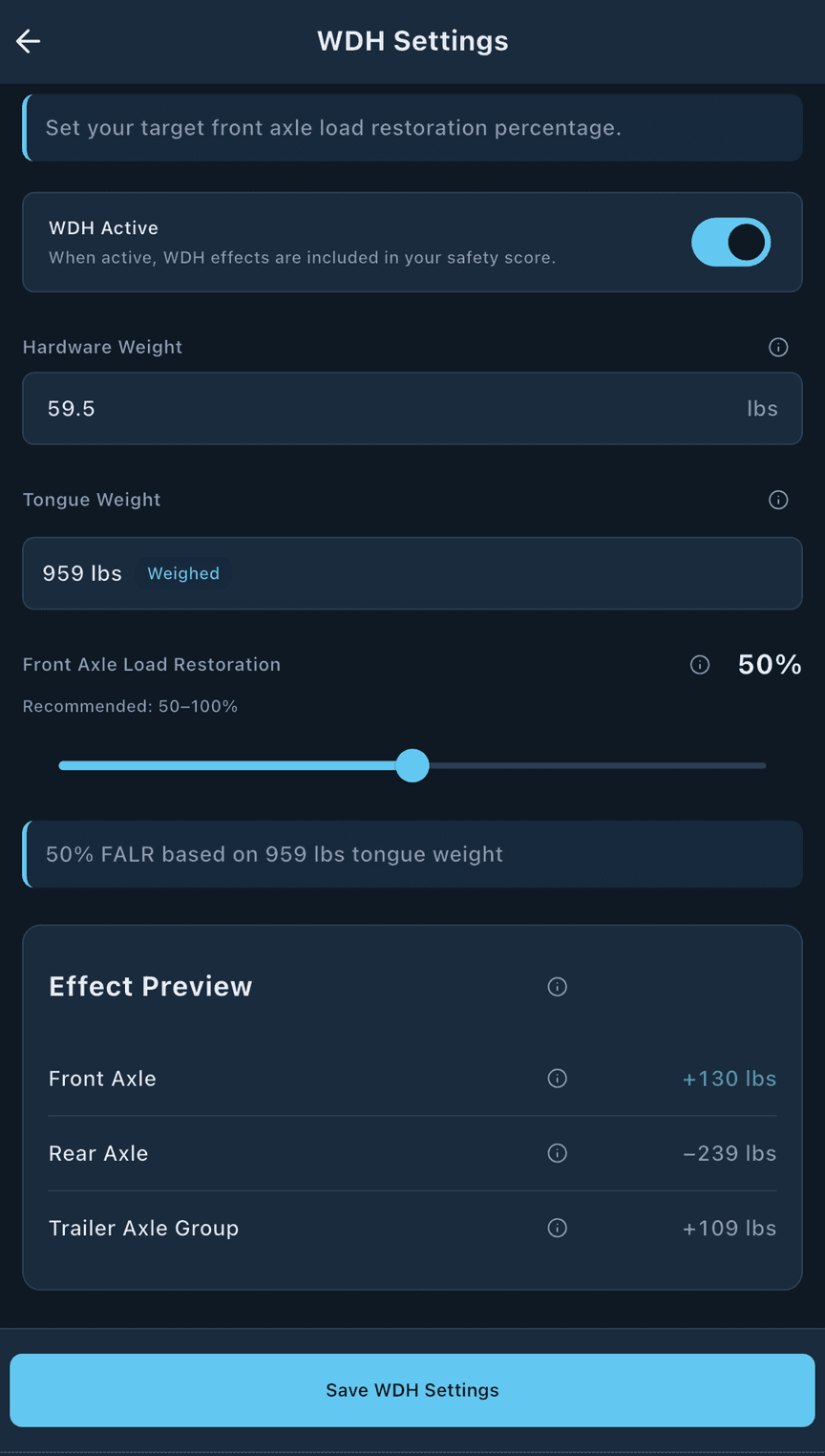
The setting, next to the weight it was set for
Jeep requires a weight-distributing hitch above 5,000 lb of trailer, "to ensure stable handling of your vehicle". Is your Grand Cherokee still holding that? loadmate keeps the distribution percentage the bars are tensioned to beside the tongue weight you measured, and reports what that pairing does at the front axle, the rear axle and the trailer axle group. Change one of the two and the reported effect changes with it.


Can a Grand Cherokee pull a 24-foot travel trailer?
Weight usually says yes and the trailer's face is the figure that catches people, because Jeep caps trailer frontal area as firmly as it caps pounds. With the tow package the allowance is 55 sq ft, up from 40 sq ft in 2025 and 2024. Without the package it is 30 sq ft.
Hold that 30 sq ft next to the car itself. Jeep's specification sheets give a two-row 2026 Grand Cherokee a frontal area of 31.7 sq ft, and 31.95 sq ft for the L. A Grand Cherokee without the tow package is allowed to pull a trailer whose face is smaller than its own, by 1.7 sq ft on the two-row and by 1.95 sq ft on the three-row. Those are two Jeep figures from two Jeep documents, subtracted.
Frontal area is height multiplied by width, so it catches tall boxes rather than heavy ones: a tall bunkhouse, a box trailer, anything with an air conditioner and a rack on the roof. It is also the figure that moved for 2026 while the weight rating stood still. A 2025 Grand Cherokee with the same 6,200 lb rating was allowed 40 sq ft of trailer face, and the 2026 car is allowed 55.
The illustrative 24-footer above is loaded to 5,200 lb, inside the rating and above the line where the hitch requirement switches on, and it is one composed example rather than a figure for the class. Length is not one of Jeep's numbers. The two that are, once the package is on the car, are the loaded weight and the face.
Does the Grand Cherokee L tow more than the two-row?
No on the trailer figure and yes on everything behind it. Both bodies are rated 6,200 lb with the tow package and 3,500 lb without, and both carry the same 620 lb and 350 lb of tongue weight.
| 2026 Grand Cherokee, with the tow package | Maximum trailer weight | GCWR | GVWR |
|---|---|---|---|
| Two rows, AWD | 6,200 lb | 11,300 lb | 6,050 lb |
| Two rows, RWD | 6,200 lb | 11,200 lb | 6,050 lb |
| Grand Cherokee L, AWD and RWD | 6,200 lb | 11,700 lb | 6,500 lb, or 6,700 lb on the 4WD Summit |
The L is the roomier tow vehicle rather than the stronger one. It carries 400 lb more combined rating than a two-row AWD and 450 lb more GVWR, on curb weights Jeep's spec sheet puts between 4,524 lb and 5,068 lb against 4,238 lb to 4,784 lb. Part of that extra GVWR is spoken for by the car itself, and the third row arrives with people in it, who come out of the same placard figure as the tongue weight.
What changed on the Grand Cherokee's towing for 2026?
A new engine that did not change the rating, a trailer-face allowance that grew by 15 sq ft, and a plug-in hybrid that was announced and then dropped. The rating itself has been 6,200 lb since the V8 left.
| Model year | What the Grand Cherokee's towing looked like |
|---|---|
| 2022 | WL generation launches. Weight-distributing hitch recommended at 5,000 lb. The table note prints the rear GAWR figure, 3,800 lb |
| 2023 | Wording unchanged. The rear GAWR figure disappears from the note |
| 2024 | 5.7L HEMI V8 in the tables at 7,200 lb, 3.6L V-6 at 6,200 lb, 4xe at 6,000 lb. Trailer frontal area 40 sq ft. Wording: required |
| 2025 | The V8 is gone, and the 7,200 lb rating with it. Gas cars stay at 6,200 lb on 40 sq ft |
| 2026 | The 2.0L Hurricane Turbo 4 arrives at the same 6,200 lb. Trailer frontal area rises to 55 sq ft. Wording: required, twice |
The Hurricane makes 324 hp and 332 lb-ft against the V-6's 293 hp and 260 lb-ft, and a February 2026 first drive of it carried the same 6,200 lb figure in its headline. More engine, identical rating, which is the ordinary result when a tow figure is set by cooling, braking and stability rather than by output.
The plug-in hybrid is now a used-car question with a caveat. Jeep announced a 2026 Grand Cherokee 4xe on October 28, 2025, the cancellation was reported in January 2026, and the 2026 manual still prints its towing table: 6,000 lb of trailer, 600 lb of tongue, 12,125 lb of GCWR with the tow package. Two open NHTSA campaigns, 25V741000 on the high-voltage battery and 25V576000 on the hybrid control processor, list 2026 4xe vehicles in their populations. Neither of those, nor 26V328000 on the air-bag controller, touches the hitch, the tow package or any rating, and all three are searchable by VIN on NHTSA.gov.
None of that reaches the sentence on pages 190 and 191, which has read the same way since the 2024 book. What that sentence needs from you is spread across everything above: the rule out of the manual, GVWR and curb weight out of the specification sheet, the ratings your car was actually built to off the label in its door frame, the tongue figure stamped on the hardware somebody bolted on, and the percentage the bars are tensioned to, which is written down nowhere at all. Five readings, five sources, and nothing Jeep publishes puts them side by side. loadmate does, against one Grand Cherokee, with the date each reading was taken beside it, so the question Jeep attaches to its own rule, "to ensure stable handling of your vehicle", can be asked again about the trailer behind the car now instead of the one the bars were set for. The mechanism that question points at is worked through on a shorter Jeep, where the load on the coupler decides the trip before the rating does. Those recorded limits and settings give the next load change a useful starting point in the app.
Related guides
Where each figure and rule above comes from, and four other vehicles whose makers split the same information differently.
- What can I tow?: the same question with no badge attached, and which trailers each capacity tier really reaches
- Towing capacity chart: the Grand Cherokee's rows beside the rest of the midsize SUV field
- Towing weight ratings explained: what GVWR, GCWR and the axle ratings each govern, before you go and read your own label
- Payload vs towing capacity: why a 6,200 lb rating and a placard figure never describe the same trip
- Tongue weight vs payload: the 620 lb on the coupler, counted against what the car is allowed to carry
- Weight distribution hitch and front axle load: what the bars Jeep requires above 5,000 lb actually move, and what they leave alone
- Weigh a travel trailer at a CAT scale: how to replace an assumed tongue weight with a measured one
- How to read a CAT scale ticket: the axle lines, read against the ratings on your own certification label
- How much can a Jeep Wrangler tow?: the shorter Jeep, where the load on the coupler decides the trip before the rating does
- How much can a Jeep Gladiator tow?: five published rows and a truck whose weight changes on a driveway
- How much can a Ram 1500 tow?: the Stellantis half-ton that levels itself, and what that does to a hitch setup
- How much can a Chevy Colorado tow?: the midsize truck whose maker tightened the same hitch wording a model year later
Frequently asked questions
- How much can a Jeep Grand Cherokee tow?
A 2026 Jeep Grand Cherokee is rated to tow 6,200 lb with the factory Trailer Tow Prep Group and 3,500 lb without it, on either engine and in 2WD or 4WD. Maximum trailer tongue weight is 620 lb with the package and 350 lb without. GCWR is 11,300 lb on a two-row AWD with the package and 11,200 lb on the RWD, against 8,600 lb and 8,500 lb without it. The three-row Grand Cherokee L carries the same 6,200 lb on an 11,700 lb GCWR. A 7,200 lb figure belongs to a 2024 or older car with the 5.7-liter HEMI V8, which is no longer offered.
- How do I know if my Grand Cherokee has the tow package?
The window sticker is the only document that lists the Trailer Tow Prep Group, and a dealer can pull the build sheet against your VIN if the sticker is gone. No Jeep manual, handbook or specification sheet published for the 2026 car says what is inside it. What they do publish is what it changes: 3,500 lb of trailer becomes 6,200 lb, 350 lb of tongue weight becomes 620 lb, GCWR on a two-row AWD goes from 8,600 lb to 11,300 lb, and allowable trailer frontal area goes from 30 sq ft to 55 sq ft. Fitting an aftermarket hitch does not move any of those four figures. Owners on the T@B and Jeep forums describe the factory group as cooling and charging hardware, an oil cooler, a transmission fluid cooler and a bigger alternator, rather than a receiver alone.
- Do I need a weight distribution hitch with my Grand Cherokee?
Above 5,000 lb of gross trailer weight, yes. The 2026 owner's manual states that at 5,000 lb or more "it is required to use a weight-distributing hitch to ensure stable handling of your vehicle", and prints that sentence twice, at pages 190 and 191. The wording used to be softer: the 2022 and 2023 manuals said recommended at the same 5,000 lb, and the 2024 manual on Jeep's US publications site already reads required. The threshold sits 1,200 lb below the 6,200 lb the car is rated to tow with the tow package fitted, so the top fifth of that rating comes with the hardware requirement attached to it.
- Can a Jeep Grand Cherokee tow a 5,000 lb travel trailer?
Yes with the Trailer Tow Prep Group, which is rated for 6,200 lb, and no without it, since an unpackaged Grand Cherokee is limited to 3,500 lb. A 5,000 lb trailer also lands exactly on the line where Jeep's owner's manual stops recommending a weight-distributing hitch and starts requiring one, so the hardware is part of the answer rather than an accessory to it. Watch the coupler as well: at Jeep's own loading instruction of 10% of gross trailer weight on the hitch, a 5,000 lb trailer puts about 500 lb there, against a 620 lb maximum that is shared with everything else the car is carrying.
- What is the tongue weight limit on a Grand Cherokee?
620 lb with the Trailer Tow Prep Group and 350 lb without it, per the 2026 owner's manual, and never more than the maximum tongue weight stamped on your own fascia, bumper or trailer hitch, which is a separate limit on the hardware fitted. Jeep adds one condition to both figures: tongue weight counts as part of the combined weight of occupants and cargo, and must not push that total past the figure on the tire and loading information placard, which sits on the driver's side B-pillar or the rear edge of the driver's door. So the weight on the coupler is paid for out of the same allowance as the passengers.
- Does the Grand Cherokee L tow more than the two-row?
Not on the trailer figure. Both bodies are rated 6,200 lb with the tow package and 3,500 lb without, with the same 620 lb and 350 lb of tongue weight. What the L adds is behind that: a GCWR of 11,700 lb against 11,300 lb on a two-row AWD, and a GVWR of 6,500 lb against 6,050 lb, rising to 6,700 lb on the 4WD Summit. The L is also heavier, with curb weights from 4,524 lb to 5,068 lb against 4,238 lb to 4,784 lb, so part of the larger GVWR is spent on the car itself before anyone gets in.
- Why does my Grand Cherokee's manual not list my engine?
Because every engine cell in Jeep's 2026 towing tables reads "2.0L Hurricane-4 Engine", including all of the Grand Cherokee L's rows, while the specification sheets list the 3.6-liter Pentastar V-6 as a standard engine on both bodies. The strings "Pentastar", "3.6L" and "V-6" appear zero times in the 376-page 2026 manual, and the Grand Cherokee L's own trailer-towing table names the V-6 and nothing else. Both engines are rated at 6,200 lb with the tow package, so the figures in the table apply to a V-6 car as printed.
- How do I set up a weight distribution hitch on a Jeep with air suspension?
Jeep prints a nine-step procedure at pages 191 and 192 of the 2026 owner's manual, and three of its instructions are specific to this car. The vehicle should be at normal ride height, in the engine run position with the doors closed, while the trailer is attached. On a Quadra-Lift car, enable Tire/Jack mode from the touchscreen before coupling, so the leveling function is paused while you measure, and note that it cancels if the car is driven above 5 mph, which means starting again. The target Jeep sets is a front fender height, and its own worked example for that target is printed in millimeters. The measurements the procedure asks for, and what the spring bars do with the pounds once they are tensioned, are covered in loadmate's weight-distribution-hitch guide rather than here.