How much can the Subaru Outback tow?
| Variant | Braked towing capacity | GVM | GCM | Kerb weight | Payload at full tow | Tow ball rating | Rear axle limit | Unbraked towing | Front axle limit |
|---|---|---|---|---|---|---|---|---|---|
| Wilderness2026 | 2,100 kg | 2,333 kg | 4,433 kg | 1,781 kg | 342 kg | 210 kg | 1,280 kg | 750 kg | 1,260 kg |
| AWD2026 | 2,000 kg | 2,280 kg | 4,280 kg | 1,705 kg | 375 kg | 200 kg | 1,280 kg | 750 kg | 1,260 kg |
| Outback AWD Premium2026 | 2,000 kg | 2,280 kg | 4,280 kg | 1,732 kg | 348 kg | 200 kg | 1,280 kg | 750 kg | 1,260 kg |
| Touring2026 | 2,000 kg | 2,280 kg | 4,280 kg | 1,733 kg | 347 kg | 200 kg | 1,280 kg | 750 kg | 1,260 kg |
| Wilderness Apex2026 | 2,100 kg | 2,333 kg | 4,433 kg | 1,802 kg | 321 kg | 210 kg | 1,280 kg | 750 kg | 1,260 kg |
5 variants
| Braked towing capacity | 2,100 kg |
|---|---|
| GCM | 4,433 kg |
| GVM | 2,333 kg |
| Kerb weight | 1,781 kg |
| Front axle limit | 1,260 kg |
| Rear axle limit | 1,280 kg |
| Tow ball rating | 210 kg |
Replacing an XT means matching the camper again
If you're trading an XT for a new Wilderness, it's natural to expect the turbo model to keep the old trailer allowance. It doesn't. Subaru's 2025 brochure, page 51 gives the Sport XT and Touring XT a 2,400 kg braked limit and 240 kg maximum ball load. The 2026 brochure, page 16 gives the Wilderness and Wilderness Apex 2,100 kg and 210 kg. Both limits drop, even though the new car is also turbocharged.
For a camper that really weighs 2,200 kg loaded, that settles the first question: it's 100 kg over the current Wilderness's braked rating. A camper at 1,900 kg clears that limit but still needs its ball, vehicle and axle checks. What the old car was rated to tow doesn't carry across to its replacement, and Subaru's documents show the change without saying why it was made.
Check the model year and grade on the car before trusting an online answer. Subaru's current towing page has an updated five-grade table, but its FAQ still mentions the XT. Use the table and the matching model-year documents for the current range. The 2,400 kg figure belongs to the older XT, never to an Australian MY26 Wilderness.
Start a camper shortlist with its travelling weight
The question often comes before the car changes. In a September 2022 ExplorOz discussion, an Outback owner wanted to keep the car and find a camper for a trip through WA, the NT and SA. That's the right order: pin down your exact Outback's limits, then look at campers that fit the real trip load. The post doesn't say which generation the car was, so it can't tell you about today's ratings.
Ask for the camper's loaded total and ball measurement with water, gas, battery, spare wheel and normal travel gear aboard. In that same discussion, Tvan owner Cuppa described a big gap between his own camper's dry and travel-ready weights, then queried an empty ball figure quoted for another camper. Compare campers in the same loaded state. Advertised tare is where a camper starts and ATM is the most it's allowed to weigh; your trip weight sits somewhere between, and only a weigh-in tells you where. Our caravan weights guide explains those figures.
For the current Wilderness, a loaded 1,800 kg trailer is 300 kg below the braked ceiling. That makes it worth a closer look, and the next example shows why it still might not fit. Weigh the ball and follow the camper maker's loading instructions; a percentage guess won't do the job.
The lightest current grade carries more at its tow limit
Subaru's Australian towing table lists the current GVM, GCM, kerb and axle ratings. On those kerb figures, the non-turbo AWD leaves 375 kg for people and added gear at its maximum tow and ball load. The Outback AWD Premium leaves 348 kg and the Touring 347 kg. The Wilderness leaves 342 kg and the Wilderness Apex 321 kg. So the grade with the bigger tow figure can leave you less room inside the car.
The sum takes the lower of two allowances, GVM minus ball load or GCM minus loaded trailer mass, then subtracts kerb mass. For the Wilderness that's min(2,333 - 210, 4,433 - 2,100) - 1,781 = 342 kg. Your towbar, accessories, passengers and luggage all have to fit in that. Optional equipment changes the starting weight, so weigh your car instead of assuming it matches the brochure.
GVM covers the loaded car, including the ball pressing down on it. GCM covers the whole combination. At the Wilderness's rated tow and ball loads, GVM is the tighter of the two. The GVM guide explains why trailer allowance that looks comfortable can't be spent again on passengers or cargo.
A 1,800 kg camper can leave just 32 kg in the car
Take one MY26 Wilderness, loaded with example figures you should replace with your own. Start with Subaru's 1,781 kg kerb figure. Add 240 kg of people, 35 kg of fitted equipment beyond kerb, and 65 kg of luggage. The unhitched car is now 2,121 kg. Hitch a trailer weighing 1,800 kg in total, with a 180 kg ball load, and the car becomes 2,301 kg. Against its 2,333 kg GVM, that leaves 32 kg.
The combination has more room. The trailer's wheels carry 1,620 kg because its 180 kg ball load is already on the car. Add 2,301 kg at the car to 1,620 kg at the trailer wheels and you get 3,921 kg combined, 512 kg under the 4,433 kg GCM. You get the same answer from the unhitched 2,121 kg car plus the complete 1,800 kg trailer. Adding the full trailer to the hitched car would count the ball twice.
The envelope shows the Wilderness's ratings and kerb figure. The example above runs a lighter trailer and ball than those maximums: its 180 kg ball is 30 kg under the limit and the trailer is 300 kg under the braked rating. Even so, another 45 kg of gear in the car takes the hitched mass to 2,346 kg, 13 kg over GVM. Combined mass would still be only 3,966 kg, and that spare GCM does nothing to fix the overloaded car.
There's no measured axle split here, so neither axle has been checked, and it assumes the towbar, coupling, trailer and tyres are all rated for these loads. Read the 32 kg as how close one limit is, and weigh the real rig before you tow.
Keep the new Wilderness weigh-in connected to later trips
A weigh-in after changing from an XT gives the Wilderness its own starting record. Note the passengers, fitted equipment, luggage and trailer condition alongside the readings. Before the next trip, ask what has changed since: another passenger, a roof load, or gear moved between camper and car. In the example, adding 45 kg is enough to cross GVM while the trailer stays exactly the same.
Give the replacement car its own measured starting point in the loadmate app: link the Wilderness weigh-in to its rig record and the loads aboard that day. Before you pack again, compare what's been added or taken out since those measurements. The old XT's record no longer describes the new car, even with the same camper on the driveway.
The coupling and axle checks still need the actual rig
Subaru's current table rates the front axle at 1,260 kg and the rear at 1,280 kg. Adding those together doesn't give you a new GVM, and a car under GVM can still overload one axle. The ball sits behind the rear axle, so the rear axle picks up more than the ball reading alone. Book a certified weighbridge that records loaded front and rear axles separately and compare each reading with its own limit. Note the trailer and hitch condition with the readings, and don't guess the weight split from the car's shape.
The coupling has to suit the camper too. One contributor to the 2022 owner discussion raised hitch height when looking at a camper behind an Outback. It's worth checking even when the weights look promising: make sure the towbar, ball mount and camper coupling connect at the equipment maker's specified height and articulation. A different ball mount needs its own rating for the load.
A higher-rated aftermarket towbar doesn't raise Subaru's vehicle limit. NSW Government towing guidance requires you to stay within the vehicle, trailer, coupling and equipment limits. These ratings come from Subaru's current towing table and MY26 brochure, which don't include the handbook's towing instructions. Check your car's Australian handbook and the hitch supplier's instructions for WDH approval before fitting a weight-distribution device or choosing towing gear.
An XT tow test answers an XT question
There's good Australian towing evidence for the previous turbo model. Philip Lord's April 2023 XT tow test used a 2,000 kg tandem pop-top with a reported 140 kg ball load. He found it climbed hills responsively and moved around a bit in crosswinds. That's one XT with one trailer, so don't read it as a Wilderness result or as a guide to every camper under 2,000 kg.
Plan fuel stops from the loaded combination too. In a December 2007 3.0R owner discussion, Dunco described a caravan replacing his lighter camper and headwinds pushing up fuel use. Treat that old car's figures as a reminder, never a Wilderness forecast. Record your own towing consumption and plan around the gaps between fuel stops; a new trailer can change that plan even when the tow rating still allows it.
If you're keeping an older Outback, use its own year-specific manual and towbar plate, and check its recall status on the Australian recall register for that model year. For a new Wilderness, weigh the loaded camper and check it against the current 2,100/210 kg limits, with the passengers and that particular trailer counted together.
Give the replacement Outback its own baseline
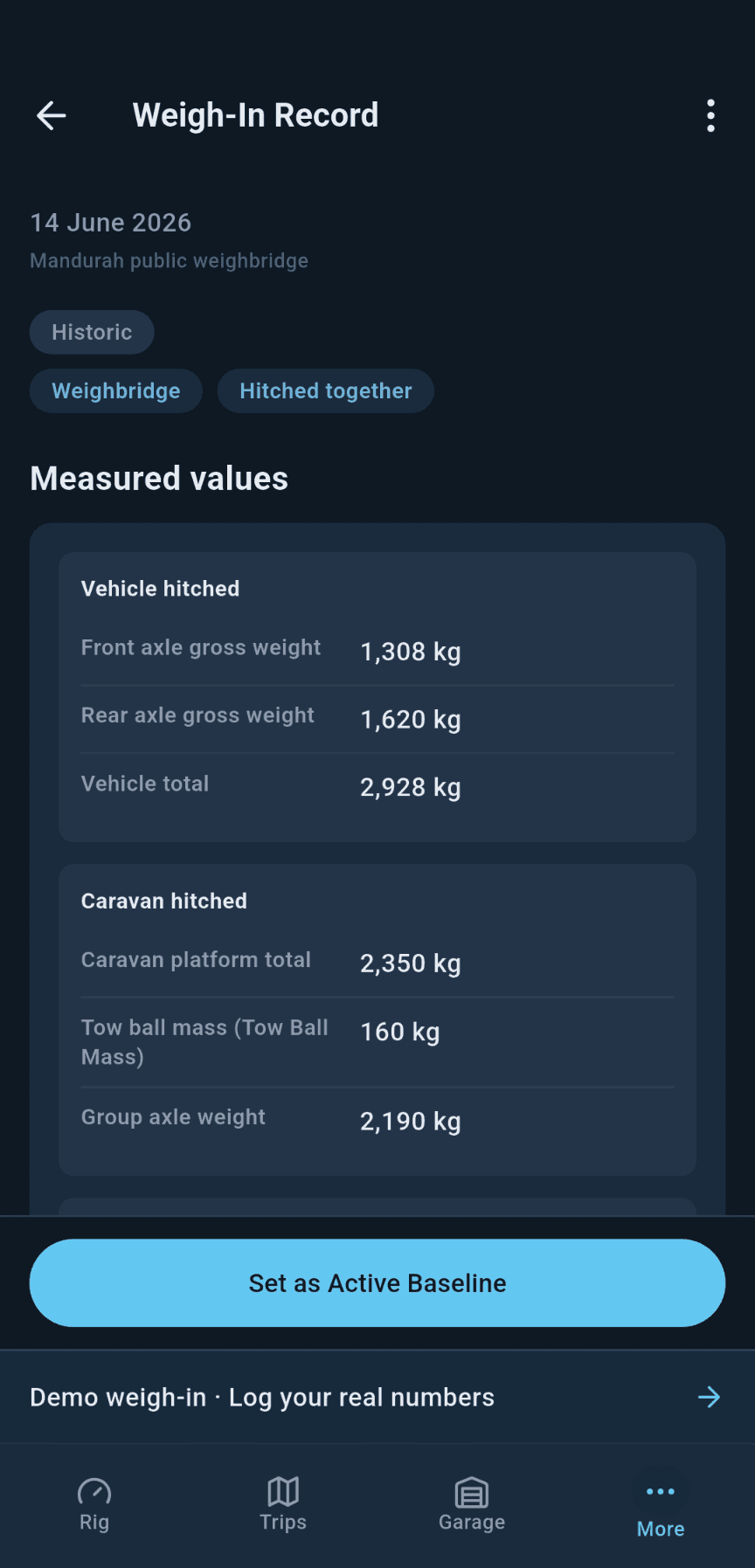
A new Wilderness needs its own measurements, even behind the same caravan. Record the replacement car's weigh-in and the loads aboard in loadmate, then compare later packing changes with that baseline. The screen shows a demo weigh-in.


Common questions
- Can an Outback tow a camper trailer?
Yes, when your exact car and the loaded camper fit every limit. Australian MY26 non-turbo grades are rated at 2,000 kg braked and 200 kg on the ball; Wilderness grades are 2,100 kg and 210 kg. Weigh the loaded camper and its ball, then check the car's GVM, axle loads, GCM and towing equipment. An empty camper weight won't tell you.
- Does the new Wilderness tow as much as the XT?
No. The Australian 2025 Sport XT and Touring XT were rated at 2,400 kg braked with a 240 kg ball maximum. The MY26 Wilderness and Wilderness Apex are 2,100 kg and 210 kg. Recheck a camper that suited the XT before you hitch it to the new car.
- How much can we carry with passengers and a caravan?
On Subaru's MY26 Wilderness kerb figure, maximum tow and ball load leave 342 kg for everyone aboard and any added gear. The Wilderness Apex leaves 321 kg. Your accessories and your car's real weight change that. In the example 1,800 kg trailer setup, the family, gear, luggage and 180 kg ball leave just 32 kg under the Wilderness GVM, with the axles still to be weighed.
- Will a higher-rated aftermarket towbar increase capacity?
No. The vehicle's published towing and ball limits stay the same whatever the towbar is rated to. The towbar, coupling, trailer, tyres and car must each be rated for the actual load. Check the towbar and ball mount are approved for your exact Outback and follow both the vehicle and equipment instructions.
- Should I buy a camper that weighs the full 2,100 kg?
Only after weighing its real travelling mass and ball load against the loaded Wilderness. A trailer at the ceiling has no room left for more trailer cargo, and the car may hit GVM or an axle limit first. Even the lighter 1,800 kg example leaves just 32 kg under GVM with a family aboard.
Understand the weight limits
Every figure above is governed by a manufacturer-set limit. These guides explain what each term means and how they fit together.
- Caravan & towing weights explainedThe master glossary: GVM, ATM, GTM, TBM and GCM in one place.
- Gross Combination Mass (GCM)The combined vehicle-plus-trailer ceiling that usually bites first.
- Aggregate Trailer Mass (ATM)What your caravan is legally allowed to weigh, fully loaded.
- Braked towing capacityWhy a 3,500 kg rating rarely means you can tow 3,500 kg.
Sources and review
Specifications checked
Page reviewed
- Subaru Australia current Outback towing table, checked 16 October 2026
Current five-grade GVM, GCM, kerb, towball, tow and axle values. The stale XT FAQ is excluded as current authority.
- Subaru Australia 2026 Outback brochure, PDF page 16
Current grade kerb, braked towing, towball and wheelbase. Optional equipment changes mass.
- Subaru Australia 2025 Outback brochure, PDF page 51
Historical Sport XT and Touring XT 2400 kg braked/240 kg ball only; no historical tare transferred to current kerb basis.