How much can the Toyota Kluger tow?
| Variant | Braked towing capacity | GVM | GCM | Kerb weight | Payload at full tow | Tow ball rating | Rear axle limit | Unbraked towing | Front axle limit |
|---|---|---|---|---|---|---|---|---|---|
| GX hybrid AWDOct25-Nov26 manual | 2,000 kg | 2,705 kg | 4,705 kg | 2,050 kg | 455 kg | 200 kg | 1,560 kg | 700 kg | 1,560 kg |
| GXL hybrid AWDOct25-Nov26 manual | 2,000 kg | 2,705 kg | 4,705 kg | 2,050 kg | 455 kg | 200 kg | 1,560 kg | 700 kg | 1,560 kg |
| Grande hybrid AWDOct25-Nov26 manual | 2,000 kg | 2,750 kg | 4,750 kg | 2,095 kg | 455 kg | 200 kg | 1,560 kg | 700 kg | 1,560 kg |
3 variants
| Braked towing capacity | 2,000 kg |
|---|---|
| GCM | 4,705 kg |
| GVM | 2,705 kg |
| Kerb weight | 2,050 kg |
| Front axle limit | 1,560 kg |
| Rear axle limit | 1,560 kg |
| Tow ball rating | 200 kg |
Grande's higher GVM buys no extra family allowance
If you're choosing between Kluger grades, the towing sums come out the same. Toyota's February 2026 specification sheet gives the GX and GXL a 2,050 kg kerb mass and 2,705 kg GVM. The Grande weighs 2,095 kg and has a 2,750 kg GVM. Take one from the other and each grade starts with 655 kg for everything you add to the car. The flagship's extra 45 kg of GVM is already used up by its extra 45 kg of kerb mass.
Seven seats don't tell you what seven people weigh, and a big boot doesn't add carrying allowance. The towbar, any gear left out of the kerb figure, passengers, luggage and the ball load all have to fit in the same total. Pick the Grande for its equipment by all means, but it won't carry any more behind the same caravan.
The current Australian specification sheet covers the hybrid AWD GX, GXL and Grande. It pairs with Toyota's Oct25-Nov26 hybrid manual, document OM48P87E. A 2026 registration date doesn't put an earlier petrol or differently built Kluger in this table, so check the model and build details of your car.
Where 655 kg becomes 455 kg
Toyota allows up to 2,000 kg of braked trailer and no more than 200 kg of tongue load. The manual's tongue load is what Australians usually call towball mass: the weight pressing down on the coupling. Toyota wants 9-11% of total trailer weight there, still capped at 200 kg. With a 2,000 kg trailer, 11% would be 220 kg, so the 200 kg cap wins.
For the GX or GXL at the maximum figures, the room left is min(2,705 - 200, 4,705 - 2,000) - 2,050 = 455 kg. For the Grande it's min(2,750 - 200, 4,750 - 2,000) - 2,095 = 455 kg. The first term checks the vehicle and the second the combination, and here the vehicle side is tighter. That 455 kg has to cover everyone aboard and everything beyond brochure kerb, including the towing gear if the kerb figure leaves it out.
With a 1,500 kg trailer and 150 kg on the ball, the same sum leaves 505 kg in every grade. Taking 500 kg off the trailer frees only 50 kg inside the car, because the ball load, and not GCM, sets the vehicle's allowance. Use your trailer's actual loaded figures. The GCM guide explains why spare combined capacity can't make up for an overloaded tow vehicle.
One family load, two caravan departure weights
Picture a GX or GXL packed for a family trip. These loads are assumed for the example, and yours will differ. Start with the 2,050 kg brochure kerb mass and add 30 kg of towing gear beyond that, 240 kg of people and 120 kg of luggage and camping gear. The unhitched car now weighs 2,440 kg. The hitched figures below leave out any load transfer from a distributing hitch; if you run one, weigh the axles with it set for travel, though the combined total stays the same.
Hitch a loaded 1,500 kg camper with 150 kg on the ball and the car reaches 2,590 kg, 115 kg under its 2,705 kg GVM. The camper's wheels carry 1,350 kg, so the combined axle total is 3,940 kg, 765 kg under GCM. Swap to a 2,000 kg caravan with 200 kg on the ball and the car's hitched weight becomes 2,640 kg. Vehicle headroom drops to 65 kg, while the combination is 4,440 kg with 265 kg of GCM headroom.
The second rig has much less room for something left off the packing list. Add a 70 kg traveller and it's 5 kg over GVM, even though the combination is still under GCM. The Grande gives the same margins with the same loads because its extra kerb mass and GVM cancel out.
The ball mass is already part of the whole trailer's loaded mass. Add the unhitched car to the whole trailer, or add up the hitched axle readings, and the ball gets counted once.
The family's packing positions still matter
Toyota rates each axle at 1,560 kg in this manual. Adding those together doesn't create a 3,120 kg GVM: the lower 2,705 or 2,750 kg whole-vehicle limit still applies. And a car under GVM can still have too much on one axle. The caravan couples behind the rear axle, while passengers and luggage sit at different points along the wheelbase. There's no measured axle split for this example, so it can't tell you how much rear-axle room is left.
So for the 65 kg example, note where the family and gear actually sit, then get front and rear readings in that travel setup at a certified weighbridge. Keep heavy gear secured where the vehicle and trailer makers say it can go. Moving things around changes axle loads without changing the total, so it can't fix an overall overload.
The third row might hold passengers on one trip and luggage on the next, which moves where the Kluger carries its load. Recording those passengers and gear positions in the loadmate app lets the family review that change against its weigh-in baseline. The 655 kg starting allowance is the same in every grade; what changes is who and what is aboard this time.
Why a Swan, Eagle or pop-top name can't settle the match
In a November 2022 Australian discussion, a buyer wanted a hybrid for everyday family use and the odd trip with two adults and two children, towing a Swan or Eagle. Another participant described towing with three children and two dogs, but didn't say which engine or give any weights. The next reply asked which engine they had, and that missing detail is why someone else's happy trip can't clear yours.
Older threads show the same family job: a 2016 Kluger owner was shopping for a pop-top with no off-road plans, and a 2018 boat buyer needed a car their partner would drive daily with two young children. The ratings in those threads are for older Klugers and rivals, so check the current hybrid's own figures.
Ask for the individual camper's plated limits, then weigh it with the battery, gas, water and belongings it will carry, and weigh the ball in that same state. An empty advertised weight leaves out the packing, and two campers with the same model name can carry different equipment. The caravan weights guide explains why the loaded ball figure needs its own check alongside total trailer mass.
Toyota's 700 kg brake threshold and hitch instructions
The current Kluger manual requires trailer brakes once total trailer weight goes over 700 kg, so the 750 kg unbraked figure you'll see on other SUVs doesn't apply. A 720 kg loaded unbraked trailer would break this Kluger rule while still sitting under that familiar number. Check the trailer's braking system, the vehicle connection and any controller it needs with your installer.
Toyota recommends a distributing hitch when towing a caravan and a sway-control device when total trailer weight is greater than vehicle weight. Follow the hitch maker's setup directions and get the correct Toyota fitment advice for your car. Whichever of the vehicle, hitch, ball and trailer connection has the lowest rating sets your ceiling.
In a January 2012 Kluger discussion, an owner changed cars after trouble with a heavy ball load and the rear sitting down, despite fitting heavier coils. That's an older car with no bearing on the current hybrid, but one point carries over: how the springs look and how well the car pulls won't tell you the ball or axle loads. Weigh the combination and deal with whichever limit is the problem before you change any hardware.
Read the hybrid's towing settings before leaving
Toyota recommends not towing for the first 800 km, including after certain new powertrain parts are fitted. It also says to raise tyre pressure 20 kPa above the recommended value when towing, and to follow the trailer maker's pressures. Use the handbook and tyre placard for your car instead of copying another owner's cold-pressure setting.
The towing chapter lists driver-assist systems you mustn't use while towing, including dynamic radar cruise, lane tracing, pre-collision, blind-spot and parking-related functions. Read the full list and how to switch them off before the trip. For engine braking downhill, it describes S mode with a range of 5 or lower.
On a used car, check the VIN against recall REC-006562. First published on 12 March 2026, it lists 2021-25 Kluger grades whose second-row seat recliner may not fully engage. It matters for the family in the second row and leaves the towing capacity unchanged. Toyota's VIN check shows whether your car is affected and whether the fix is still outstanding.
Choose the grade after the family and camper fit
In the current hybrid range, towing doesn't separate the GX, GXL and Grande. All three share 2,000 kg braked towing, a 200 kg ball ceiling and the same 455 kg left at those maximums. Start with the weighed people, fitted gear and camper, then pick the grade's equipment around a match with room for the real trip.
A trailer over 2,000 kg or a ball over 200 kg rules out this factory specification. Under those numbers, you still need to check GVM, GCM, each axle, the fitted labels and the handbook conditions. If the family example leaves too little room for changing passengers or gear, compare another vehicle with exactly the same loaded trailer and people; a bigger advertised tow rating won't necessarily fix it.
Specs were checked on 16 October 2026 against the February 2026 sheet and the Oct25-Nov26 manual. The examples are planning sums and say nothing about handling. See the safety disclaimer; your vehicle documents, its labels and the weighed travel setup are what the decision rests on.
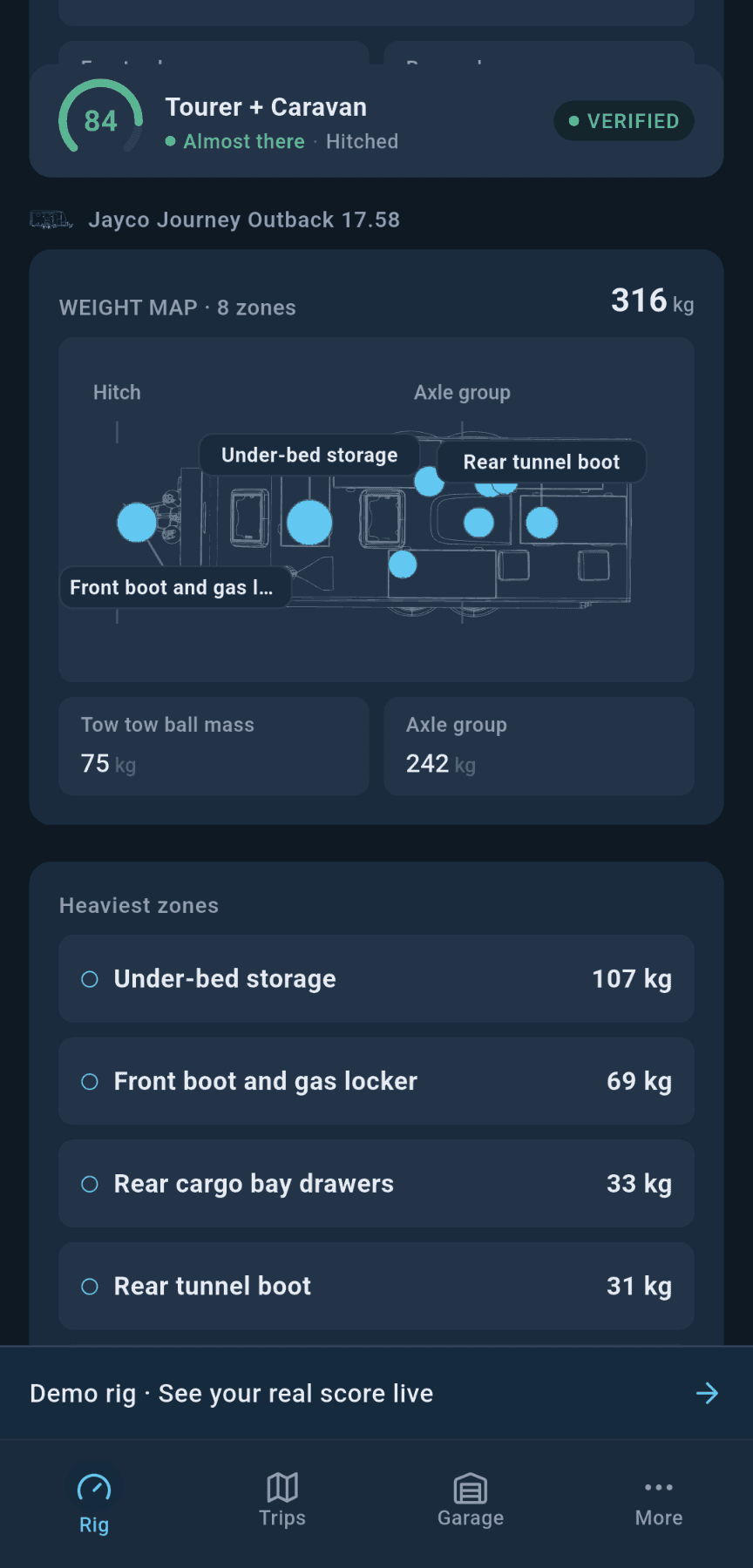
Plan where the Kluger's family load sits
All three grades start with the same 655 kg carrying allowance, but third-row passengers and luggage put it in different places. Record where they sit alongside the Kluger and caravan in loadmate, then check packing changes against your measured baseline. The screen shows a demo load map.


Common questions
- Can a Toyota Kluger hybrid tow a caravan?
Yes. The current Australian hybrid is rated to tow 2,000 kg braked with a maximum 200 kg tongue load. Check the fully loaded caravan, people and gear against GVM, GCM, both 1,560 kg axle limits and the fitted hitch ratings. A caravan model name or another owner's good trip won't tell you those numbers.
- Does a Grande have more towing payload than a GX or GXL?
Not on the current figures. The Grande is 45 kg heavier at kerb and has 45 kg more GVM, so it leaves the same 655 kg before coupling and 455 kg at a 200 kg ball load. Fitted equipment and scale readings can change what your own car has left.
- Can I use older Kluger or Highlander towing figures?
Use the manual for your Australian model and build. Toyota's Oct25-Nov26 manual and February 2026 specification sheet cover the current AXUH78R hybrid AWD range. Older V6, petrol, two-wheel-drive and overseas Highlander figures belong to different vehicles.
- How much can a Kluger tow without trailer brakes?
The current hybrid manual requires trailer brakes above 700 kg total trailer weight. Count the trailer itself and everything on it, and use 700 kg even if other vehicles you know allow 750 kg.
- Can a Kluger use a weight distribution hitch?
Yes. Toyota's current hybrid manual recommends a distributing hitch for caravan towing. Use a compatible installation and follow Toyota's and the hitch maker's directions. It doesn't raise GVM, GCM, the axle limits or the 200 kg maximum tongue load.
- Will a Jayco Swan, Eagle or pop-top fit a Kluger?
It depends on that particular camper's loaded mass and measured ball load. Start under the 2,000 kg and 200 kg limits, then add people, fitted towing gear and luggage to the car's totals and check both axles. The camper's empty listing won't tell you what it weighs packed for a trip.
Understand the weight limits
Every figure above is governed by a manufacturer-set limit. These guides explain what each term means and how they fit together.
- Caravan & towing weights explainedThe master glossary: GVM, ATM, GTM, TBM and GCM in one place.
- Gross Combination Mass (GCM)The combined vehicle-plus-trailer ceiling that usually bites first.
- Aggregate Trailer Mass (ATM)What your caravan is legally allowed to weigh, fully loaded.
- Braked towing capacityWhy a 3,500 kg rating rarely means you can tow 3,500 kg.
Sources and review
Specifications checked
Page reviewed