Caravan weights at a glance
- MTPLM
- The caravan's maximum legal laden weight, set by the manufacturer and stamped on the weight plate. Also the caravan's MAM.
- MiRO / MRO
- The caravan's empty weight as it left the factory, on the same plate. NCC-Approved vans from 2011 include a gas bottle and the hook-up cable.
- User payload
- MTPLM − MiRO. The weight you may add: belongings, dealer options, a retailer-fitted leisure battery, awning, motor mover, food. Not printed on the plate — you work it out.
- MAM (two meanings)
- "Maximum authorised mass." The caravan's MTPLM is its MAM; the tow car's maximum gross weight is also called its MAM. Check which one a source means.
- GTW + combination rule
- Gross train weight is the car plus loaded caravan ceiling, on the car's VIN plate. The loaded car plus the loaded caravan must not exceed it.
- Where to find them
- Caravan: the weight plate near the door or in the gas locker, plus the handbook. Car: a plate or sticker and the handbook; GTW on the VIN plate.
- Licence note
- A category-B licence passed from 1 January 1997 lets you tow up to 3,500 kg MAM without the old car-and-trailer test (GB, since 16 December 2021).
- If you exceed a limit
- DVSA can issue an immediate prohibition notice at the roadside and may immobilise the vehicle; graduated fixed penalties apply, and overloading can affect your insurance.
Caravan weight plates carry a small alphabet of acronyms, and the one that catches people out is not the term they cannot read — it is MAM, which means two different things depending on whether you are reading the caravan's plate or the car's. This guide separates MTPLM, MiRO and payload from the car-side MAM, runs one illustrative outfit through every limit, and shows which check actually bites first.
What does MTPLM mean?
MTPLM stands for Maximum Technically Permissible Laden Mass — the absolute maximum weight your caravan is allowed to be when fully loaded for the road. The manufacturer sets it and stamps it on the caravan's weight plate, normally near the entrance door or inside the gas locker. It already includes the user payload, all fluids such as fresh water, and the personal belongings you carry — clothes, food and the rest. Go over it and the caravan is over its legal weight.
You will also see MTPLM called the caravan's MAM (maximum authorised mass). Before 1998 the same figure was the maximum gross weight (MGW), so older handbooks and adverts may still use that term. They all point at the same number: the ceiling the loaded caravan must not cross.
What is MiRO (MRO), and what does it include?
MiRO — mass in running order, now usually written MRO — is the weight of your caravan as it left the factory to the manufacturer's standard specification. It appears on the weight plate alongside the MTPLM. The term shifted from MiRO/MIRO to MRO over recent years; one manufacturer's own page heads the entry "MRO (formerly MIRO)". Both mean the same factory running-order weight, and people type it every way: MIRO, MiRO, MRO and "mass in running order".
MiRO is not the bare shell. For an NCC-Approved caravan built from 2011 it carries an allowance for basic equipment such as a gas bottle and the electrical hook-up cable. Older caravans include different items, so the handbook is the only reliable list.
Water is where owners get caught out. Since 2015 manufacturers state how much fresh water sits in the MiRO figure, and most have chosen to include zero — covering storage tanks, water heaters and the pipework. So do not assume your MiRO already accounts for a full tank. Often it accounts for none, and a brimmed tank is roughly 1 kg per litre out of your payload. Check the handbook for your model.
| Term | What it is | Where you read it |
|---|---|---|
| MiRO | The empty, factory running-order weight of the caravan | Stamped on the weight plate |
| MTPLM | The maximum laden weight the caravan may not exceed | Stamped on the same weight plate |
The difference between those two stamped numbers is the only weight you control: your payload.
How do I calculate my caravan's user payload?
Your payload is MTPLM minus MiRO — the manufacturer never prints it on the plate, so you work it out yourself. It is the allowance for everything you add to a van that left the factory at its MiRO weight.
On the illustrative outfit this guide uses throughout, the caravan has a MiRO of 1,250 kg and an MTPLM of 1,500 kg, so the payload is 250 kg (1,500 − 1,250). That 250 kg has to cover the awning, the bedding and crockery, the food, the leisure battery if your retailer fitted it rather than the factory, any motor mover, and the water you carry. It is gone faster than most first-time owners expect.
A few things eat payload silently. A leisure battery counts towards MiRO only when the caravan manufacturer supplied it; a retailer-fitted battery comes straight out of your payload instead. Dealer-fitted extras — a motor mover, solar, air conditioning — push the real weight above the published MiRO without changing the plate. Many buyers fixate on the MTPLM, never check the MiRO, and then find they have surprisingly little room for gear. The figures on a poster, in a brochure and on the plate can all differ, so the plate and handbook win.
Is MTPLM the same as MAM?
Yes — and that is exactly where the confusion starts. MAM means maximum authorised mass, and the caravan's MTPLM is its MAM. The trouble is that the tow car's maximum gross weight is also called its MAM (you will also see it as GVW or maximum permissible weight). One acronym, two referents.
So when a towing source says "MAM", read which side it is talking about. On the caravan it is the MTPLM. On the car it is the loaded-car ceiling that, together with the caravan, must fit under the gross train weight.
| Reading of "MAM" | What it labels | The figure it caps |
|---|---|---|
| Caravan MAM | The caravan's MTPLM | The fully loaded caravan, on its own weight plate |
| Car MAM | The tow car's maximum gross weight (GVW/MPW) | The fully loaded car, on the car's plate or sticker |
What is gross train weight, and how does the combination rule work?
Gross train weight (GTW) is the weight of the fully loaded car plus the fully loaded caravan, and it must not be exceeded — it is usually the limit that bites first. GOV.UK puts the rule plainly, and the car's GTW is listed on its VIN plate. The legal test is on the actual weights on the day: your loaded car plus your loaded caravan against the car's GTW. As a stricter pre-trip ceiling, add the car's MAM to the caravan's MTPLM and check that total stays under GTW — if the maxed-out figures fit, the real ones will.
Here is the illustrative outfit run end to end (all figures kg; this is a composite, not a real registered rig):
| Side | Figure | Value (kg) |
|---|---|---|
| Tow car | kerbweight | 1,900 |
| Tow car | MAM (loaded car) | 2,450 |
| Tow car | gross train weight | 4,200 |
| Tow car | braked towing limit | 2,000 |
| Tow car | maximum noseweight | 100 |
| Caravan | MiRO | 1,250 |
| Caravan | user payload | 250 |
| Caravan | MTPLM | 1,500 |
| Caravan | noseweight (≈6%) | 90 |
Four checks have to hold at once, and on this outfit they all close:
- Caravan MTPLM against the car's braked towing limit: 1,500 ≤ 2,000 — fine, with 500 kg in hand.
- Car MAM plus caravan MTPLM against the car's GTW: 2,450 + 1,500 = 3,950 ≤ 4,200 — fine, but only 250 kg in hand. This is the tightest legal check.
- Caravan MTPLM against 85% of the car's kerbweight: 0.85 × 1,900 = 1,615 kg, so 1,500 kg is a ratio of 78.9% — comfortably novice-safe, with 115 kg of margin. The 85% figure is industry guidance, not law (more below).
- Caravan noseweight against the car/towbar maximum: 90 ≤ 100 — fine, with 10 kg in hand. The 90 kg is 6% of the 1,500 kg MTPLM, inside the recommended 5–7% band.
The lesson sits in checks 2 and 3. The headline braked towing limit of 2,000 kg has 500 kg to spare, yet the combination ceiling leaves only 250 kg and the match guideline only 115 kg. The limit that binds your outfit is rarely the big number on the brochure — a point worth its own guide, on what a car's towing limit does and doesn't prove.
How loadmate helps you stay under your MTPLM
MTPLM, MiRO and MAM describe different parts of the outfit, but the family packs them as one trip. loadmate connects the recorded car and caravan loads with their limits, so adding water or luggage shows up in the margins it affects. Explore loadmate in the app to see those definitions become a useful loading picture.
loadmate provides decision support for towing safety, not legal weight certification. For legal weight evidence, use a certified weighbridge. Towing remains the operator's responsibility. See /safety-disclaimer.
Where do I find my caravan's MTPLM and MiRO?
Both are stamped on the caravan's weight plate — normally close to the entrance door, though some makers now fit it inside the gas locker — and repeated in the handbook. Payload is the one figure you will not find printed anywhere; you derive it by subtracting MiRO from MTPLM.
On the car side, the MAM is on a plate or sticker and in the handbook, and the gross train weight is on the VIN plate. For Great Britain the handbook, specification sheet and the vehicle's plate are the reliable sources for towing weights.
Noseweight versus payload — what each one limits
Noseweight and payload are different numbers doing different jobs, and people muddle them. Payload is how much weight you may add inside the caravan. Noseweight is the downward force the caravan's hitch puts on the car's towball once it is loaded — a question of where the weight sits, not how much there is.
Noseweight should sit in the region of 5–7% of the caravan's actual laden weight, which on the 1,500 kg illustrative van is about 75–105 kg; the worked 90 kg lands in the middle. That band is guidance for stability, not a legal figure. The hard cap is the lowest of four physical limits — the car's towbar and ball, the car's own noseweight limit, the caravan's drawbar limit and the caravan's hitch coupling — so the lowest of those four is the one you must not exceed. Setting noseweight correctly is its own topic; the full method, with how to measure it and which of the four limits caps it, is in our guide to caravan noseweight. Treat this as the short version.
| Number | What it measures | What caps it |
|---|---|---|
| Payload | How much weight you may add inside the caravan (MTPLM − MiRO) | The caravan's MTPLM |
| Noseweight | The hitch's downward force on the car's towball when loaded | The lowest of the towbar/ball, car noseweight, drawbar and hitch limits |
Is the 85% rule a law, and what about my licence?
No — the 85% rule is the caravan industry's recommendation for less experienced tow-car drivers, not a legal limit. It says a novice should keep the caravan's MTPLM to no more than 85% of the tow car's kerbweight, rising towards 100% with experience. It is a sensible stability guideline, and it is subordinate to the legal limits: the NCC is explicit that the combined MAM "takes preference" over the weight ratio. On the illustrative outfit the ratio is 78.9%, so it sits inside the novice guideline as well as under every legal ceiling. Whether a particular car and caravan go together is a decision in its own right — our guide to matching a tow car to a caravan and the 85% rule runs the full five checks.
On licences, the GB rules changed in 2021. DVSA stopped running the separate car-and-trailer (B+E) test on 20 September 2021, and the law came into force on 16 December 2021. Since then a category-B licence passed from 1 January 1997 lets you tow a trailer up to 3,500 kg MAM without that extra test. Drivers who passed before 1 January 1997 can usually drive a car-and-trailer combination up to 8,250 kg MAM. Your licence category is one more ceiling the outfit has to fit under.
What happens if my caravan is over its MTPLM?
An overloaded outfit can be stopped at the roadside: DVSA can issue an immediate prohibition notice and may immobilise the vehicle. A car with a trailer is treated as two separate units, so the car and the caravan can each be prohibited at the same time, and a prohibition can keep you off the road until the problem is fixed.
There are graduated fixed penalties for overloading: less than 10% over is £100, 10% to under 15% is £200, and 15% or more is £300. Examiners allow a 5% leeway before acting, but that is examiner discretion, not a legal allowance, and it does not apply once the excess reaches 1 tonne. Serious overloading — 30% or more over, or 5 tonnes of excess — draws a court summons instead of a fixed penalty. The driver is responsible for the outfit being within its limits. Overloading may also affect an insurance claim, so it is worth keeping clear of the limits rather than skirting them.
Related guides
This pillar defines the terms; each spoke takes one of them deeper:
- Caravan noseweight: how to measure, set and stay legal — the deep dive on the download at the towball: hitting the 5–7% band, the lowest-of-four cap, and how packing changes it.
- Can my car tow a caravan? Tow-car matching and the 85% rule — the five checks that decide a pairing, and where the 85% kerbweight ratio sits beneath them.
- How to weigh a caravan at a public weighbridge — turning these plate limits into measured weights, and why a hitched van reads lighter than it really is.
- How to load a caravan: axle weights and noseweight — where the payload goes once you have it, and the axle rating that sits alongside the MTPLM.
- Maximum towing weight: what it does and doesn't prove — why a generous towing rating says nothing about whether your loaded outfit clears the combination rule.
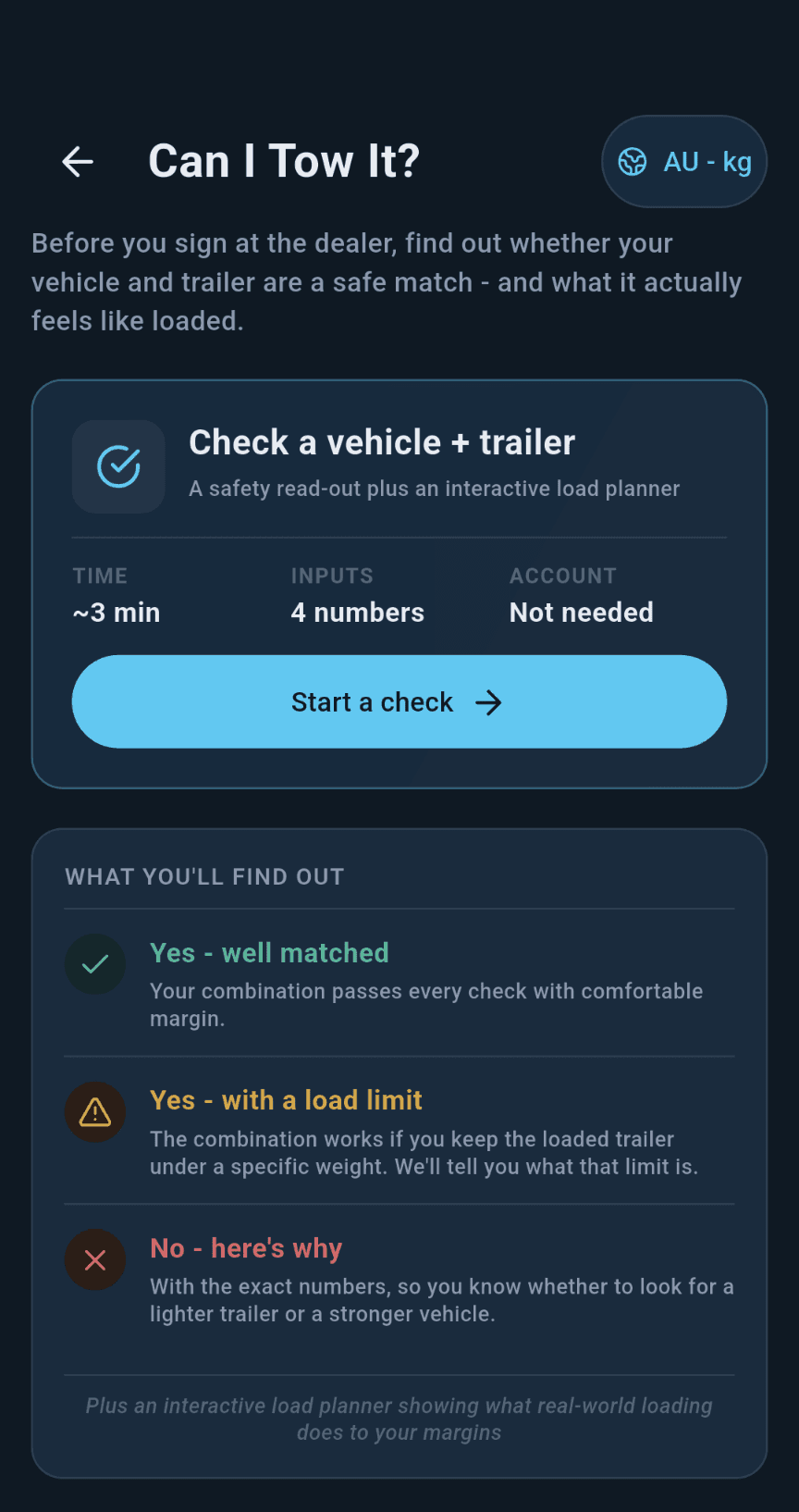
Get the answer before you commit
Choose a tow vehicle and a van; loadmate returns a clear verdict (pass, caution or fail) with the reasons behind it. Load it up and the margins move with you. Free in the app.


Frequently asked questions
- What does MTPLM stand for?
MTPLM stands for Maximum Technically Permissible Laden Mass — the caravan's absolute maximum legal weight when fully loaded, set by the manufacturer and stamped on the weight plate. It includes the user payload, all fluids and your personal belongings. It is also called the caravan's MAM.
- What's the difference between MiRO and MTPLM?
MiRO (mass in running order, now usually written MRO) is the caravan's empty factory weight on the weight plate. MTPLM is the maximum laden weight it may reach. The gap between them — MTPLM minus MiRO — is your user payload, the weight you are allowed to add.
- Is MTPLM the same as MAM?
Yes. The caravan's MTPLM is its MAM (maximum authorised mass). The catch is that the tow car's maximum gross weight is also called its MAM, so when a source says MAM, check whether it means the caravan or the car.
- How do I calculate my caravan's user payload?
Subtract the MiRO from the MTPLM. For example, an MTPLM of 1,500 kg and a MiRO of 1,250 kg leave 250 kg of payload. That allowance has to cover your belongings, dealer-fitted options, a retailer-fitted leisure battery, the awning, any motor mover and the water you carry.
- What's included in my caravan's MiRO (MRO)?
For an NCC-Approved caravan built from 2011, MiRO includes a basic-equipment allowance such as a gas bottle and the electrical hook-up cable — not the bare shell. Since 2015 manufacturers state the fresh water in MiRO, and most include zero, so a full tank usually comes out of your payload. Older caravans differ; check the handbook.
- Where do I find my caravan's MTPLM and MiRO?
Both are stamped on the caravan's weight plate, normally near the entrance door or inside the gas locker, and repeated in the handbook. Payload is not printed anywhere — you work it out from MTPLM minus MiRO.
- What happens if my caravan is over its MTPLM?
DVSA can issue an immediate prohibition notice at the roadside and may immobilise the vehicle, and a car with a trailer can be prohibited as two separate units. Graduated fixed penalties apply — £100, £200 or £300 by the percentage over — and serious overloading draws a court summons. Overloading can also affect an insurance claim.
- Is the 85% rule a legal limit?
No. The 85% rule is the caravan industry's recommendation for less experienced drivers — keep the caravan's MTPLM to no more than 85% of the tow car's kerbweight, rising towards 100% with experience. The legal limits, including the combined MAM against the car's gross train weight, always take precedence.