Weighing a caravan at a weighbridge, at a glance
- What a weighbridge gives
- A measured weight of whatever sits on the platform, on a printed ticket — the loaded reality the weight plate only states as a limit
- Why it takes passes
- One deck reads one configuration, so the gross, the car and the caravan axle each need a different drive-on; noseweight is a subtraction
- The drive-on sequence
- 1) whole outfit hitched → gross; 2) car only, van reversed off but still coupled → car-with-noseweight; 3) car alone, uncoupled
- Caravan axle load
- Gross minus car-with-noseweight (on the worked rig, 3,890 − 2,395 = 1,495 kg) — not the true laden weight
- Noseweight
- Car-with-noseweight minus car-alone (2,395 − 2,300 = 95 kg), the part the towball carries
- True laden weight
- Caravan axle load plus noseweight (1,495 + 95 = 1,590 kg) — this is what you check against MTPLM
- Where to find one
- GOV.UK's find-a-weighbridge service; most are run by private businesses, so call ahead about cost, access and hours
- If you are over
- DVSA can issue an immediate prohibition and graduated fixed penalties (£100 / £200 / £300 by percentage over); overloading affects cover
The weight plate on your caravan states the limits. It cannot tell you whether you are under them, because the figure that matters is how the van weighs once it is loaded the way you tow it, and only a scale reads that. A public weighbridge is one flat platform, so your real car, caravan, axle and noseweight figures fall out of a short sequence of drive-on passes plus one subtraction. Get the sequence wrong and a van that is over its MTPLM can read as legal, which is the trap this guide is built around.
How do you weigh a caravan at a weighbridge?
You take three drive-on passes on one platform and do one subtraction, because a weighbridge only reads what is resting on the deck at that moment. The figures you need — the gross outfit, the car on its own, the caravan's axle load and the noseweight — describe different things, and a single deck cannot show them all at once. Fill the car's fuel tank before you set off, since a full tank is roughly 50 kg and you want every drive-on to reflect how you actually travel.
The sequence runs in three passes, illustrated with one worked outfit throughout this guide (a composite, not a real registered car or caravan):
- Whole outfit, hitched, every wheel on the platform reads the gross weight: 3,890 kg.
- Drive forward so only the car's wheels are on the deck, the caravan reversed off but still coupled. The towball still carries the nose, so this is the car including noseweight: 2,395 kg.
- Uncouple and weigh the car alone, unhitched: 2,300 kg.
From those three numbers, two more fall out by subtraction. The caravan's axle load is the gross minus the car-with-noseweight: 3,890 − 2,395 = 1,495 kg. The noseweight is the car-with-noseweight minus the car alone: 2,395 − 2,300 = 95 kg — the download the towball was carrying on the second drive-on and lost on the third. Neither of those is the figure you check against MTPLM, which is the catch the next section covers.
Why does a hitched caravan read lighter than it really is?
A caravan weighed while still hitched puts only its axle load on the deck — the noseweight is being carried by the car — so the platform reads less than the van's true laden weight. On the worked outfit the caravan axle load is 1,495 kg. That looks 5 kg under the 1,500 kg MTPLM, so a quick glance at the plate and a single hitched reading both say the van is fine — but add the 95 kg of noseweight back and the true laden weight is 1,590 kg, 90 kg over the 1,500 kg MTPLM, a 6.0% breach.
This is the reading trap, and it catches careful people. The caravan's true laden weight is its axle load plus the noseweight it hands to the car: 1,495 + 95 = 1,590 kg. You can reach the same number a second way — gross minus the car alone, 3,890 − 2,300 = 1,590 kg — which is a useful cross-check that your passes are consistent. The lesson is that the figure to compare against MTPLM is the true laden weight, never the lone hitched reading.
| Reading | What sits on the platform | Worked rig | What it is good for |
|---|---|---|---|
| Caravan axle load (hitched) | The van's wheels only; the car carries the noseweight | 1,495 kg | A part figure — reads light, never check MTPLM against it |
| True laden weight | The whole loaded van, noseweight added back | 1,590 kg | The figure you check against the 1,500 kg MTPLM |
What the weight plate tells you versus what the weighbridge tells you
The plate states the manufacturer's limits; the weighbridge measures whether your loaded outfit is under them. The two answer different questions, and the gap between them is the whole reason to drive to a weighbridge. The plate near the caravan door carries the MTPLM and MiRO; the car's plate and VIN plate carry its MAM and gross train weight (GTW). None of those numbers moves when you pack the van, fit a motor mover or fill the water tank — but your real weight does, and the weighbridge is the only place it shows up.
| Source | What it gives you | What it cannot tell you |
|---|---|---|
| The weight plate | The fixed legal limits: MTPLM, MiRO, the car's MAM and GTW | What your outfit actually weighs as you load it |
| The weighbridge | The measured loaded weights: gross, car, caravan axle, noseweight | The limits themselves — you bring those to compare |
For what those plate figures mean and how they relate, the UK caravan weights pillar walks through MTPLM, MiRO, MAM and payload in full. The weighbridge is where you put those limits to the test.
Reading the ticket against your four limits
Once you have the measured weights, you check four limits at once — and on this worked outfit exactly one is breached. The weighbridge hands you the numbers; the comparison against your plate is the job that turns a ticket into a verdict.
- Caravan true laden 1,590 kg against MTPLM 1,500 kg — over by 90 kg (6.0%). This is the breach, and it is past the 5% leeway a DVSA examiner may allow, sitting in the under-10% band that carries a £100 fixed penalty — over the legal MTPLM either way. It is the figure the single hitched reading hides: the 1,495 kg axle load looks 5 kg under the limit until the 95 kg of noseweight goes back on, which is the trap the section above set out.
- Car against its MAM. Unhitched the car is 2,300 kg, comfortably under the 2,450 kg MAM with 150 kg in hand. Hitched, the towball download lifts it to 2,395 kg — still under, but only 55 kg in hand, because the nose eats into the car's own MAM.
- Outfit gross against gross train weight. The gross is 3,890 kg against a GTW of 4,200 kg, 310 kg clear. As a pre-trip ceiling, the car's MAM plus the caravan's MTPLM is 2,450 + 1,500 = 3,950 kg, under 4,200 kg, so the pairing is legal on paper.
- Noseweight against the towball limit. The measured 95 kg is under the 100 kg towball maximum, and at about 6% of the 1,590 kg true laden weight it sits inside the 5–7% guidance band. For what that band means and which physical limit caps the noseweight, see the deep dive on caravan noseweight.
The caravan also weighs 1,590 kg against the car's 2,000 kg braked towing limit, well within range. So three of the four limits hold with room to spare, and the rig still fails — on the one figure the hitched reading hid. That is why you add the noseweight back rather than trusting the number on the deck.
How do you find a weighbridge in the UK, and what does it cost?
GOV.UK runs a find-a-weighbridge service, and a caravan is covered as a trailer or other vehicle. The page describes it as finding your nearest weighbridge if you need to weigh your van, lorry, trailer, tractor or other vehicle. Most weighbridges are operated by private businesses, so GOV.UK tells you to contact the operator before going to check how much it costs, how to get there and the operating hours.
Cost is a small, operator-set fee that varies from site to site — some self-service bridges are free and charge only for a printout — so there is no single national figure; call ahead. A category-B car licence tows a trailer up to 3,500 kg MAM; the licence detail belongs to the caravan weights pillar rather than the weighbridge trip. When you ring, confirm the platform is long enough to take the whole outfit in one go and that you can move forward and uncouple on site, because the sequence above depends on both.
What does a weighbridge ticket prove?
A public weighbridge is a certified weighing platform, and the ticket is the operator's written statement of the weight found — independent, dated evidence that a plate cannot give. Public weighbridges are regulated under the Weights and Measures Act 1985; the operator holds a certificate of competence and keeps records, and you leave with a printed statement of the weights rather than a number you wrote down yourself. That makes the ticket a stronger record than your own estimate when you want to prove what the outfit weighed on the day.
It is evidence of weight, not a certificate of compliance. The ticket records what your loaded outfit weighed once; it does not waive any limit, and your weight changes the moment you fill a tank, repack or fit something new. Use it to check your figures against the limits, then reweigh when the load changes materially.
Should you weigh the caravan loaded or empty?
Weigh it loaded the way you tow, because that is the weight a roadside check measures against MTPLM and the other limits. An empty or near-empty weigh tells you almost nothing about whether your travelling outfit is legal — the worked rig's 1,590 kg breach only appears once the van is packed. Weigh it brimmed and loaded, fuel tank full, and you see the figure that actually matters.
There is a second, narrower reason to weigh near-empty: to verify the van's MiRO and work out your real user payload. If you want to know how much weight the factory figure leaves you, a near-empty weigh against the published MiRO answers that. For the trip itself, though, the loaded weigh is the one to act on.
How loadmate helps you stay under your limits
The weighbridge supplies the measured numbers. On this worked outfit, comparing them with the plates reveals a caravan 90 kg over MTPLM, the breach the hitched reading hid. loadmate connects a recorded weigh-in with later load changes, so the water and luggage added before the next trip can be reviewed against that baseline. Explore loadmate in the app to see how the ticket stays useful between weighbridge visits.
loadmate provides decision support for towing safety, not legal weight certification. Score, compliance checks, and trip readiness are based on the data you enter and the regulator information current at the time of release. For legal weight evidence, use a certified weighbridge. Towing remains the operator's responsibility. See /safety-disclaimer.
What happens if the weighbridge shows you are overweight?
If a roadside check finds you over a limit, DVSA can issue an immediate prohibition and a graduated fixed penalty, set by how far over you are. The examiner will also prevent the vehicle going any further. The fixed-penalty bands are layered: less than 10% over is £100; 10% up to but not including 15% is £200; 15% and over is £300. On the worked outfit the caravan is 6.0% over its MTPLM, which sits in the first band — a £100 fixed penalty is on the table.
Separately from those bands, DVSA examiners allow a 5% leeway before issuing a fixed penalty or prohibition, unless the relevant weight has been exceeded by 1 tonne or more. The worked rig's 6.0% is past that leeway, so it does not save it. Serious overloading — 30% and over, or 5 tonnes of excess — draws a court summons instead of a fixed penalty. Overloading can also affect an insurance claim, which is one more reason to find a breach at a weighbridge rather than at the roadside.
Related guides
Once you have your weighbridge figures, these companion guides tell you what to do with them:
- MTPLM, MiRO, MAM and Payload Explained — the pillar that explains the plate limits you are checking your measured weights against (start here).
- Caravan noseweight: how to measure, set and stay legal — the 95 kg you derived here, set properly at home: the 5–7% band and the lowest-of-four cap.
- How to load a caravan: axle weights and noseweight — once the scales show a breach, where to move weight to fix the noseweight and the axle load.
- Can my car tow a caravan? Tow-car matching and the 85% rule — checking your weighed laden figure against the kerbweight ratio and the rest of the matching test.
Turn an estimate into a measured number
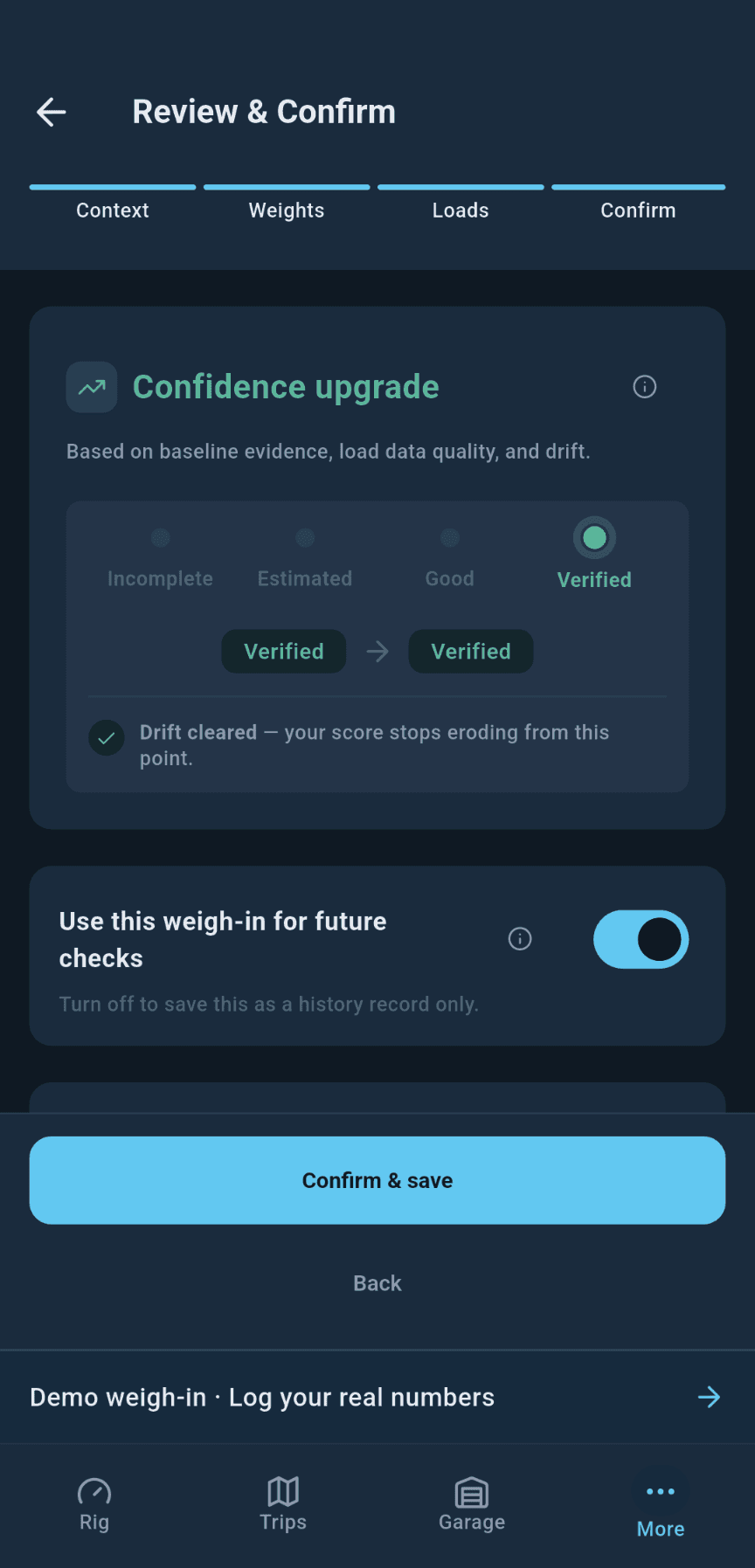
Log a weighbridge ticket and loadmate recalculates from your measured weights. The ticket is a snapshot; loadmate tracks what changes after it, so the verified baseline stays useful between weighs. Create a free account to explore it on a populated demo rig in the app.


Frequently asked questions
- How do you weigh a caravan on a weighbridge?
You take three passes on one platform. Weigh the whole outfit hitched for the gross weight, drive forward so only the car is on the deck with the van reversed off but still coupled for the car-with-noseweight figure, then uncouple and weigh the car on its own. Fill the car's fuel tank first so every drive-on reflects how you actually tow.
- How do you work out noseweight from a weighbridge?
Subtract the car weighed alone from the car weighed with the caravan still coupled. On the worked outfit that is 2,395 − 2,300 = 95 kg, the download the towball was carrying. You can reach the same figure by taking the caravan's true laden weight minus its hitched axle load.
- Why might a weighbridge reading make a legal-looking caravan overweight?
A caravan weighed while hitched reads only its axle load, because the car is carrying the noseweight. Add the noseweight back to get the true laden weight. On the worked outfit the hitched axle load is 1,495 kg, which looks under the 1,500 kg MTPLM, but adding 95 kg of noseweight gives 1,590 kg — 90 kg over.
- Where can I find a weighbridge in the UK?
Use GOV.UK's find-a-weighbridge service, where a caravan is covered as a trailer or other vehicle. Most weighbridges are run by private businesses, so contact the operator before you go to check the cost, how to get there and the operating hours.
- How much does it cost to weigh a caravan?
A small fee that varies by operator — some self-service bridges are free and charge only for the printout. There is no single national figure, so call ahead to confirm the cost along with access and opening hours.
- What is a public weighbridge, and what does the ticket prove?
A public weighbridge is a certified weighing platform regulated under the Weights and Measures Act 1985; the operator holds a certificate of competence and gives you a written statement of the weight found. The ticket is independent, dated evidence of what your outfit weighed — proof a plate cannot give. It records the weight, not legal compliance.
- What happens if the weighbridge shows I'm overweight?
At a roadside check DVSA can issue an immediate prohibition and prevent the vehicle going further, with graduated fixed penalties of £100, £200 or £300 by the percentage over. Examiners allow a 5% leeway unless the excess reaches 1 tonne, and serious overloading — 30% or more, or 5 tonnes — draws a court summons. Overloading can also affect an insurance claim.
- Do I need to empty the caravan before weighing?
No. Weigh it loaded the way you tow, because that is the weight checked against MTPLM and the other limits. Weigh it near-empty only if you want to verify the MiRO and work out your real user payload — for the trip itself, the loaded weigh is the one that matters.