Caravan loading at a glance
- The rule that matters
- Placement, not just total weight, decides the noseweight and the axle load. Two vans at the same MTPLM can sit very differently.
- Where the heavy gear goes
- Low and as close to the axle as you can, evenly side to side; club and maker guidance says within roughly 60 cm of the axle line. (Guidance.)
- Axle rating
- The running gear has its own maximum mass for each axle, stamped on the manufacturer's weight plate — a separate ceiling from the MTPLM.
- Single-axle van
- The axle is plated at or above the MTPLM and the car carries the noseweight, so bad placement bites the noseweight limit or starves the nose first.
- Twin-axle van
- Each axle is plated separately and must not be individually exceeded, whatever the gross — so one axle can go over while the gross is still legal.
- Noseweight band
- Aim for about 5–7% of the caravan's laden weight; too far forward overloads the towbar, too far rear starves the nose and invites snaking. (Guidance.)
- Where to read the limits
- The caravan's manufacturer weight plate (near the door or in the gas locker) lists the laden mass and the maximum mass on each axle, front to rear.
- If you exceed a limit
- DVSA weighs each axle in turn and can issue an immediate prohibition; graduated fixed penalties apply (£100 / £200 / £300 by percentage over).
Two owners pack the very same kit for the very same caravan, both bang on the MTPLM the manufacturer stamped on the plate. One stows the awning and the leisure battery just ahead of the wheels; the other piles them in the rear locker. Same total weight, two different stowage plans — and two different verdicts at the towball and the axle. The figure that separates them is not stamped on the plate; it is where the weight ends up relative to the axle.
How do you load a caravan correctly?
Load the heaviest items low and close to the axle, spread evenly from side to side, then keep lighter things forward and back of that so the noseweight lands in the 5–7% band. The axle is the van's balance point. Weight stowed ahead of it presses the hitch down and adds noseweight; weight behind it lifts the hitch and shifts load onto the axle. Get the heavy gear sitting over or just forward of the axle and both numbers settle where you want them.
A useful order of operations:
- Heaviest items low, over or just ahead of the axle — the awning, a full toolbox, the leisure battery if it is portable, a motor mover. These are the items that swing the figures most, so they belong nearest the balance point.
- Medium-weight items low and central — food, crockery, the toilet chemicals, under the seats and in floor lockers rather than overhead.
- Light items high and in the end lockers — bedding, clothes, towels. They barely move the figures, so the spots that are wrong for heavy gear are exactly where light items can go.
- Balance left and right — a heavy item all on one side loads one wheel and one side of the running gear harder than the other, even when the front-to-back picture looks fine.
The Caravan and Motorhome Club and the caravan makers put the heavy-low-over-the-axle advice as loading guidance for stability, not as a legal figure. It works because it keeps the weight near the fulcrum, where it disturbs neither the noseweight nor the axle load much. The terms behind the limits — MTPLM, MiRO and your user payload — are decoded in the UK caravan weights pillar; this page is about where that payload sits once you have it. The 5–7% target the placement aims for, and how to measure it, is covered in full in our guide to caravan noseweight.
Does a caravan's axle have its own weight limit?
Yes. The running gear is plated with a maximum mass for each axle, and that is a separate ceiling from the MTPLM. Retained GB law (EU Regulation 19/2011, kept on the statute book after Brexit) requires the manufacturer's plate to show, among other figures, "the technically permissible maximum mass on each axle listed in order from front to rear". GOV.UK's plating guidance says the same: a plate must display the maximum axle, gross and train weights at which the vehicle is designed to operate. For a touring caravan you read it on the manufacturer's weight plate near the door or inside the gas locker; the heavier, MOT-class trailers carry a DVSA ministry plate as well.
The axle weight is enforced in its own right, not only as part of the gross. GOV.UK's consolidated code of practice for enforcement weighing has each axle weighed statically in turn, with measurement tolerances of about ±50 kg on a static axle weigher and ±100 kg on portable weighpads. Those tolerances are allowances for the equipment, not permission to run over a plated axle limit. So the relevant weight a roadside check measures includes each plated axle weight, not just the all-up figure.
What the axle rating does not mean is that you can quietly overload it while staying under the MTPLM — and how that plays out depends entirely on whether the van has one axle or two.
| Number | What it limits | Where you read it |
|---|---|---|
| MTPLM | The caravan's maximum laden mass — the all-up legal ceiling | The manufacturer's weight plate |
| Axle weight | The maximum mass the running gear may carry on each axle | The same plate, listed for each axle from front to rear |
| Noseweight | The downward force the loaded hitch puts on the car's towball | The lowest of the car, towbar, drawbar and hitch limits |
One heavy item, three places: the placement swing
Hold the laden mass fixed at the MTPLM, move one heavy item across the axle line, and the noseweight swings while the MTPLM never changes — that single move is what decides legality. This is the controlled experiment that makes placement concrete. It runs on a single-axle illustrative van (a composite, not a real model): an MTPLM of 1,400 kg, a MiRO of 1,150 kg and so a user payload of 250 kg, a single axle plated to 1,450 kg, and a lowest noseweight limit of 100 kg. Throughout, the axle carries everything except the noseweight the car takes, so axle load = laden mass − noseweight.
The item being moved is a 50 kg load — say the awning packed with the leisure battery.
- Plan A — loaded correctly, just ahead of the axle. Noseweight 90 kg (6.4% of 1,400 kg, inside the band). Axle load 1,400 − 90 = 1,310 kg, well under the 1,450 kg rating. The MTPLM sits at 1,400 kg, at the ceiling but not over. Legal and stable.
- Plan B — that 50 kg piled at the front locker. Noseweight 90 + 50 = 140 kg, which is 40 kg over the 100 kg towbar limit. The axle actually gets lighter at 1,400 − 140 = 1,260 kg. The MTPLM is unchanged at 1,400 kg. The breach is the noseweight, not the axle.
- Plan C — that 50 kg in the rear locker. Noseweight 90 − 50 = 40 kg, only 2.9% of the laden weight, well below the safe band. The axle is 1,400 − 40 = 1,360 kg, still under its rating. The MTPLM is unchanged. The danger here is snaking from a starved nose, not an axle ticket.
Moving one 50 kg item across the axle line swings the noseweight by ±50 kg — from 40 kg too far rear to 140 kg too far forward, with 90 kg correct — while the axle barely moves and the MTPLM never changes at all. (The figures are illustrative and modelled as a straight transfer; the real noseweight change depends on how far the item sits from the axle. The direction is what holds.)
The honest lesson for a single-axle van is the one people get wrong. Because the axle is plated above the MTPLM and the car is carrying the noseweight, the axle has headroom to spare. On a correctly-MTPLM'd single-axle van, you reach the noseweight or towbar limit, or you starve the nose into instability, long before the axle gets anywhere near its rating.
| Plan | Noseweight | Axle load | What gives way |
|---|---|---|---|
| A — over/ahead of axle | 90 kg | 1,310 kg | Nothing — legal and stable |
| B — too far forward | 140 kg | 1,260 kg | Noseweight: 40 kg over the 100 kg towbar limit |
| C — too far rear | 40 kg | 1,360 kg | Stability: nose too light, snaking risk |
Single axle versus twin axle: how the load splits
On a single-axle van bad placement bites the noseweight first; on a twin-axle van it can put one axle over its own limit while the gross is still legal. That difference is the whole reason the two need separate treatment. A single axle is plated at or above the MTPLM, so it never reaches its rating on a legally-laden van. A twin-axle van is built differently: each of its two axles is plated separately and must not be individually exceeded, so you have to keep each axle under its own limit and the gross under the MTPLM. Because load can shift between the two axles, each is rated to carry more than an even half-share — so it is the per-axle figure, not half the gross, that you check against.
Here is a second, twin-axle illustrative example (again a composite, not a real model): an MTPLM of 1,800 kg, a front axle and a rear axle each plated to 1,000 kg in this illustrative example, with the noseweight near 108 kg. With the noseweight taken by the car, the two axles share 1,800 − 108 = 1,692 kg.
- Balanced — load spread evenly fore and aft, the two axles carry about 846 kg each. Both are under 1,000 kg, the gross is 1,800 kg at the MTPLM, the noseweight is in band. Legal.
- Rear-loaded — concentrate the heavy gear over and behind the rear axle, shifting about 164 kg of the split rearward. The rear axle now carries 846 + 164 = 1,010 kg, which is 10 kg over its 1,000 kg rating. The front axle drops to 682 kg. The two still sum to 1,692 kg, the gross is 1,800 kg at the MTPLM, and the noseweight is still 108 kg in band. The rear axle is over its plated limit while every other check passes.
That is the genuine case where the axle ceiling bites under a legal MTPLM, and it is twin-axle only. The same logic applies side to side on either type of van: pile the weight on one side and you can load one wheel and one side of the running gear past its share while the all-up weight stays legal.
| Layout | Per-axle ceiling vs MTPLM | What bad placement breaks first |
|---|---|---|
| Single axle | One axle, plated at or above the MTPLM | The noseweight/towbar limit, or a starved nose (snaking) |
| Twin axle | Two axles, each plated separately and not to be individually exceeded | One axle over its own limit while the gross stays legal |
How loadmate helps you stay under your axle and noseweight limits
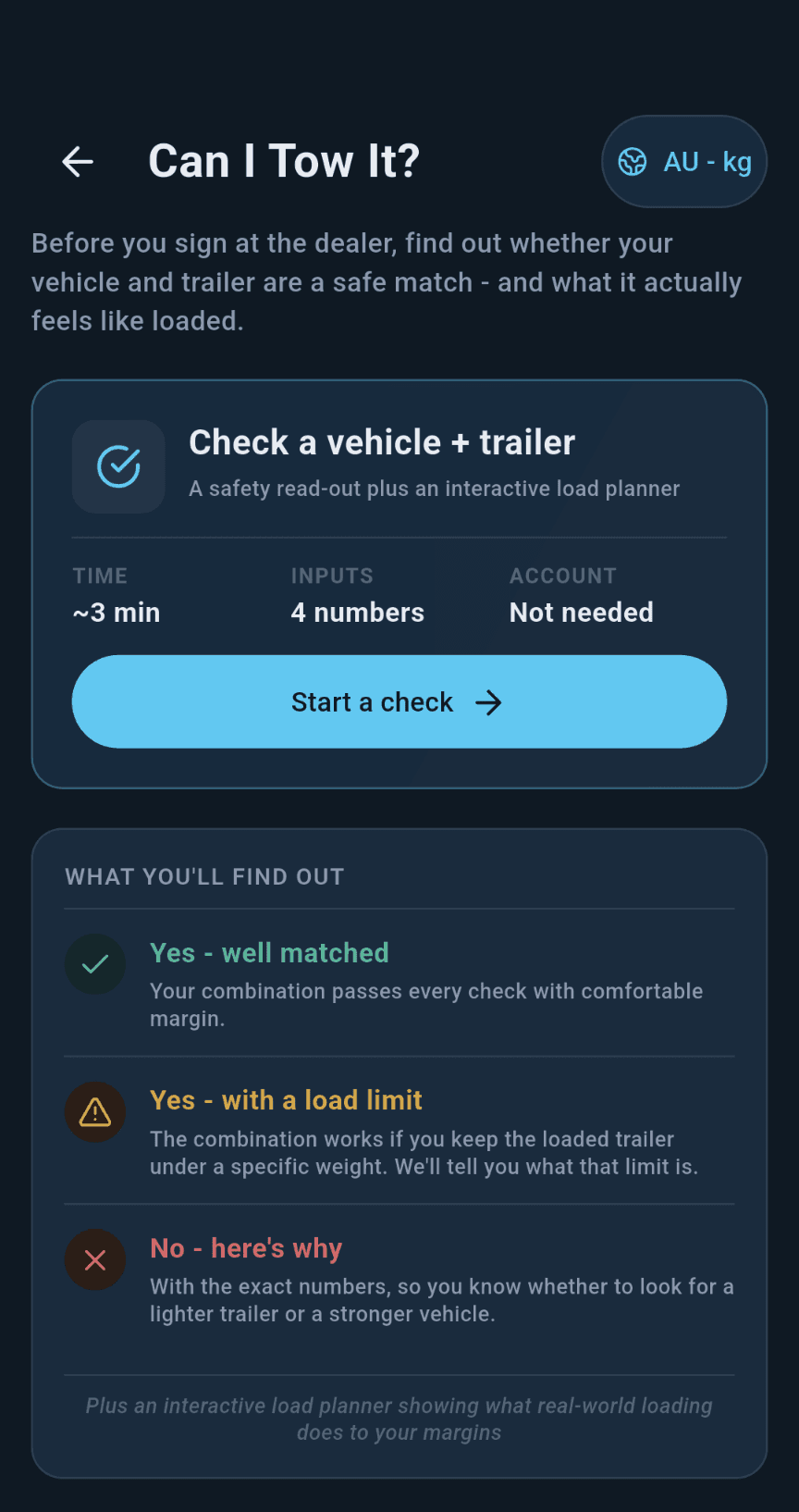
You now know that placement, not just total weight, sets the noseweight and the axle load — and that the limit which bites depends on whether your van has one axle or two. The question a guide cannot answer is whether the loaded figures for your own outfit actually fit: does the laden MTPLM you are aiming for, with the noseweight it produces, sit inside your car and towbar limits? Can I Tow It? in the loadmate app settles that. You enter the caravan's loaded weight and noseweight alongside the car's towing limit, its loaded limit and its noseweight limit, and it runs the match across each check, then tells you whether the outfit is within its limits or over and which check is tight.
The weight picture depends on the figures you record; confirming the real axle split remains a job for the scales. loadmate connects a measured baseline with later changes to water, luggage and load placement, so you can review what has changed before towing. Explore loadmate in the app to see how packing affects the outfit beyond its total weight.
loadmate provides decision support for towing safety, not legal weight certification. Score, compliance checks, and trip readiness are based on the data you enter and the regulator information current at the time of release. For legal weight evidence, use a certified weighbridge. Towing remains the operator's responsibility. See /safety-disclaimer.
Related guides
Where you put the weight is half the story; these guides cover the numbers it moves:
- MTPLM, MiRO, MAM and Payload Explained — the pillar behind the payload you are placing: what the MTPLM, MiRO and axle figures on the plate actually mean.
- Caravan noseweight: how to measure, set and stay legal — the towball-download side of placement: dialling the noseweight into its band and against the towbar limit.
- How to weigh a caravan at a public weighbridge — how to weigh each axle so you can confirm the per-axle split this guide models rather than estimate it.
- Can my car tow a caravan? Tow-car matching and the 85% rule — the pairing decision that comes before loading: choosing a caravan your car can carry well.
Get the answer before you commit
Choose a tow vehicle and a van; loadmate returns a clear verdict (pass, caution or fail) with the reasons behind it. Load it up and the margins move with you. Free in the app.


Frequently asked questions
- How do you load a caravan correctly?
Put the heaviest items low and as close to the axle as you can, spread evenly from side to side, then keep lighter things forward and back of that so the noseweight lands in the 5–7% band. The axle is the van's balance point: weight ahead of it adds noseweight, weight behind it lifts the nose and loads the axle. Stay under the MTPLM, the axle rating and the towbar noseweight limit at once.
- Can you overload a caravan's axle if it's still under the MTPLM?
On a single-axle van, no. The axle is plated at or above the MTPLM and the car carries the noseweight, so you hit the noseweight limit or starve the nose into snaking before the axle reaches its rating. On a twin-axle van, yes: each axle is plated separately and must not be individually exceeded, so concentrating load over one axle can put it over its own limit while the gross stays legal.
- Where should the heavy items go in a caravan?
Low and as close to the axle as possible, kept within roughly 60 cm of the axle line and balanced left to right. Medium items go low and central under the seats; light items such as bedding go high and in the end lockers. This is club and maker guidance for stability, not a legal figure.
- What happens if you load a caravan too far to the rear?
The noseweight drops too low, which makes the outfit prone to snaking and instability. On the single-axle example, moving a 50 kg item to the rear locker drops the noseweight from 90 kg to 40 kg, below the safe 5–7% band. On a twin-axle van, rear-loading also shifts weight onto the rear axle and can put it over its own plated limit.
- Does a caravan's axle have its own weight limit, separate from the MTPLM?
Yes. Under retained GB law (EU Regulation 19/2011, kept after Brexit) the manufacturer's plate must show the technically permissible maximum mass on each axle, listed front to rear. That per-axle figure is a separate ceiling from the MTPLM, read on the same weight plate.
- Where is my caravan's axle weight shown?
On the caravan's manufacturer weight plate, normally near the entrance door or inside the gas locker. The plate lists the maximum laden mass and the maximum mass on each axle from front to rear; heavier MOT-class trailers also carry a DVSA ministry plate.
- Is an overloaded axle a separate offence from being over the MTPLM?
DVSA weighs each axle statically in turn, so the relevant weight a check measures includes each plated axle weight, not just the all-up figure. Graduated fixed penalties apply by how far over you are — £100 under 10%, £200 from 10% to under 15%, £300 at 15% or more — and an examiner can issue an immediate prohibition.
- How is the load split on a twin-axle caravan, and can one axle be over while the total is legal?
Yes. Each axle is plated separately and must not be individually exceeded, so you keep each axle under its own limit and the gross under the MTPLM. On the twin-axle example, rear-loading puts the rear axle at 1,010 kg, over its 1,000 kg rating, while the gross stays at the legal 1,800 kg MTPLM.