Silverado 1500 towing at a glance
- Scope
- 2026 US Silverado 1500, conventional towing
- Published comparison range
- 8,700–13,300 lb across configurations; an individual truck's allowance can be lower
- 8,700 lb configuration
- 3.0L diesel ZR2, Crew Cab, short bed, 4x4
- 13,300 lb configuration
- 3.0L diesel, Double Cab, standard bed, 2WD, Max Trailering Package and required 20-inch wheels
- GCW Alert, if equipped
- An estimate of combined weight after driving, with the feature enabled and enough driving data
- Separate checks still needed
- Loaded truck, front and rear axles, complete trailer, trailer axles and tongue/hitch limits
- Your truck's starting record
- Trailering Information Label, occupant-and-cargo allowance, loaded truck limit and axle ratings, paired with actual loaded weights
Sources checked October 16, 2026: Chevrolet's 2026 model chart, 2026 Trailering Guide v2, pp. 26–27, and 2026 towing supplement, pp. 6–9.
How much can a Chevy Silverado 1500 tow?
The published 2026 conventional-towing maxima run from 8,700 lb for the diesel ZR2 Crew Cab short-bed 4x4 to 13,300 lb for the diesel Double Cab standard-bed 2WD with Max Trailering and the required 20-inch wheels. Both are specific configurations in Chevrolet's 2026 chart. The upper figure belongs to that one build, not to every diesel Silverado.
Match your engine, cab, bed, drive layout and towing equipment to the model-year chart, then read your own Trailering Information Label. The range is made of published maxima, so a loaded truck's usable allowance can fall below 8,700 lb. The US towing capacity chart compares other vehicles; the truck-and-trailer matching guide explains how the separate limits fit together.
This page covers the 2026 truck, which Chevrolet still lists with 2026 offers and buying links (checked October 16, 2026). The next-generation 2027 Silverado Chevrolet has announced has its own model-year figures. Silverado EV, HD trucks and fifth-wheel or gooseneck towing are outside this guide.
What does a Silverado's GCW Alert actually check?
If equipped, GCW Alert estimates the combined weight of the loaded truck and trailer once you've driven; it doesn't check the individual weight limits. Chevrolet spells that out in the 2026 towing supplement, p. 7.
Owners have wondered how it gets that number. In a May 23, 2023 forum post, a Silverado owner in New York asked exactly that. Another owner, posting on June 23 about a 2022 Silverado, reported warnings after fitting air springs, with the trailer load described as unchanged. Those are owner accounts from older trucks. They don't show that the air springs caused the warnings, and they tell you nothing about how the 2026 system behaves.
On the 2026 truck, Chevrolet says the setting has to be enabled and the system needs enough driving data. It warns when its estimate of combined mass reaches the alert condition. Amber means confirm; red means you're likely over, and you still confirm. Either way, the manual says to stop safely and check actual weights at a scale, even if the trailer feels easy to pull.
| Information | What it tells you | What still needs checking |
|---|---|---|
| GCW Alert, if equipped and operating | A driving-data estimate of combined weight | Actual combined weight and the separate vehicle, axle, trailer and tongue limits |
| Truck and trailer labels | Ratings for the equipment you own | The weights of the trip as loaded |
| Measurements of that loaded setup | Weight at the time and in the hitch condition measured | Whether later load or equipment changes have altered that setup |
Sources: Chevrolet's towing supplement, pp. 6–9, and measured baselines and recorded load changes.
What belongs in your Silverado's before-trip record?
Your truck's configuration and ratings, next to the weights of the loaded setup, with room to note what changes later. That way you know where each number came from: Chevrolet, your own label, a scale or a later entry.
Start with the Trailering Information Label for truck-specific trailering limits. The B-pillar Tire and Loading Information label supplies the combined occupant-and-cargo allowance; the Certification/Tire label gives the gross vehicle weight rating (GVWR) and front and rear gross axle weight ratings (GAWR). GVWR limits the loaded truck; gross combined weight rating (GCWR) limits the loaded truck and trailer together. Include added accessories and hitch hardware when recording what the truck carries. 2026 Silverado owner's manual, pp. 206–209, and towing supplement, pp. 6–9.
Chevrolet's conventional-trailer guidance is 10–15% of the total loaded trailer weight on the tongue. Boats and some other trailer types have different guidance, so follow that trailer's manual and its limits. The percentage is a target; any separate tongue-weight ceiling still applies. 2026 towing supplement, p. 8.
Here's one example record. The truck is a 2026 Silverado 1500 Crew Cab, short bed, 4x4, 3.0L diesel, without Max Trailering and not a ZR2. Chevrolet lists 9,000 lb maximum trailer weight and 15,000 lb GCWR for that chart row in both the model chart and annual guide, p. 27.
Only those two ratings come from Chevrolet. The label values, loads and scale readings below are made up to show the checks; use your own truck's. The example uses a conventional hitch with no weight distribution engaged, counts the hitch hardware in the truck's load, and assumes suitably rated hardware and brakes on both trailer axles.
| Example record entry | Assumed value | Annotation |
|---|---|---|
| Truck GVWR | 7,200 lb | Copy your actual rating from the truck |
| Front / rear GAWR | 3,800 / 3,800 lb | Each axle has its own limit |
| Unloaded, as-equipped truck | 5,500 lb | Assumed baseline, not a published diesel curb weight |
| Occupant-and-cargo allowance | 1,700 lb | Consistent here with 7,200 lb minus 5,500 lb |
| People, truck cargo, added equipment and hitch hardware | 1,000 lb | Counted once in the loaded truck |
| Loaded truck, unhitched | 6,500 lb | 5,500 lb plus 1,000 lb |
| Complete loaded trailer / trailer GVWR | 6,500 / 7,000 lb | Complete trailer weight includes its tongue load |
| Tongue load / applicable truck-and-hitch tongue ceiling | 780 / 900 lb | Assumed tongue load is 12% of 6,500 lb |
| Hitched front / rear truck axle readings | 3,500 / 3,780 lb | Assumed readings with no weight distribution engaged |
| Trailer axle readings / ratings | 2,860 / 3,500 lb on each of two axles | Assumed separate readings total 5,720 lb |
Note the hitch condition with the readings. Chevrolet requires a weight-distributing hitch above 7,000 lb trailer weight (2026 supplement, p. 11); the example's 6,500 lb trailer is under that, though your hitch and trailer may have their own requirements. The CAT scale ticket guide explains which readings to keep for your setup.
Can combined weight be under the limit while the truck is overloaded?
Yes. In this example the combination is 2,000 lb under its 15,000 lb GCWR while the hitched truck is 80 lb over its assumed 7,200 lb GVWR. Both results come from the same loaded state.
Add the assumed hitched front and rear readings: 3,500 lb plus 3,780 lb gives 7,280 lb on the truck. Add the trailer's 5,720 lb axle total and the combination is 13,000 lb. The alternative calculation agrees: 6,500 lb of loaded unhitched truck plus the complete 6,500 lb trailer equals 13,000 lb. Tongue weight is counted once in either calculation.
The same assumed 780 lb tongue load also counts against the truck's carrying allowance: 1,000 lb + 780 lb = 1,780 lb, which is 80 lb above the assumed 1,700 lb allowance. The 1,000 lb already includes people, truck cargo, equipment and hitch hardware.
| Check on the same example setup | Weight compared with its limit | Result |
|---|---|---|
| Loaded combination | 13,000 lb against Chevrolet's 15,000 lb GCWR | 2,000 lb below |
| Complete trailer against truck tow rating | 6,500 lb against Chevrolet's 9,000 lb rating | 2,500 lb below |
| Loaded hitched truck | 7,280 lb against assumed 7,200 lb GVWR | 80 lb over |
| Front axle | 3,500 lb against assumed 3,800 lb GAWR | 300 lb below |
| Rear axle | 3,780 lb against assumed 3,800 lb GAWR | 20 lb below |
| Tongue load | 780 lb against assumed 900 lb ceiling | 120 lb below |
| Trailer against its own GVWR | 6,500 lb against assumed 7,000 lb GVWR | 500 lb below |
| Each trailer axle | 2,860 lb against assumed 3,500 lb rating | 640 lb below on each |
That's a failed truck-weight check, and the spare combined allowance can't offset it. Assumed readings can't tell you whether GCW Alert would trigger; the point is that a combined-weight number leaves the other limits open, as Chevrolet says of the alert in the 2026 supplement, p. 7.
If your measured truck is over GVWR, change the load and recheck the truck and axle weights before you tow.
What changed since the setup was weighed?
Anything added, removed or moved since the weigh-in, and where it now sits. Without that, you can't tell whether a saved weight still describes this trip.
A Silverado owner's September 10, 2023 account describes trailer solar, inverter and battery changes alongside a loaded tongue weight above the trailer's published figure. It's one owner's report on an older truck, and it doesn't break down how much each change added.
Keep the original load list with the measurement, and date the last complete loaded setup. Note a replacement battery or new equipment with its weight and location, and note moves too: loadmate's load-change documentation separates changes in total weight from changes in distribution, because moving the same weight can shift distribution without changing the recorded weight difference.
How can loadmate keep the Silverado record useful?
A full weigh-in recorded with its linked loads gives loadmate a measured baseline for the changes you enter later. In the example, the 13,000 lb combined total came with an 80 lb truck overload; keeping the separate readings and their loads together is what lets you plan a revised setup.
After a full weigh-in that includes loads, Changes since shows moves, weight edits and removals, along with item history. A coupling-only reading doesn't give you that full baseline. You enter the changes yourself; opening the Rig tab refreshes the rig picture from the saved entries. Review load changes.
A newly recorded load that was absent from the weigh-in contributes its full entered weight to drift, the recorded difference from the measured baseline, until you reweigh, and a weight you type as an estimate stays an estimate. After your weigh-in.
Explore the loadmate app for your Silverado's recorded setup.
Before the next departure, fill the gaps in your own record: copy a blank tongue ceiling from the label, and enter the current weight and location of anything changed since the weigh-in. Leave any check without a rating or measurement open; a quiet GCW Alert can't close it.
loadmate provides decision support for towing safety, not legal weight certification. Score, compliance checks, and trip readiness are based on the data you enter and the regulator information current at the time of release. For legal weight evidence, use a certified truck scale / CAT scale. Towing remains the operator's responsibility. See /safety-disclaimer.
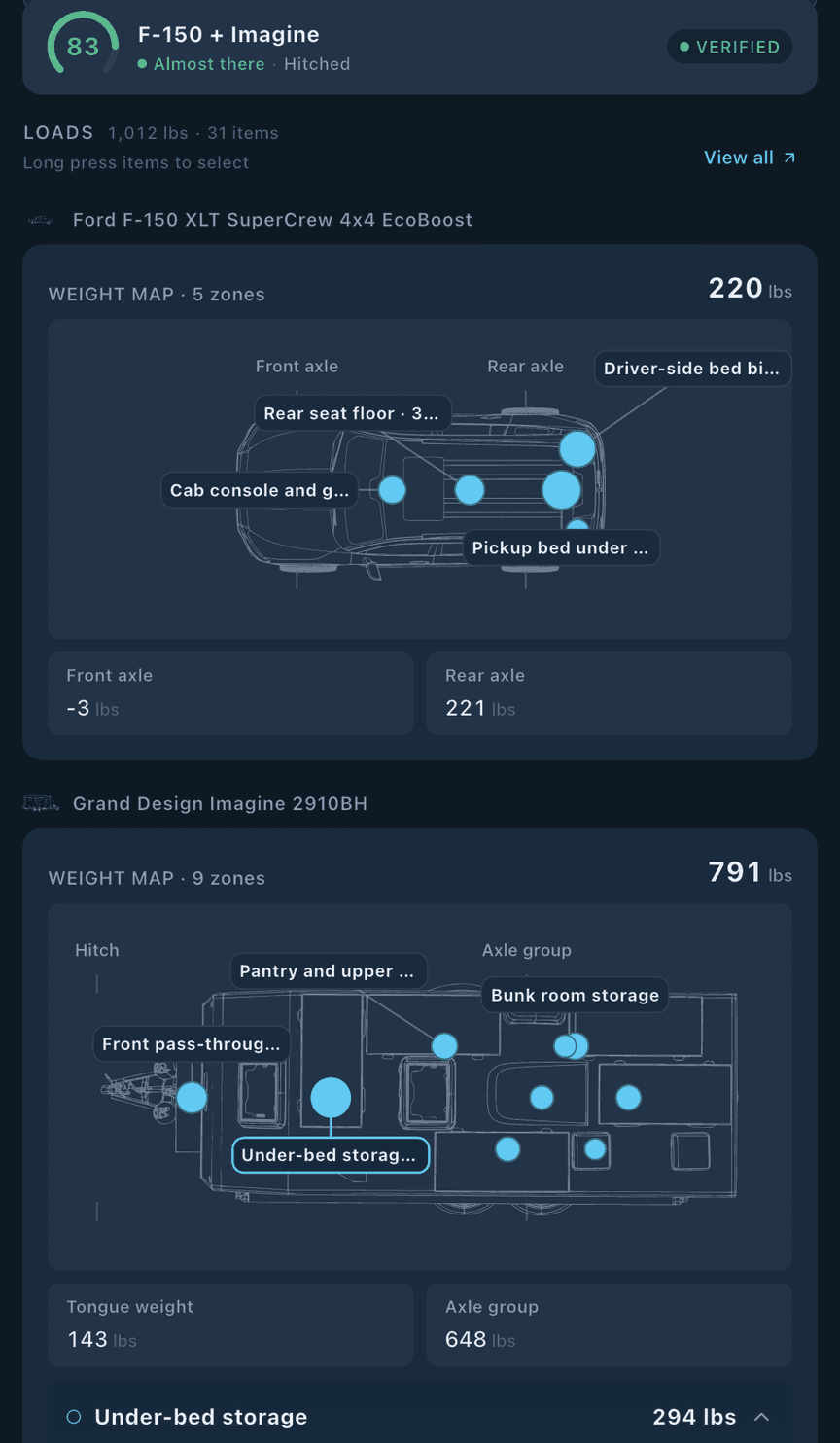
Keep the load record with your measured baseline
The Silverado example is 2,000 lb under its GCWR and 80 lb over its truck rating. Record your own full weigh-in with its loads in loadmate, then review the changes you enter later; typed estimates stay estimates. Screen shown: another US example's load map, not Silverado results or change history.


Related guides
- What can I tow?: compare the loaded truck and trailer with their separate limits.
- Read a CAT scale ticket: identify the truck and trailer axle readings used in the record.
- US towing capacity chart: compare vehicles with each maximum tied to its stated configuration.
Frequently asked questions
- How much can a Chevy Silverado 1500 tow?
Chevrolet's published 2026 US conventional-towing maxima span 8,700–13,300 lb. The low endpoint is the 3.0L diesel ZR2 Crew Cab short-bed 4x4. The high endpoint is the 3.0L diesel Double Cab standard-bed 2WD with Max Trailering and required 20-inch wheels. Your own truck's labels and loaded weights decide what it can use. Chevrolet's 2026 chart.
- Why does my Silverado show a combined-weight warning?
If equipped, the enabled 2026 GCW Alert system warns when its combined-weight estimate reaches the alert condition. It derives that estimate from vehicle data after sufficient driving. Stop safely when warned and confirm actual weights at a scale. The warning on its own doesn't diagnose a fault or check each separate weight limit. 2026 towing supplement, p. 7.
- Does no GCW warning mean my Silverado and trailer are within their limits?
No. The 2026 system, if equipped, estimates combined weight under its operating conditions; it doesn't check the truck, axle, trailer or tongue-load limits. Weigh the loaded rig and compare it with the ratings before you leave, warning or not. 2026 towing supplement, pp. 6–9.
- How do I tell if my Silverado has a Max tow package?
Check the truck's model-year build and equipment documentation for Max Trailering, then use its individual Trailering Information Label for the applicable ratings. A receiver and wiring on their own don't mean you have it: Chevrolet lists Z82 receiver and connector equipment separately from the Max Trailering conditions. 2026 Trailering Guide v2, pp. 26–27, and 2026 towing supplement, pp. 6–9.
- Can the diesel Silverado ZR2 tow 13,300 lb?
No. Chevrolet's 2026 comparison chart gives the 3.0L diesel ZR2 Crew Cab short-bed 4x4 an 8,700 lb conventional-towing maximum. The 13,300 lb figure belongs to a diesel Double Cab standard-bed 2WD with Max Trailering and required 20-inch wheels. Chevrolet's 2026 chart.
- When does a Silverado 1500 need a weight-distributing hitch?
Chevrolet's 2026 towing supplement requires a weight-distributing hitch above 7,000 lb trailer weight and makes it optional through 7,000 lb. Your hitch and trailer may add their own requirements. Follow Chevrolet's setup instructions and verify the rear axle after adjustment. 2026 towing supplement, pp. 9 and 11.