Sequoia towing at a glance
- Model covered
- 2026 US Sequoia i-FORCE MAX hybrid; 2027 is separately listed as upcoming
- Published range and conflict
- Current US table: 8,980–9,500 lb, Capstone 4WD to SR5 RWD. The 2026 manual and launch release say 9,520 lb; check your vehicle's documents
- Combined limit
- 15,600 lb GCWR in the 2026 manual and live table
- Loaded tongue guidance
- 9–11% of complete loaded trailer weight, within vehicle and component limits
- Trailer-brake threshold
- Toyota requires trailer brakes above 1,000 lb loaded trailer weight
- Changes that set gain to zero
- Changing the selected trailer ID or brake type
- 12-volt battery work
- Disconnecting and reconnecting resets gain data; Toyota doesn't say what value results
Sources checked October 16, 2026: Toyota's current US specifications, 2026 announcement, and Toyota's 2026 manual, printed pp. 242–248 and 477–480, hosted by Ownersman. Toyota's official manual selector identifies this publication as OM0C087U.
In July 2026, a 2024 Sequoia owner asked about weak-feeling trailer braking after moving an Aliner over from a Mazda with a different controller. The wiring had changed too, so the post doesn't point to a reset. It does raise a practical question: what needs checking when the trailer is familiar but its brake setup has changed?
How much can a Toyota Sequoia tow?
Toyota's current 2026 US table spans 8,980–9,500 lb, from Capstone 4WD to SR5 RWD; its 2026 manual and launch release list 9,520 lb. The 2026 brochure also says 9,500 lb. Until Toyota confirms which applies, go by your own vehicle's documents.
The manual's table, printed pp. 246–247, uses model code and seating; the website table uses grade and drive layout. Match the model code on your certification label in the manual and your build documentation, and ask Toyota to confirm the rating if they disagree.
These are 2026 figures and instructions. Toyota lists 2027 separately as upcoming; check that model's own documents when they're out.
To compare other vehicles, see the US towing capacity chart. Your own Sequoia also has a gross vehicle weight rating (GVWR), gross axle weight ratings (GAWR), a gross combined weight rating (GCWR), an occupant-and-cargo allowance and hitch limits; the what can I tow guide explains how they fit together.
Why check brake gain for a trailer I already saved?
A saved trailer profile doesn't mean the current gain setting suits today's tow. The 2026 Sequoia stores up to 10 trailer profiles, with fields that depend on installed systems. See profile settings, printed pp. 114–116, and the separate controller instructions, pp. 477–480.
Gain sets the controller's trailer-brake output; at zero, there's no output. Toyota treats these events differently:
| Event in the 2026 instructions | What happens or needs attention |
|---|---|
| Change trailer ID | Current gain resets to zero |
| Change brake type | Current gain resets to zero |
| Disconnect and reconnect the 12-volt battery | Gain data resets; Toyota doesn't give the resulting number |
| Change vehicle/trailer load, road or weather conditions | Gain needs adjustment for those conditions |
See printed pp. 478–479. After a battery disconnect, check both the current gain and the trailer selection: the manual doesn't say gain goes to zero, or that your named profile survives.
Follow Toyota's complete gain setup and compatibility instructions, which call for working brakes, the correct connection and a suitable place to test. Don't borrow another owner's gain number. The integrated controller runs compatible electric or electric-over-hydraulic brakes through the seven-pin connection; hydraulic surge brakes use their own system.
What does a 4,800 lb trailer leave on a 1794 Edition 4WD?
On this example 2026 1794 Edition 4WD, the trailer sits 4,210 lb under the tow rating, but the hitched Sequoia is only 230 lb under its GVWR, and that 230 lb isn't spare cargo capacity.
Toyota's 1794 Edition 4WD column lists 9,010 lb towing, 15,600 lb GCWR and 7,560 lb GVWR. Assume your label confirms that GVWR. Here's one example rig. Every load in it is made up, so swap in your own.
| Example input | Weight and condition |
|---|---|
| Loaded Sequoia, unhitched | 6,850 lb, including fuel, people, cargo and all vehicle-carried hitch hardware |
| Complete loaded tandem-axle travel trailer | 4,800 lb, including its contents, equipment and tongue load |
| Tongue load | 480 lb, separately assumed |
| Trailer GVWR | Assumed 6,000 lb label |
| Hitch condition | No weight-distribution transfer; functioning compatible electric brakes and adequately rated sway-control equipment assumed |
The hitched Sequoia carries 6,850 + 480 = 7,330 lb, and the trailer axles carry 4,800 − 480 = 4,320 lb. Combined weight is 7,330 + 4,320 = 11,650 lb, the same as adding the unhitched Sequoia to the complete trailer; both count the tongue once.
| Separate comparison | Example weight | Limit | Difference |
|---|---|---|---|
| Sequoia GVWR | 7,330 lb | 7,560 lb | 230 lb below |
| Combination GCWR | 11,650 lb | 15,600 lb | 3,950 lb below |
| Trailer against Sequoia rating | 4,800 lb | 9,010 lb | 4,210 lb below |
| Trailer against its own GVWR | 4,800 lb | 6,000 lb, assumed | 1,200 lb below |
The assumed tongue load is 10% of 4,800 lb, inside Toyota's 9–11% guidance. The axle readings and ratings, the occupant-and-cargo placard, tires and coupling parts are still unknown, so these comparisons can't clear the pairing on their own.
Toyota requires a sway-control device above 2,000 lb and an adequately rated weight-distributing hitch above 5,000 lb. This example is under the second trigger, but your hardware's own instructions still apply. Printed pp. 242–248 has the full loading and equipment conditions.
What changes after battery service if the load stays the same?
The weights can stay exactly the same while Toyota's gain data has reset. Take the same example 1794 and trailer. Between trips, a service disconnects and reconnects the 12-volt battery, and the next trip carries exactly the same fuel, people, gear and hardware.
The hitched Sequoia is still 7,330 lb, the combination still 11,650 lb, and the GVWR difference still 230 lb, but none of that tells you the current brake setting. Confirm the trailer selection and brake type, then complete Toyota's gain setup and check before towing. The battery instruction on printed p. 479 gives no reset value to assume.
How can loadmate keep the next trip connected to that record?
A dated weigh-in and a service note let you review the load and the work done since the last tow side by side. After this Sequoia's battery service, what changed even though the weights didn't?
In loadmate, recording a full weigh-in with its linked loads sets the baseline for later load changes you enter. A coupling-only update doesn't replace that full record. If the packing changes, record the item's weight and location so the load-change review matches the trip you're preparing.
Log the battery work as a dated service entry, using Other and notes to describe it next to your earlier weigh-in. The entry holds what you type in; it doesn't read Toyota's gain or detect a reset.
Explore loadmate for the changes between Sequoia tows.
Before the next departure, check what's been serviced or changed since the last tow, then run Toyota's gain setup for the current trailer and brake type.
loadmate provides decision support for towing safety, not legal weight certification. Score, compliance checks, and trip readiness are based on the data you enter and the regulator information current at the time of release. For legal weight evidence, use a certified truck scale / CAT scale. Towing remains the operator's responsibility. See the safety disclaimer.
Related guides
- What can I tow?: compare the loaded combination with each applicable limit.
- US towing capacity chart: compare source-qualified vehicle ratings.
What happened between your Sequoia tows?
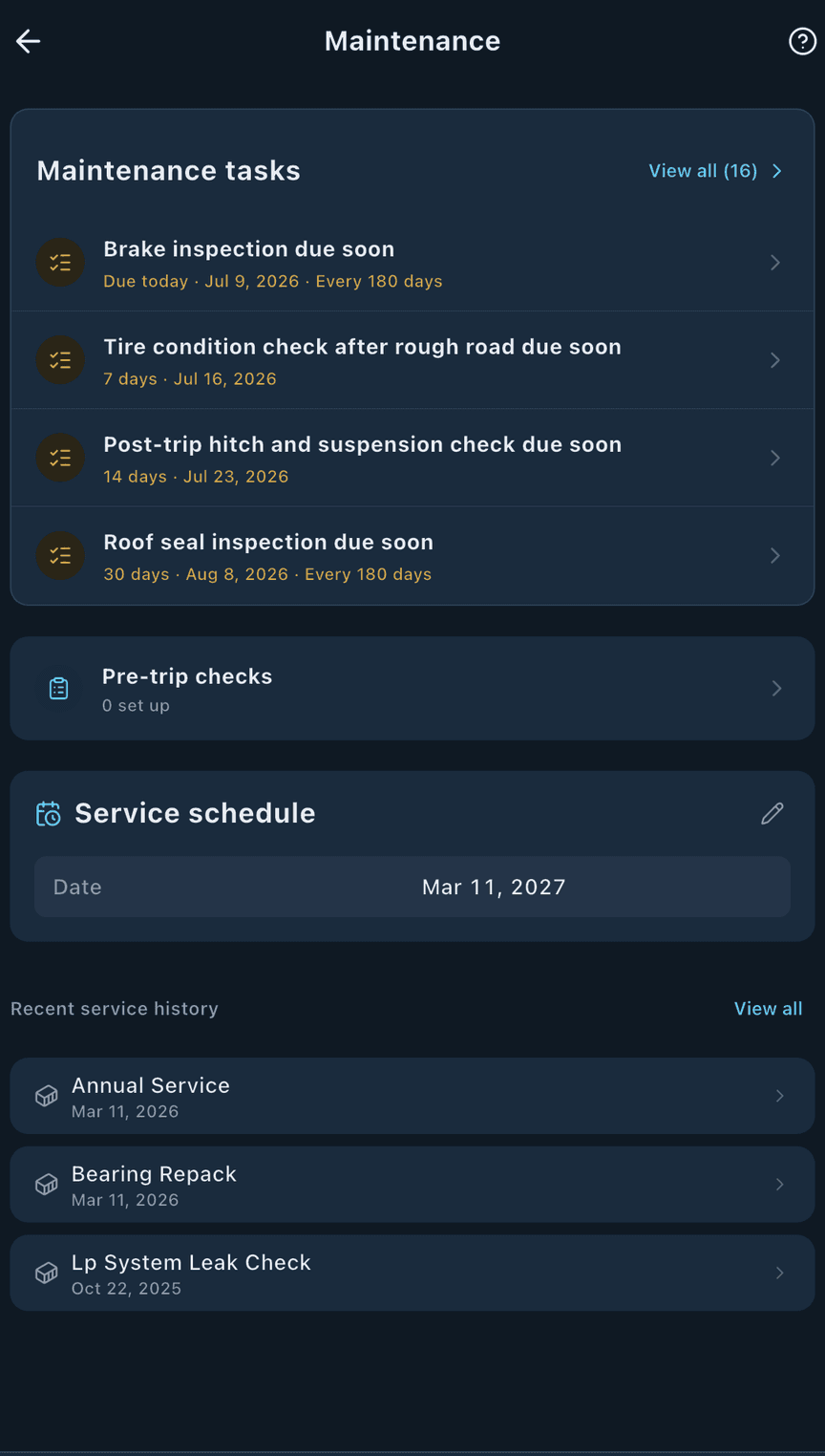
Screen shown: another US example's due tasks, service schedule and dated service history. It is not a Sequoia result, gain screen, battery-reset record or this article's weigh-in. Keep your actual weigh-in with its linked loads and enter completed work as a dated service note in loadmate. Review that record before the next tow, then follow Toyota's current setup instructions. The app relies on your entries; it does not detect gain or a reset.


Frequently asked questions
- Can a 2026 Sequoia tow 10,000 lb?
No. Toyota's published 2026 figures top out below that: 9,500 lb on SR5 RWD in the current US table, and 9,520 lb in the manual and launch release. The two sources don't match, but both are under 10,000 lb. Toyota specifications and 2026 announcement.
- Which Toyota Sequoia has the highest towing capacity?
In Toyota's current 2026 US table, SR5 RWD is highest at 9,500 lb. The 2026 manual and launch release list a 9,520 lb maximum instead, so match your model code and seating in the manual and check your vehicle's documents. Toyota table and manual, printed pp. 246–247.
- Why check gain if I already saved this trailer?
On the 2026 Sequoia, changing the trailer ID or brake type resets current gain to zero, and disconnecting and reconnecting the 12-volt battery resets gain data without saying what value results. Load, road and weather changes also call for gain adjustment. Follow Toyota's full setup instructions. Toyota manual, printed pp. 477–480.
- Does a Sequoia need a weight-distribution hitch?
Above 5,000 lb loaded trailer weight, yes. Toyota's 2026 manual requires an adequately rated weight-distributing hitch above 5,000 lb, plus a sway-control device above 2,000 lb. Follow the vehicle, hitch and trailer instructions, and check the loaded-weight limits too. Toyota manual, printed pp. 242 and 247.
- Can I use a separate brake controller in a Sequoia?
Toyota doesn't recommend adding a third-party controller to the 2026 Sequoia. Identify the trailer's brake system and follow the integrated controller's compatibility and setup instructions; it doesn't control hydraulic surge brakes. Toyota manual, printed pp. 477–480.
- Does a past trouble-free tow mean this trip is within the limits?
Not by itself. An earlier trip can't tell you today's loaded weights or brake setup. Compare actual weights with the ratings and review any service, setting and load changes since then. Even with unchanged loads, this guide's example still needs gain checked after the 12-volt battery is disconnected and reconnected. Toyota manual, printed pp. 242–248 and 478–480.