Ascent towing at a glance
- Model year and market
- 2027 US Subaru Ascent, all seven listed trim/seating configurations
- Loaded trailer with brakes
- 5,000 lb maximum, with required towing equipment
- Loaded trailer without brakes
- 1,000 lb maximum
- Loaded tongue weight
- 8–11% of complete trailer weight, within the 500 lb maximum
- Hitch instruction
- Genuine Subaru hitch, used as a weight-carrying hitch; weight-distributing hitches prohibited
- Vehicle and axle ratings
- GVWR and front/rear GAWR on your certification label; occupant/cargo allowance on the placard
- Three different numbers
- Tongue weight, net vehicle-weight change and rear-axle change
Sources checked October 16, 2026: Subaru's 2027 comparison, pp. 1 and 3, and 2027 owner's manual, printed pp. 430 and 433–441.
How much can a Subaru Ascent tow?
Every trim and seating entry in Subaru's 2027 US comparison is rated to tow 5,000 lb; the manual limits an unbraked trailer to 1,000 lb. Seven seats or eight, the trailer maximum is the same, though the people and gear you carry still count against the vehicle and axle limits.
All seven entries use a 2.4-liter turbo engine, CVT and AWD, and the 2027 comparison lists the same trailer maximum across them. The 2026 comparison also listed 5,000 lb across its seven entries. For an earlier Ascent, check that year's manual instead of assuming the current figure.
Compare 5,000 lb with the complete loaded trailer, including its tongue weight. A camper's empty spec leaves out everything you pack. The what can I tow guide connects the vehicle, trailer and hitch checks; the US towing capacity chart compares other vehicles.
Why can the same Ascent weight sheet produce different answers?
Hitch-load threads often mix three numbers: a direct tongue reading, the change in vehicle total, and the change at one axle. Label each one and note how the rig was loaded before you compare them.
In a June 30, 2026 owner discussion, a 2024 Ascent owner shared a spreadsheet while trying to reduce tongue weight. The owner and a respondent read the hitch weight differently, and the respondent didn't show their math. The owner had also changed hitch height and cargo arrangement between dates, so the entries can't separate the effect of either change or show which limits that rig met.
If your own sheet gives conflicting answers, work out what each number measures first:
| Claim or reading | What it describes | What you need | Before choosing a fix |
|---|---|---|---|
| Tongue-scale reading | Downward load at the trailer coupling | Loaded trailer, measured at towing height | Compare with Subaru's tongue cap and percentage guidance, plus actual component limits |
| Hitched vehicle total minus unhitched total | Net weight added to the vehicle between readings | Identical people, fuel, cargo and hitch hardware; no weight distribution | Cross-check against the separate tongue reading |
| Hitched rear axle minus unhitched rear axle | Change carried by that axle | Matched vehicle state across both readings | Keep the difference separate from tongue weight |
| Full hitched rear-axle reading | Actual weight on the rear axle in that state | Your vehicle's rear GAWR from its certification label | Compare the full reading with rear GAWR |
Subaru shows tongue weighing at the trailer's actual towing height in the 2027 manual, printed p. 440. Write the date and what was aboard next to each reading. If the family, fuel or equipment changed between vehicle weighings, the subtraction includes those changes too.
What do 425 lb of tongue weight and a 600 lb rear-axle increase mean?
Both can be right for the same setup, because the rear-axle increase and the vehicle's net increase measure different things. With matched vehicle readings, the axle changes add up to the net increase, and you can cross-check that against a separate tongue reading.
Here's one example: a 2027 Ascent Limited 7-Passenger AWD with correctly installed genuine Subaru towing equipment and a braked travel trailer, on a weight-carrying hitch with no weight-distributing hitch. The weights are made up to show the math. Both vehicle weighings carry the same fuel, people, cargo and hitch hardware, and a separate tongue reading, also assumed, is taken at towing height.
| Example reading | Unhitched vehicle | Hitched vehicle | Change |
|---|---|---|---|
| Front axle | 2,850 lb | 2,675 lb | −175 lb |
| Rear axle | 2,450 lb | 3,050 lb | +600 lb |
| Vehicle total | 5,300 lb | 5,725 lb | +425 lb |
The totals show 5,725 − 5,300 = 425 lb added to the vehicle. The axle changes give the same value, 600 − 175 = 425 lb, which matches the separate 425 lb tongue-scale reading.
Use 425 lb for the tongue comparison. For the rear axle, compare the full 3,050 lb hitched reading with the rear GAWR on the Ascent's certification label. The 600 lb increase tells you how much the rear reading changed; it can't tell you whether the axle is within its rating.
These readings line up because the example was built that way. If yours disagree, go back to the original readings and what was aboard for each before you change the trailer's loading.
Which limits can this 4,000 lb trailer example settle?
It fits Subaru's trailer and tongue maximums. The vehicle, axle and combined checks need label figures this example doesn't have. Say the same trailer's axles read 3,575 lb and its own GVWR is 4,500 lb, both assumed.
The complete trailer weighs 3,575 + 425 = 4,000 lb, and its tongue share is 425 ÷ 4,000 × 100 = 10.625%, inside Subaru's 8–11% guidance. Here's how it compares:
| Check on the example 2027 Limited 7-Passenger AWD | Weight used | Limit | Result |
|---|---|---|---|
| Vehicle's trailer rating | 4,000 lb complete trailer | 5,000 lb, Subaru | 1,000 lb remaining |
| Vehicle's tongue limit | 425 lb separately measured tongue | 500 lb, Subaru | 75 lb remaining |
| Trailer's own GVWR | 4,000 lb complete trailer | 4,500 lb, assumed label | 500 lb remaining if label reads 4,500 lb |
| Loaded Ascent | 5,725 lb hitched vehicle | Your label's GVWR | Unknown |
| Front axle | 2,675 lb | Your label's front GAWR | Unknown |
| Rear axle | 3,050 lb | Your label's rear GAWR | Unknown |
| Combination | 9,300 lb | An authoritative GCWR | Unknown |
Subaru's trailer and tongue limits come from the 2027 manual, printed pp. 438–439. The combination totals 5,725 + 3,575 = 9,300 lb (hitched vehicle plus trailer axles), or equally 5,300 + 4,000 = 9,300 lb (unhitched vehicle plus complete trailer). Either way, the tongue counts once.
GVWR, the maximum loaded vehicle weight, and both gross axle weight ratings (GAWR) are on your driver's-door certification label. The occupant-and-cargo placard gives a separate allowance, and the tongue load counts against it when you tow. The 2027 manual, printed pp. 430 and 438–439, explains these checks.
Subaru's current comparison and manual don't list a numeric gross combined weight rating (GCWR). Get an authoritative figure for your vehicle before you work out a combined margin; adding the tow rating to GVWR doesn't give you one.
The trailer's axle, tire and hitch-component limits still need checking too. Neither the 75 lb tongue margin nor the 1,000 lb trailer margin tells you anything about the Ascent's axles.
Can a weight-distribution hitch fix the Ascent's axle load?
No. Subaru prohibits a weight-distributing hitch on the 2027 Ascent, so it's off the table as a fix for a heavy axle. The manual specifies weight-carrying use on printed page 433 and directs owners to the genuine Subaru hitch on page 441. 2027 Ascent hitch instructions.
First find out whether anything is actually over a limit. In the example, that means comparing 3,050 lb with the actual rear GAWR. If a measured load is over its rating, change the load within the vehicle and trailer makers' instructions and weigh again before towing. Reworking the spreadsheet won't make a real overload go away.
Subaru's other towing rules still apply. It requires adequate trailer brakes above 1,000 lb loaded trailer weight; electric and surge systems connect differently, so follow the instructions for the brakes you have. Subaru also rules out towing during the first 1,000 miles of a new vehicle or new powertrain component, calls for the severe-use maintenance schedule when towing, and prohibits towing with the temporary spare fitted. 2027 manual, printed pp. 437 and 441–442.
How can loadmate keep the Ascent's axle and tongue numbers apart?
Keep each weight next to its own limit, so every later check asks two questions: does the tongue still have room, and does the loaded axle? In the Ascent example, the tongue sits 75 lb under its cap while the rear-axle margin is unknown, so they belong in separate rows.
In loadmate, separate margins show the front axle, rear axle and coupling, using your recorded weights and entered limits. You can explore those rows on the app's region-matched sample rig, a read-only example of a different setup, so its numbers aren't your Ascent's.
For your own rig, enter real ratings and loads. The setup requirements include GVWR, GCWR and braked towing capacity, and missing core ratings or a baseline can keep the score and complete snapshot from being available (missing-data guidance). An optional axle limit you don't know isn't assessed.
When you record measurements, keep the date, reference and hitched or separate context with them. The review and linking step puts measured values and supported margins beside the loads recorded for that state, so a later comparison still makes sense after the family or camping gear changes.
Explore loadmate's separate weight margins.
Before you change the loading, label the number that won't reconcile as a tongue reading, a vehicle-total change or an axle reading, and note what was aboard when it was taken. For the example, that means finding out whether the actual rear GAWR covers 3,050 lb.
loadmate provides decision support for towing safety, not legal weight certification. Score, compliance checks, and trip readiness are based on the data you enter and the regulator information current at the time of release. For legal weight evidence, use a certified truck scale / CAT scale. Towing remains the operator's responsibility. See the safety disclaimer.
Related guides
- What can I tow?: connect the vehicle, trailer and hitch ratings.
- US towing capacity chart: compare current vehicle configurations.
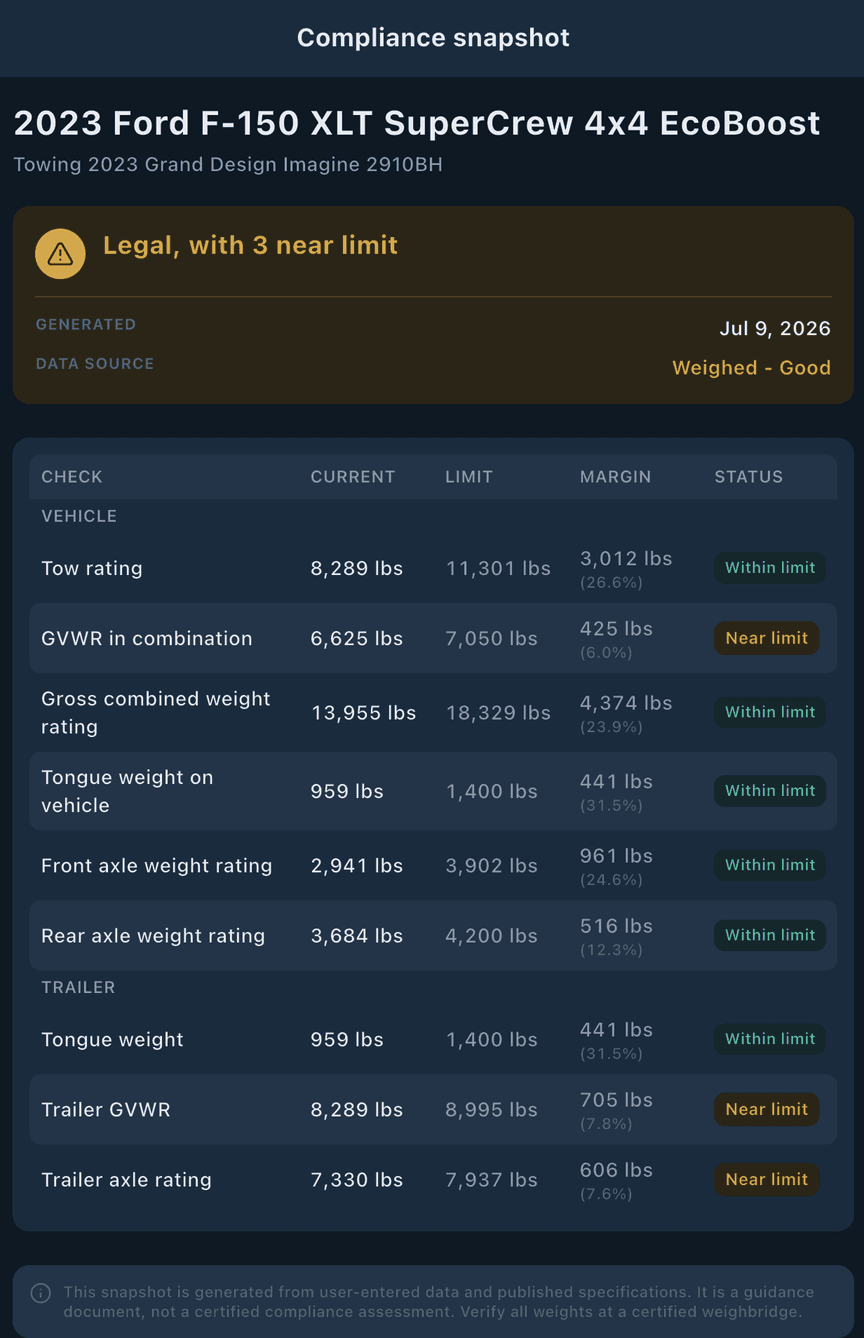
Which margin does your next reading change?
In the Ascent example, 425 lb goes in the tongue row, while the rear axle needs its full 3,050 lb reading checked against the actual GAWR. Explore those separate rows on loadmate's sample rig. For your own Ascent, enter the core ratings, a baseline and current loads; without a GCWR it can't get a complete score or snapshot. Recheck each margin when your recorded load changes. Screen shown: a 2023 F-150 towing a Grand Design Imagine, not Ascent results.


Frequently asked questions
- How much can a Subaru Ascent tow?
All seven listed 2027 US trim/seating configurations are rated for 5,000 lb with trailer brakes and the required towing equipment, and 1,000 lb without trailer brakes. Your loaded vehicle, axles, trailer and hitch parts still have their own limits. Subaru's 2027 comparison and 2027 manual, printed pp. 433–441.
- Are Subaru Ascents good for towing?
The 2027 US Ascent is rated to tow up to 5,000 lb with trailer brakes and the required equipment. A good match also stays within the 500 lb tongue cap, Subaru's 8–11% tongue guidance, and your vehicle's axle and equipment limits. Other owners' experience with older Ascents can't tell you how your loaded setup measures up. 2027 manual, printed pp. 433–441.
- Can an Ascent use a weight-distribution hitch?
No. Subaru's 2027 manual specifies weight-carrying use, prohibits a weight-distributing hitch and directs owners to the genuine Subaru trailer hitch. Measure the actual tongue and axle loads before deciding how to fix an exceeded limit. 2027 manual, printed pp. 433 and 441.
- Does the rear-axle increase equal tongue weight?
No, they measure different things. In this guide's example, the rear reading rises 600 lb and the front falls 175 lb, a 425 lb net increase that matches the separate assumed tongue reading, with the same vehicle state for both weighings and no weight-distributing hitch. Compare the full 3,050 lb rear reading with rear GAWR.
- Can an Ascent tow a camper close to 5,000 lb?
Only if its complete loaded weight and tongue load fit within the limits, along with the loaded Ascent, each axle and the towing parts. The 2027 maximum is 5,000 lb with trailer brakes, with a 500 lb tongue cap and 8–11% tongue guidance. A dry weight or another owner's camper photo can't settle those checks. 2027 manual, printed pp. 438–441.
- Do I need trailer brakes with a Subaru Ascent?
Above 1,000 lb, yes. Subaru requires adequate trailer brakes above 1,000 lb loaded trailer weight for the 2027 Ascent and allows up to 5,000 lb with them, subject to the other loading and equipment limits. Brake connections and controller needs depend on the system fitted. 2027 manual, printed pp. 437–441.