F-250 towing at a glance
- Scope
- US 2027 F-250 pickup, conventional receiver towing
- Published range
- 15,500–22,000 lb; engine, cab, box, drive layout, axle and required equipment select the applicable rating
- 7.3L gas range
- 16,300–18,200 lb across the gas configurations
- Factory receiver opening
- 2.5 inches; Ford instructs owners to retain the factory pickup receiver
- Retained hitch in this guide
- Equal-i-zer 90-00-1000: 10,000 lb trailer and 1,000 lb tongue ratings
- When the truck changes
- Confirm maker-approved removable parts and loaded height, then readjust the hitch for the current pair
- Your truck's carrying limits
- Gross Vehicle Weight Rating (GVWR) and axle ratings on its certification label; occupant-and-cargo allowance on its tire/loading placard
Sources checked October 16, 2026: Ford's 2027 towing guide, pp. 1–2, 2027 owner's manual, printed pp. 340–343 and 348, and Equal-i-zer's model ratings and changing-trucks guidance.
In a March 16, 2021 FordTremor discussion, an F-250 Tremor owner was taking on a trailer with an Equal-i-zer weight-distribution hitch (WDH) previously used behind a Tahoe, and asked which shank and drop would make it work on the truck. If you're keeping a trailer for a 2027 F-250, start with Ford's receiver instruction and the hitch maker's parts list.
How much can a Ford F-250 tow?
Ford's 2027 US F-250 table gives conventional-towing ratings of 15,500–22,000 lb, so match your complete configuration before picking a figure. The bottom of the range is a 6.7L H.O. diesel Crew Cab 4x4 with the 176-inch wheelbase, 8-ft box, 3.31 axle and 23,500 lb Gross Combined Weight Rating (GCWR).
One configuration that reaches 22,000 lb is the 6.7L V8 H.O. diesel Crew Cab 4x4, 159.8-inch wheelbase, 6.75-ft box, 3.31 axle and 31,000 lb GCWR, with High-Capacity Axle Upgrade Package 535. Above 18,200 lb, Ford also requires the specified 18-inch all-season or 20-inch all-terrain tires, so the maximum only applies with all of that fitted. 2027 F-250 conventional table and equipment notes, pp. 1–2.
The 7.3L gas configurations span 16,300–18,200 lb. The gas truck in the example below is a non-Tremor automatic Crew Cab 4x4 with a 159.8-inch wheelbase, 6.75-ft box and 3.73 axle, rated for 16,600 lb towing and 23,500 lb GCWR. Ford's table assumes a 150 lb driver and 150 lb passenger, so your actual equipment and loading still matter. 2027 towing guide, p. 2.
For an older truck, use its own model-year documents. The US towing capacity chart compares configurations across vehicles, and the what can I tow guide explains how the loaded-rig limits fit together.
Can the hitch from my old truck stay with the trailer?
It can, once the hitch maker confirms the removable parts suit the new truck and the complete assembly meets the load and setup requirements. Start by separating the receiver fixed to the F-250 from the shank and hitch head you can take off.
On the 2027 F-250, Ford says to keep the factory pickup receiver, because it plays a role in fuel-system crash protection, and to use its supplied hitch pin or an appropriately rated one. So don't swap the receiver to suit an old removable hitch. 2027 owner's manual, printed p. 348.
| Part of the connection | What to confirm when moving the hitch |
|---|---|
| Factory receiver | Keep Ford's receiver; read its label and confirm the applicable truck configuration |
| Removable shank | Confirm the hitch maker approves the exact shank/head combination and that its available rise or drop suits the loaded pair |
| Retained head and spring arms | Identify the hitch model, its ratings and condition, then have the complete setup adjusted for the F-250 |
Equal-i-zer offers 2.5-inch replacement shanks for its 6K–16K models, including past models. Match your Equal-i-zer model to that list and have the old assembly's condition checked. Another brand's head needs its own compatibility confirmation.
The Equal-i-zer 90-00-1000 is rated for 10,000 lb trailer weight and 1,000 lb tongue weight. The maker's model index shows where the model number sits on the spring-arm labels, and its specification table confirms those limits. A new approved shank doesn't make it a higher-rated hitch.
Equal-i-zer's hitch-sizing guidance also counts cargo behind the truck's rear axle, so bring that load information to the installer along with the loaded tongue weight. The example below has no added cargo behind the rear axle.
What needs measuring when the hitch moves to the F-250?
Measure the current truck and loaded trailer to pick the right rise or drop, then readjust the hitch for that pair. Don't assume the old truck's setting carries over, even if the new one looks similar; Equal-i-zer's changing-tow-vehicles guidance calls for a complete adjustment.
Ford says to choose the rise or drop that leaves the loaded trailer level or slightly nose-down. The receiver opening tells you which parts fit; the loaded heights tell you which adjustment you need. Have a competent installer use those measurements to identify the correct, undamaged assembly and its instructions. 2027 owner's manual, printed p. 356.
Ford's 2027 towing guide recommends 50% front axle load restoration (FALR) when load bars are used, and the manual says the adjustment must not raise the rear bumper above its unhitched position. Follow both Ford's and the hitch maker's instructions, then check the result physically. Towing guide, p. 2, owner's manual, printed p. 349.
The factory receiver table lists 22,000 lb trailer / 2,200 lb tongue for non-Tremor and 18,200 lb / 1,820 lb for Tremor. Ford's weight-carrying and weight-distributing columns match, as do the corresponding vehicle tow figures. None of that raises the old Equal-i-zer's rating or means its old adjustment suits the F-250. 2027 towing guide, pp. 1–2.
What does the retained hitch allow in this F-250 example?
In the example below, the old hitch has just 100 lb of tongue rating left, while the gas F-250 has 7,600 lb left against its trailer rating. That's why it pays to identify the old hitch.
Here's one example loadout. The truck is the 2027 non-Tremor 7.3L gas automatic Crew Cab 4x4, 159.8-inch wheelbase, 6.75-ft box, 3.73 axle from above, with Ford's 16,600 lb tow rating and 23,500 lb GCWR. Every weight and label figure in the next table is assumed, including the 10,000 lb actual-label GVWR and 3,000 lb occupant-and-cargo allowance; they aren't catalog specs for this configuration.
Assume a competent installer has identified a compatible, undamaged Equal-i-zer 90-00-1000 complete assembly for the new truck and the bars are engaged for travel after setup. The exact rise/drop, restoration and axle transfer aren't known.
| Example input | Weight and what it includes |
|---|---|
| Truck baseline | 7,000 lb, full fuel, no people or added equipment; includes the factory receiver |
| Assumed truck labels | 10,000 lb GVWR and 3,000 lb occupant-and-cargo allowance |
| People and cab cargo | 400 lb people plus 25 lb cargo; no added cargo behind the rear axle |
| Removable truck-side hitch hardware | 75 lb added once; factory receiver excluded from this addition |
| Complete loaded trailer | 9,000 lb, including the 900 lb tongue load and 50 lb of trailer-side WDH hardware |
| Assumed trailer label | 9,500 lb Trailer GVWR |
| Current tongue reading | 900 lb, assumed independently measured at normal towing height with the trailer loaded |
The hardware weights are made-up teaching figures, not Equal-i-zer component weights; the 50 lb trailer-side hardware is already in the 9,000 lb total and the tongue reading.
| Comparison for this example loadout | Calculation | Result |
|---|---|---|
| Loaded truck, unhitched | 7,000 + 400 + 25 + 75 | 7,500 lb |
| Pre-distribution truck accounting only | 7,500 + 900 | 8,400 lb |
| Room below assumed 10,000 lb GVWR, before distribution only | 10,000 − 8,400 | 1,600 lb |
| Complete combination | 7,500 + 9,000 | 16,500 lb, tongue counted once |
| Room below Ford's 23,500 lb GCWR | 23,500 − 16,500 | 7,000 lb |
| Room below Ford's 16,600 lb trailer rating | 16,600 − 9,000 | 7,600 lb |
| Room below assumed 9,500 lb Trailer GVWR | 9,500 − 9,000 | 500 lb |
| Retained hitch's trailer comparison | 10,000 − 9,000 | 1,000 lb |
| Retained hitch's tongue comparison | 1,000 − 900 | 100 lb |
The 8,400 lb truck figure and 1,600 lb GVWR difference are paper accounting before weight distribution, not measured travel weights with the bars engaged; the real coupled truck weight and axle readings are unknown. The combination counts the 900 lb tongue once, inside the 9,000 lb trailer, so adding it to 16,500 lb again would double-count it.
Ford's manual specifies 10–15% of loaded trailer weight on the tongue, also capped by the receiver label and by 10% of the exact truck's maximum tow rating; the towing-guide table uses a 10% loaded-tongue basis. Here, 900 ÷ 9,000 is 10%. The gas truck's separate ceiling is 1,660 lb, leaving 760 lb, and the non-Tremor receiver's 2,200 lb ceiling leaves 1,300 lb. The old hitch's 100 lb is the tightest of these tongue margins. 2027 owner's manual, printed pp. 348 and 356, towing guide, pp. 1–2.
That 100 lb doesn't clear the hitch or the rig. The truck and trailer axle ratings and readings, tire and wheel limits, ball/pin/coupler labels, condition, clearances, loaded height and WDH adjustment all still need checking. Ford also sets a 60 sq ft conventional frontal-area limit; check it against the trailer separately, because the weights can't answer it. 2027 towing guide, p. 1.
What should I record in loadmate after changing trucks?
Record the F-250's sourced limits and a current loaded tongue reading, so the kept trailer's coupling record describes the new pair. With the 10,000/1,000 lb hitch in this example, the 900 lb tongue reading is the number to watch: after the next repack, has it changed, and does the record still describe how the trailer hooks up to this truck?
In loadmate, rating entries come from your documents and labels. Put the truck's own towing capacity in its vehicle rating field, keep the hitch's ratings as separate evidence and check the complete assembly's limits, and enter a coupling limit only from its actual source. Keep source photos and component instructions outside the app for the installer and later reference.
You can update tongue weight from a loaded reading at normal towing height, which updates the coupling context. A tongue-only entry doesn't replace the full load-inclusive baseline or give you gross and axle weights. When you record later changes, count hardware that was in the measured baseline only once.
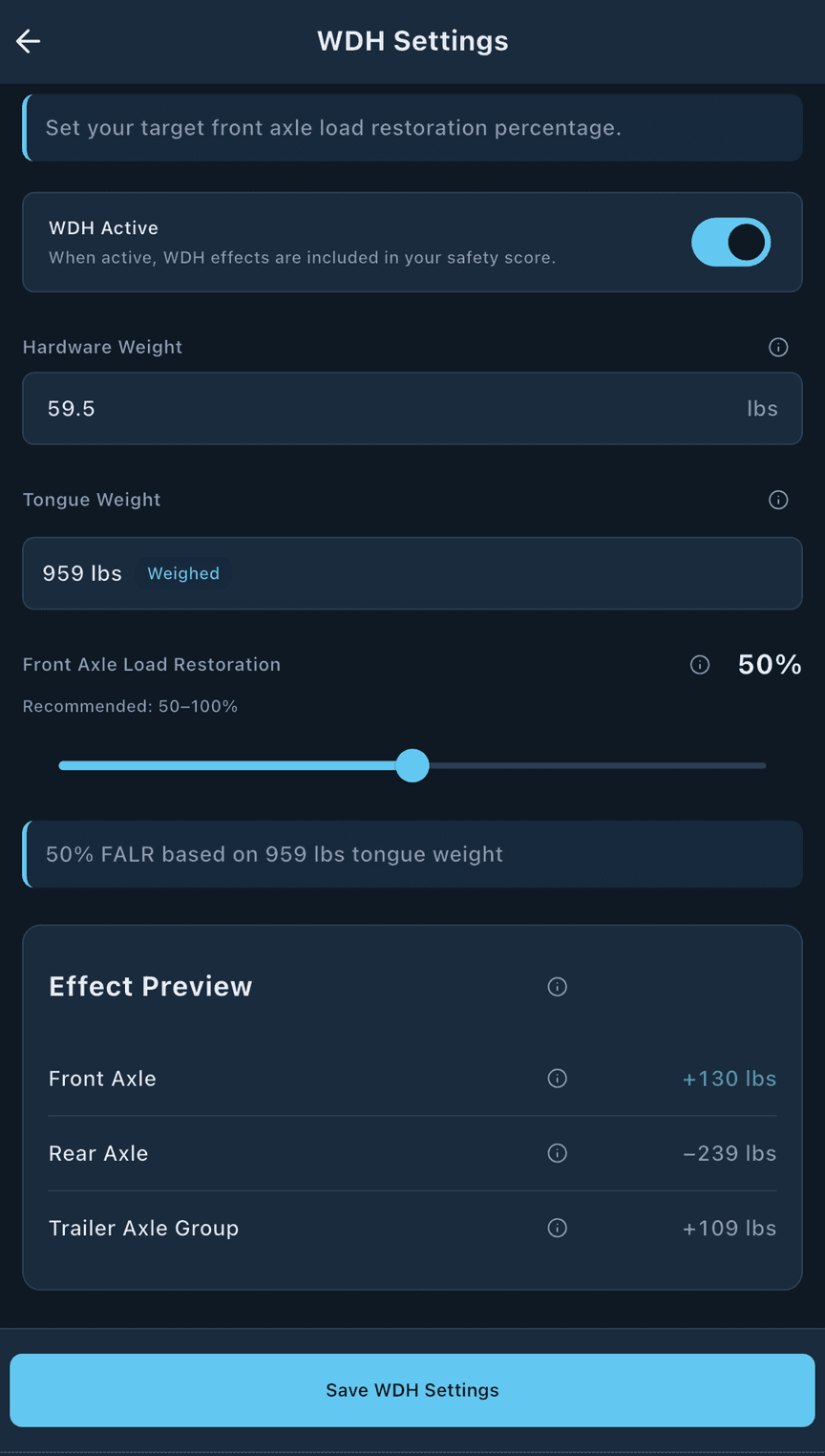
If you also record weight-distribution effects, WDH settings belong to the trailer paired with the active vehicle. The preview needs the actual setup and vehicle/trailer geometry. A missing-measurement warning with zero preview values means inputs are missing, not zero physical transfer. The F-250 example doesn't have those measurements, so there's no axle-effect preview for it here.
Do the physical work first: a competent installer identifies the old hitch and adjusts it for this F-250 under the manufacturer's instructions. Then record the confirmed pair, and revisit it when you enter changed loads.
Explore loadmate for your F-250 and retained trailer.
Related guides
- What can I tow?: work through the limits of the complete loaded combination.
- US towing capacity chart: compare published configurations across trucks and SUVs.
Does the coupling record describe this F-250?
Record your F-250's limits and a current loaded tongue reading in loadmate, so the kept trailer's coupling record describes this truck. A tongue-only update keeps your measured baseline; a WDH preview needs the actual setup and geometry. Ford recommends 50%, which differs from the screen's generic 50-100% range. A selected percentage records a setting; the restoration you get and the hardware fit still need checking at the truck. Screen shown: a different US setup with 59.5 lb hardware, 959 lb tongue and +130/-239/+109 lb axle effects.


Frequently asked questions
- What is the towing capacity of a Ford F-250 gas engine?
The 2027 US 7.3L gas F-250 configurations span 16,300–18,200 lb for conventional towing, and engine size alone doesn't pick the rating. The non-Tremor automatic Crew Cab 4x4 with a 159.8-inch wheelbase, 6.75-ft box and 3.73 axle used in this guide is rated for 16,600 lb, with 23,500 lb GCWR. Ford's 2027 gas table.
- Which F-250 can tow 22,000 lb?
One 2027 US conventional-towing configuration that can is the 6.7L V8 H.O. diesel Crew Cab 4x4, 159.8-inch wheelbase, 6.75-ft box, 3.31 axle and 31,000 lb GCWR, with High-Capacity Axle Upgrade Package 535. Above 18,200 lb, Ford also requires the specified 18-inch all-season or 20-inch all-terrain tires. Your truck and hitch limits still apply. Ford's 2027 table and equipment conditions.
- Can I reuse my old weight-distribution hitch?
You may be able to. Confirm the model, ratings, condition and maker-approved removable parts, then measure and readjust the complete hitch for the new truck and loaded trailer. Equal-i-zer offers 2.5-inch shanks for its 6K–16K models, including past models, and recommends a complete adjustment when you change tow vehicles; other brands need their own confirmation. Equal-i-zer shanks and setup guidance.
- Can I replace the factory receiver with a 2-inch receiver?
Ford's 2027 Super Duty manual tells pickup owners to keep the factory receiver because it plays a role in fuel-system crash protection. Have the hitch maker or a competent installer find compatible removable hardware for the F-250's 2.5-inch opening, and use Ford's supplied pin or an appropriately rated one. 2027 owner's manual, printed p. 348.
- Does the F-250 need weight distribution to reach its published rating?
Ford's 2027 F-250 tables show the same ratings for weight-carrying and weight-distributing setups. That doesn't tell you whether a particular hitch and trailer suit each other or how to adjust them. When load bars are used, Ford recommends 50% front axle load restoration; follow Ford's and the hitch maker's setup instructions. 2027 towing guide, pp. 1–2.
- Does a 2.5-inch shank increase my hitch's capacity?
No. A maker-approved shank confirms fit for the named hitch models, but it doesn't raise the hitch's published rating. The Equal-i-zer 90-00-1000 in this guide stays at 10,000 lb trailer weight and 1,000 lb tongue weight. Confirm the complete assembly and your current loaded setup. Equal-i-zer compatibility and model ratings.
- What tongue weight does Ford specify for the F-250?
The 2027 owner's manual specifies 10–15% of loaded trailer weight, also capped by the receiver label and by 10% of the exact truck's maximum tow rating; the towing-guide table uses a 10% loaded-tongue basis. This guide's example puts 900 lb on a 9,000 lb trailer, which is 10%, and the old hitch's own limits still apply. Owner's manual, printed pp. 348 and 356 and towing-guide notes.