Expedition towing at a glance
- Model year and market
- 2027 US Expedition and Expedition MAX
- Published towing range
- 6,000–9,600 lb across Ford's configurations; actual loaded allowances can be lower
- 9,600 lb configuration
- Standard-wheelbase 4x4, 3.5L EcoBoost, 3.73 axle, Heavy-Duty Trailer Tow 61E, weight-distributing hitch and 15,900 lb combined-weight limit (GCWR); excludes 24-inch-wheel and separate Tremor applications
- MAX with 61E
- 9,000 lb towing and 15,600 lb combined-weight limit on the 3.73-axle 4x4
- Package identification
- A 3.73 axle on its own doesn't mean 61E or a higher 2027 rating
- 4x4 receiver, weight-carrying mode
- 7,000 lb trailer and 700 lb tongue ceilings; vehicle and installed component limits also apply
- Cargo behind the third row
- Ford lists 22.9 cu ft for standard length and 37.4 cu ft for MAX, a derived 14.5 cu ft difference
- Your carrying allowance
- Occupant-and-cargo capacity on the Tire and Loading label; loaded-SUV and axle limits on the certification label
Sources checked October 16, 2026: Ford's 2027 Expedition towing guide, p. 1, current Expedition cargo specifications, and 2027 owner's manual, pp. 304–307.
The space behind MAX's third row makes it easy to leave a camping box in the SUV. Once a trailer is attached, that choice also decides where the box's weight is carried. A prospective Expedition buyer in December 2024 asked about payload while planning for six passengers and a trailer. With six people seated, the real question is which gear rides in the SUV and which can be secured in the trailer.
How much can a Ford Expedition tow?
Ford's 2027 US guide spans 6,000–9,600 lb, with different rows for standard length, MAX, drive layout and towing equipment. The high figure belongs to one specific standard-wheelbase 4x4. Match your row before you pack:
| 2027 configuration | Maximum loaded trailer | Combined limit (GCWR) |
|---|---|---|
| Standard length, 4x2, 3.31 axle | 6,000 lb | 12,000 lb |
| MAX, 4x2, 3.31 axle | 6,300 lb | 12,500 lb |
| Standard length or MAX, 4x4, 3.73, lower-GCWR row | 6,000 lb | 12,500 lb |
| Standard length, 4x4, 3.73, 61E, 24-inch wheels | 9,200 lb | 15,600 lb |
| Tremor, standard length, 4x4, High Output, 3.73, 61E | 9,300 lb | 15,600 lb |
| Standard length, 4x4, 3.73, 61E, eligible 15,900 lb GCWR configuration | 9,600 lb | 15,900 lb |
| MAX, 4x4, 3.73, 61E | 9,000 lb | 15,600 lb |
The 9,600 lb row excludes the 24-inch-wheel application and the separately rated Tremor. Ford requires an aftermarket weight-distributing hitch above 7,000 lb. A receiver's hardware rating can't lift a lower vehicle rating. 2027 towing guide, p. 1 and footnotes.
For 2027, verify Heavy-Duty Trailer Tow, code 61E, against your build information. Ford's 2026 guide called that equipment standard on 4x4; the 2027 guide calls it available and includes the 6,000 lb 4x4 row. A 3.73 axle, Class IV receiver, 7-pin connector or brake controller on its own doesn't tell you the SUV has it.
This page follows the 2027 model currently marketed on Ford's US Expedition page. For an older Expedition, use its own model-year guide. The US towing capacity chart compares other vehicles; the what can I tow guide pulls the separate ratings together for a full setup.
Does MAX's extra space decide where the heavy gear should go?
No. MAX's extra 14.5 cu ft behind the third row is space; the weight still has to fit the vehicle's carrying and axle limits. Ford lists 37.4 cu ft for MAX against 22.9 cu ft for standard length in its cargo FAQ.
Start with the largest movable item you plan to carry. Its weight and where you put it decide what needs checking. In the SUV, added cargo and the trailer's downward tongue load both use the occupant-and-cargo allowance. The certification label gives the gross vehicle weight rating (GVWR), the maximum loaded SUV weight, and gross axle weight ratings (GAWR), which limit each axle. The towing guide supplies gross combined weight rating (GCWR), the maximum loaded combination. 2027 manual, pp. 304–307 and 322.
Ford directs you to secure luggage and warns that the cargo net is not a restraint for a collision or heavy braking. For heavy trailer cargo, its instructions specify a low position, centered side-to-side, above or slightly forward of the axles. Wherever it goes, the floor and anchors have to take it, and the trailer maker's instructions apply. 2027 manual, pp. 310 and 320.
What changes when one 100 lb box moves into the trailer?
In the example below, the move takes 100 lb off the SUV's cargo floor and puts 10 lb back through the trailer tongue. The SUV ends up 90 lb lighter and the trailer axles carry 90 lb more.
The example uses one 2027 Expedition MAX Active Touring 4x4, standard 3.5L EcoBoost, ten-speed automatic, 3.73 axle and verified factory 61E. See Ford's March 27, 2026 order guide, p. 1, hosted on Blue Oval Forums, for that package pairing. Ford's 2027 towing guide, p. 1, supplies the 9,000 lb tow rating and 15,600 lb GCWR, plus the 4x4 receiver's weight-carrying ceilings of 7,000 lb trailer and 700 lb tongue.
Ford supplies only those tow, GCWR and receiver ratings. The labels, weights and dimensions below are assumptions for the arithmetic; replace them with your SUV's. No weight-distributing hitch is engaged, and the ball, mount and coupler are assumed to be rated at least as high as the receiver ceilings; check their real labels.
| Assumed starting input | Value |
|---|---|
| SUV GVWR / occupant-and-cargo placard | 7,600 / 1,600 lb |
| As-built SUV baseline, full fuel, no occupants or added gear | 6,000 lb |
| All occupants | 500 lb |
| Other added SUV cargo, excluding the box and hitch hardware | 200 lb |
| Added ball, mount and carried hitch hardware | 100 lb |
| Movable camping box | 100 lb |
| Complete loaded trailer, including its tongue weight | 6,000 lb |
| Loaded tongue / trailer's own GVWR | 600 / 7,500 lb |
| Coupling to effective trailer axle-group center | 200 in |
The assumed baseline and labels agree: 7,600 lb minus 6,000 lb leaves 1,600 lb, and nothing already in that baseline is counted again. Before the move, the unhitched SUV weighs 6,900 lb: 6,000 + 500 + 200 + 100 + 100 lb.
The box starts on the SUV floor and moves to one trailer storage zone; the positions and restraint capacities are assumed too.
| Location | Box placement | Effect in this example |
|---|---|---|
| SUV cargo floor, before | 100 lb box securely restrained | All 100 lb rides in the SUV |
| Permitted trailer storage zone, after | Same box low and laterally centered, 20 in ahead of the axle-group center | Complete trailer gains 100 lb |
| Coupling and trailer axles, after | Coupling is 200 in ahead of the axle-group center | 10 lb added tongue load; 90 lb added trailer-axle load |
The static load split follows the stated geometry: 100 lb × 20 in ÷ 200 in = 10 lb added at the coupling. The remaining 90 lb goes to the trailer axle group. That comes from assumed geometry, so weigh the tongue and axles to confirm your packed setup. A different location gives a different split.
Which margins improve, and which get smaller?
The example gains 90 lb of SUV carrying room, uses 10 lb of receiver tongue room and leaves combined weight unchanged.
| Check on the same example rig | Box in SUV | Box in permitted trailer zone |
|---|---|---|
| Loaded SUV, unhitched | 6,900 lb | 6,800 lb |
| Complete loaded trailer | 6,000 lb | 6,100 lb |
| Loaded tongue | 600 lb | 610 lb |
| Hitched SUV total, no weight distribution | 7,500 lb | 7,410 lb |
| SUV GVWR and carrying margin | 100 lb | 190 lb |
| Receiver tongue margin below 700 lb | 100 lb | 90 lb |
| Receiver trailer margin below 7,000 lb | 1,000 lb | 900 lb |
| Vehicle tow-rating margin below 9,000 lb | 3,000 lb | 2,900 lb |
| Trailer's own GVWR margin below 7,500 lb | 1,500 lb | 1,400 lb |
| Trailer axle-group load | 5,400 lb | 5,490 lb |
| Combined weight | 12,900 lb | 12,900 lb |
| GCWR margin below 15,600 lb | 2,700 lb | 2,700 lb |
The carrying calculation includes the tongue once: before the move, 500 + 200 + 100 + 100 + 600 = 1,500 lb against the assumed 1,600 lb placard. Afterward it is 500 + 200 + 100 + 610 = 1,410 lb. For combined weight, use unhitched SUV plus complete trailer: 6,900 + 6,000 = 6,800 + 6,100 = 12,900 lb. The tongue is already part of the complete trailer.
Both packing states happen to put exactly 10% of the complete trailer weight on the tongue. Ford's 2027 towing guide recommends 10%; its owner's manual, pp. 314 and 320, gives a 10–15% band while also capping tongue load at 10% of the vehicle's maximum towing capacity and the receiver rating. The example fits both percentage statements and the tighter 700 lb weight-carrying receiver ceiling.
The table leaves out actual axle ratings and readings, tires, wheels, fitted hitch components, trailer floor and anchor capacities, frontal area and operating conditions, so it gives no rear-axle result or full towing verdict. If your setup needs or uses weight distribution, these no-distribution axle figures won't carry over.
How can I compare a packing move in loadmate?
Record the item's weight and actual zone, then preview that single item's move between the SUV and trailer.
In loadmate, you can mark an item weight as weighed or estimated and assign it to a storage zone with measured location information. The single-item move preview shows expected changes at the axles and coupling from the entered setup. Use a storage location the maker permits; a zone's entered capacity doesn't tell you the floor or restraints can take the item.
After saving the move, review the Rig tab and the separate weight checks. Checks without an entered rating stay unassessed. The saved destination keeps the item's location in the record for the next trip.
Explore loadmate for your Expedition's packing locations.
For your next load, weigh the largest movable item, put it where the vehicle or trailer maker allows, and check the separate limits. Then measure the changed tongue and axle loads.
loadmate provides decision support for towing safety, not legal weight certification. Score, compliance checks, and trip readiness are based on the data you enter and the regulator information current at the time of release. For legal weight evidence, use a certified truck scale / CAT scale. Towing remains the operator's responsibility. See the safety disclaimer.
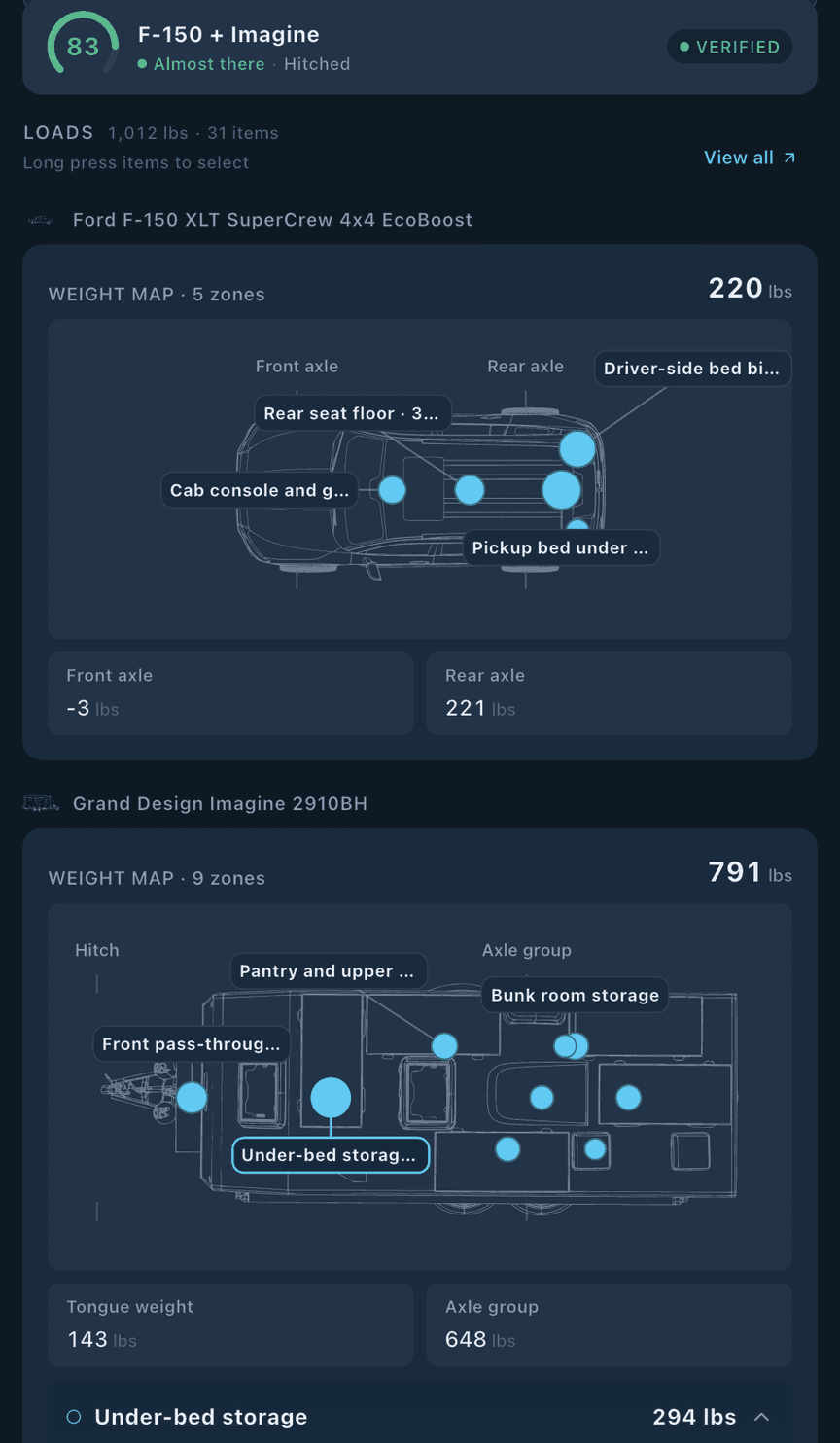
Compare where the camping box will ride
In the Expedition example, moving one 100 lb box into the trailer frees 90 lb of SUV carrying room and uses 10 lb more receiver tongue allowance. Enter your item's weight and permitted storage zone in loadmate, then preview that single move. Screen shown: another US example's load map, not Expedition results or a move preview.


Related guides
- What can I tow?: connect the separate ratings for the loaded SUV and trailer.
- US towing capacity chart: compare configurations across vehicles.
Frequently asked questions
- How much can a 2027 Ford Expedition tow?
Ford's US guide lists 6,000–9,600 lb across configurations. The 9,600 lb maximum requires an eligible standard-wheelbase 4x4 with the 3.73 axle, 61E package, 15,900 lb GCWR and weight-distributing hitch; it excludes the 24-inch-wheel application and separately rated Tremor. Match your full configuration, then check your loaded limits. 2027 Ford towing guide.
- Does Expedition MAX tow more than the standard Expedition?
It depends on configuration. Ford's 2027 4x2 rows rate MAX at 6,300 lb and standard length at 6,000 lb. With 61E, the MAX 4x4 is rated 9,000 lb, while the eligible standard-wheelbase 4x4 reaches 9,600 lb. MAX's extra cargo volume doesn't add payload. 2027 towing guide and Ford cargo specifications.
- Does a 3.73 axle mean my Expedition has Heavy-Duty Trailer Tow?
No. Ford's 2027 guide includes 3.73-axle 4x4 rows rated 6,000 lb with 12,500 lb GCWR. Verify package 61E and the exact towing-guide row against your build information. A receiver, 7-pin connection or brake controller on its own doesn't confirm it either. 2027 towing guide.
- Can I tow 9,000 lb on the Expedition's built-in receiver?
Only with an eligible vehicle and the right hitch setup. Ford's 2027 4x4 receiver ceilings are 7,000 lb trailer and 700 lb tongue in weight-carrying mode. Ford requires an aftermarket weight-distributing hitch above 7,000 lb; the MAX's weight-distributing receiver ceilings are 9,000 lb trailer and 900 lb tongue. Your vehicle, component and loaded limits still apply. 2027 towing guide.
- Can moving camping gear into the trailer help Expedition payload?
Partly: the SUV carries less, but some of the moved load comes back through the tongue. In the example's assumed geometry, moving a 100 lb box into a permitted trailer zone adds 10 lb at the tongue and 90 lb at the trailer axles. SUV carrying room increases by 90 lb, receiver tongue room falls by 10 lb and combined weight is unchanged. Follow the trailer's instructions on placement, restrain the load securely and measure the changed loads. 2027 manual, pp. 310 and 320.
- How big of a camper can an Expedition pull?
Check the camper's complete loaded weight and tongue load against your exact Expedition, plus vehicle, axle, trailer and hardware limits. Ford's 2027 frontal-area guidance is 55 sq ft without Heavy-Duty Trailer Tow and 60 sq ft with it; HD applies to 4x4. Length alone won't tell you. Ford recommends separate functioning brakes above 1,500 lb loaded; state requirements are separate. 2027 towing guide and manual, pp. 319–320.
- Does a lighter scale result increase my Expedition's sticker payload?
No. A scale tells you how the SUV is loaded; the occupant-and-cargo placard stays as printed. Use the actual Tire and Loading label alongside the certification-label GVWR and axle ratings. Added equipment and tongue load use up carrying allowance even when there's cargo space left. 2027 manual, pp. 304–307.