Traverse towing at a glance
- Scope
- 2027 civilian US Traverse, conventional trailer towing
- Maximum trailer
- 5,000 lb with standard V92 on LT, Z71, High Country and RS
- Combined-weight limit
- 10,250 lb for FWD with V92; 10,470 lb for AWD with V92
- Tongue-weight maximum
- 500 lb with V92, within the fitted components' and vehicle's loading limits
- Trailer-light test
- Chevrolet's Trailering App cycles the lamps; pressing the brake pedal ends the sequence
- Trailer brakes
- Chevrolet requires brakes on each axle when the loaded trailer exceeds 1,500 lb
Sources checked October 16, 2026: GM's 2027 equipment list, 2027 trailering specifications, and 2027 Traverse towing supplement, pp. 7 and 11-14.
In May 2021, a former 2010 Traverse owner described wiring the lights for a popup and never installing the controller for its electric brakes. That's one owner's old setup, not something to copy or a claim about today's Traverse. It does raise the question this guide answers: once you've seen the lights work, what do you actually know about the brakes?
How much can a Chevy Traverse tow?
Every Traverse in the 2027 US lineup is rated to tow up to 5,000 lb of loaded trailer, because V92 trailering equipment is standard on every configuration. That covers LT, High Country and RS in FWD or AWD, plus the AWD-only Z71. GM's equipment table and trailering table list all seven configurations, High Country included.
The drivetrain sets how much the whole combination, and the Traverse itself, can weigh:
| 2027 Traverse with V92 | Maximum loaded trailer | Gross combined weight rating (GCWR) | Gross vehicle weight rating (GVWR) | Maximum tongue weight |
|---|---|---|---|---|
| FWD | 5,000 lb | 10,250 lb | 6,160 lb | 500 lb |
| AWD | 5,000 lb | 10,470 lb | 6,400 lb | 500 lb |
Trailer, GCWR and tongue figures come from the 2027 towing supplement, p. 7; GVWR comes from GM's mechanical specifications. GCWR caps the loaded vehicle and trailer together. GVWR caps the loaded Traverse on its own, including the tongue load it carries.
The table can't give you an individual payload. For that, read your Tire and Loading Information label (the occupant-and-cargo allowance) and the certification label (GVWR plus front and rear gross axle weight ratings, or GAWR), then weigh the loaded rig. See the 2027 owner's manual, pp. 178-181.
The supplement also lists 1,500 lb rows for a Traverse without V92. The current US order guide makes V92 standard throughout, so those rows don't create a 1,500-5,000 lb range for today's retail lineup. For an older Traverse, use that model year's manual and build information. To compare other vehicles, use the US towing capacity chart; for how the loaded-rig limits fit together, see the what can I tow guide.
Why does pressing the brake stop the trailer-light test?
Chevrolet lists the brake pedal as one of the ways to end the automatic lamp sequence. Press it while someone is still watching the trailer and the test stops. That's by design, not a sign of a wiring fault. Chevrolet describes the behavior on page 14 of the 2027 towing supplement.
The current Traverse includes Chevrolet's Trailering App. You start its light test, the vehicle cycles the lamps on a timer, and you watch the trailer. The running lamps stay on while the other functions take turns:
| During Chevrolet's trailer-light sequence | What the manual describes |
|---|---|
| Brake lamps | Lit for about 2 seconds |
| Each turn signal | 3 flashes |
| Reverse lamps | Lit for about 2 seconds |
| Repeated portion of the sequence | Approximately 1 minute 45 seconds |
| Ways to end it | Stop, vehicle off, shifting from Park, brake pedal, turn signal or hazards |
The 1 minute 45 seconds is approximate and covers only the repeating part. Follow the on-screen steps and watch which lamps actually light. A helper at the trailer makes this easier while the rig is parked, though Chevrolet doesn't require two people.
Don't go by the dashboard arrows. The supplement warns they can light up even with a trailer connection or bulb problem (2027 towing supplement, p. 12). Watch the lamps at the trailer, including any the sequence hadn't reached yet.
If your helper was still waiting for the reverse lamps when the driver touched the brake, agree on which lamps they actually saw before you call the check done. Keep everyone clear of the rig before any check that involves moving it.
Does a working light connection mean the trailer brakes work?
No. The lamp sequence never tests the trailer's brakes, so they need their own check. Chevrolet treats electric-brake wiring separately from the lighting circuits and specifies a separate functional check, using the trailer-brake controller while moving. Follow your controller's and trailer's instructions for it (2027 towing supplement, pp. 2 and 12).
Start with what brakes the trailer has. Electric brakes need a compatible controller and correctly installed wiring, and Chevrolet sends controller installation to a dealer or qualified service center. Surge brakes work differently, so an electric-controller check isn't the right test for every boat trailer.
For the 2027 Traverse, Chevrolet requires brakes on each trailer axle above 1,500 lb loaded trailer weight, properly installed, adjusted and maintained (2027 towing supplement, p. 11). That's Chevrolet's requirement, not a nationwide legal threshold.
Then inspect the hitch itself: coupling parts that match and are rated for the load, their retention, the safety chains, and a clean, secure electrical connector. The supplement, pp. 9-12 describes these physical checks, and watching the lamps covers none of them.
What does a 4,200 lb trailer leave on an LT AWD?
On this example LT AWD, a 4,200 lb trailer sits 800 lb under the tow rating, but the axle loads, hitch parts and brakes still need checking.
The vehicle is a 2027 Traverse LT AWD with standard V92, rated for 5,000 lb of trailer, 10,470 lb GCWR, 6,400 lb GVWR and 500 lb of tongue weight, from the 2027 supplement, p. 7 and GM equipment table.
Here's one example rig. Every load in it is an assumption, including the 4,700 lb starting weight, so swap in your own. It uses a conventional weight-carrying hitch with no weight-distribution bars moving load around.
| Example input | Weight or basis |
|---|---|
| Traverse starting weight | 4,700 lb, full fuel, without people, trip cargo or removable hitch hardware |
| Driver and passengers together | 530 lb |
| Cargo in the Traverse | 140 lb |
| Removable hitch hardware | 50 lb, counted once |
| Complete loaded trailer | 4,200 lb, including its 480 lb tongue load |
| Trailer GVWR | Assumed 4,500 lb label |
Before coupling, the Traverse weighs 4,700 + 530 + 140 + 50 = 5,420 lb. Add the 480 lb tongue load and the hitched vehicle weighs 5,900 lb. With this hitch, the trailer axles carry 4,200 - 480 = 3,720 lb.
| Limit checked | Example load | Limit | Room left |
|---|---|---|---|
| Vehicle GVWR | 5,900 lb | 6,400 lb | 500 lb |
| GCWR | 9,620 lb | 10,470 lb | 850 lb |
| Tow rating | 4,200 lb | 5,000 lb | 800 lb |
| Trailer GVWR | 4,200 lb | 4,500 lb, assumed | 300 lb |
| Tongue weight | 480 lb | 500 lb | 20 lb |
Combined weight is 5,900 + 3,720 = 9,620 lb. Adding the unhitched vehicle and the complete trailer gives the same answer, 5,420 + 4,200 = 9,620 lb, because both sums count the tongue once.
The tongue share is 480 ÷ 4,200 × 100 = 11.43%. Chevrolet generally calls for 10-15% of loaded trailer weight and notes that trailer types differ; the trailer's own instructions and the other limits still apply (2027 towing supplement, p. 8). The 20 lb left under the tongue maximum isn't spare room for more gear.
Weigh the front and rear axles with the hitch set up the way Chevrolet specifies and compare each with its GAWR; the 480 lb tongue figure doesn't tell you how much the rear axle gains. Then confirm the trailer's axle, tire and wheel limits and the lowest-rated, compatible hitch component. The 2027 supplement, pp. 5-10 treats each of these as its own check.
At 4,200 lb, this trailer is also over Chevrolet's 1,500 lb brake threshold. Even with every lamp working, its brakes need their own check before this rig is ready to tow.
How can loadmate carry the Traverse's checks to the next tow?
Keep your Traverse and trailer setup in one place, next to the physical checks you repeat before each tow. A finished lamp sequence still leaves the brake check open, so what's left to do before this Traverse leaves?
In loadmate, you can create a custom task, add notes and select it for checking before every tow. Keep lamp observation and the trailer-brake check as two separate tasks, with notes pointing to your equipment's instructions. The pre-trip checklist brings those selected checks into each trip. Ticks belong to that trip, so the next one starts fresh. A tick records that you did the check, so leave anything you haven't actually done unticked; a repair needs its own maintenance record.
Keep the loaded setup current too. When you record adding, removing or moving a load, load changes compares it with your latest weigh-in that included loads. A coupling-only check doesn't reset that baseline. Entered changes stay estimates until you weigh again, so decide whether the rig needs a fresh weigh-in before you rely on the old margins.
Explore loadmate for your Traverse's next departure.
loadmate provides decision support for towing safety, not legal weight certification. Score, compliance checks, and trip readiness are based on the data you enter and the regulator information current at the time of release. For legal weight evidence, use a certified truck scale / CAT scale. Towing remains the operator's responsibility. See the safety disclaimer.
Related guides
- What can I tow?: check the complete loaded combination against its separate limits.
- US towing capacity chart: compare the published configurations of SUVs and trucks.
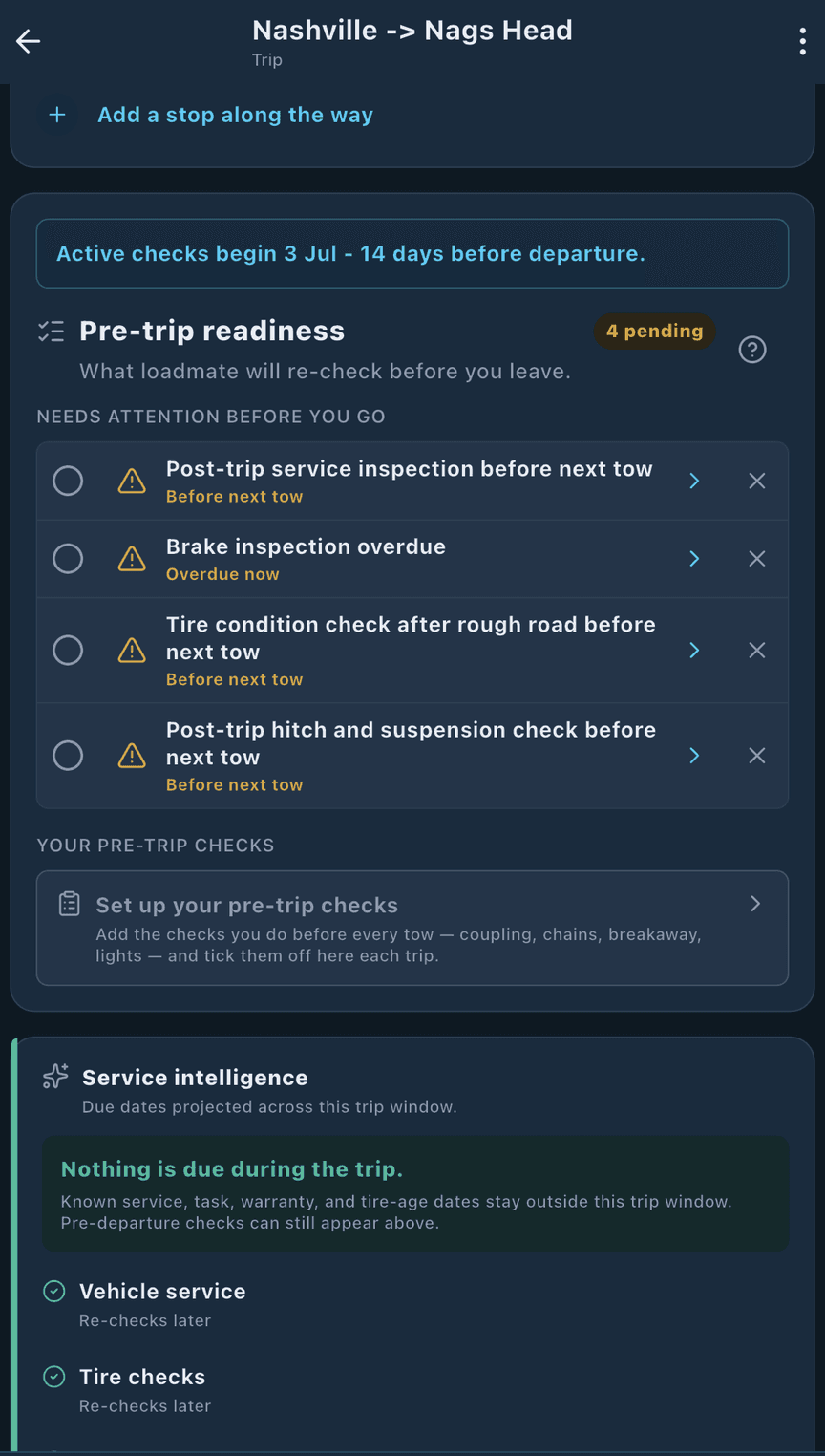
What's left to check before this Traverse leaves?
Keep your Traverse and trailer setup in loadmate with the physical checks you choose. Review what's outstanding before each tow, tick an item only after you've done it, and tell your helper what you actually saw at the rig. Screen shown: a different US demo trip, Nashville to Nags Head, with its own tasks and service status.


Frequently asked questions
- How much can a Chevy Traverse tow?
Every Traverse in the 2027 US lineup is rated for up to 5,000 lb of loaded trailer, with standard V92 equipment. LT, High Country and RS come in FWD or AWD; Z71 is AWD only. Your loaded vehicle, trailer, tongue, axles and hitch parts each have their own limits as well. GM's 2027 trailering specifications.
- Can a Chevy Traverse pull an RV?
Yes, if the RV's complete loaded weight is within the 5,000 lb rating and the loaded vehicle, combination, tongue, axles and equipment also stay within their limits. This guide's 4,200 lb example trailer fits the totals but still needs its axles, hitch parts and brakes checked. 2027 towing supplement, pp. 5-8.
- What model Traverse has a tow package?
For 2027, all of them. V92 trailering equipment is standard on all seven configurations in the current US order guide: LT, High Country and RS in FWD or AWD, and Z71 AWD. Confirm it on your vehicle's build information; earlier model years need their own documents. GM's 2027 mechanical equipment.
- Does the trailer's seven-pin connection mean its electric brakes work?
No. A connected plug and working lamps don't show that the brakes physically work. Check the controller and wiring, then follow the trailer and controller instructions for the functional check, keeping everyone clear before the vehicle moves. 2027 towing supplement, pp. 2 and 12.
- Why should someone watch the trailer lights if the dashboard arrows work?
Chevrolet warns that the dashboard arrows can light up even with a trailer connection or bulb problem. Watch the actual trailer lamps with the rig parked. A helper makes that easier, but Chevrolet doesn't require two people. 2027 towing supplement, p. 12.
- Why did the Traverse's trailer-light test stop when I pressed the brake?
The brake pedal is one of the listed ways to end the 2027 Traverse's automatic lamp sequence. Stop, switching the vehicle off, shifting from Park, a turn signal and the hazards end it too. A stopped sequence on its own doesn't mean there's a fault. 2027 towing supplement, p. 14.
- Does every trailer need an electric brake controller?
It depends on the trailer's brakes. Electric brakes need a compatible controller and wiring; surge brakes work differently. For the 2027 Traverse, Chevrolet requires brakes on each axle above 1,500 lb loaded trailer weight. Follow your equipment's instructions. 2027 towing supplement, pp. 11-12.