Tahoe towing at a glance
- Scope
- 2027 civilian US Tahoe, conventional ball-hitch towing
- Published towing range
- 7,600-8,400 lb across engine, drivetrain and Max Trailering configurations
- 8,400 lb configuration
- 5.3L V8, 2WD, NHT Max Trailering Package
- The rear-axle condition
- Check the fully loaded rear axle before applying weight-distribution spring bars
- Weight-distributing hitch requirement
- Required above 6,000 lb loaded trailer weight in the 2027 supplement
- Tongue guidance
- Generally 10-15% of loaded trailer weight; trailer-specific instructions and separate tongue limits also apply
- Individual carrying limits
- Vehicle loading and certification labels, including occupant-and-cargo allowance, GVWR and axle ratings
- What to note with a reading
- The loaded configuration and whether the spring bars were applied
Sources checked October 16, 2026: GM's 2027 Tahoe trailering specifications, 2027 towing supplement, pp. 5-10, and 2027 owner's manual, pp. 192-195.
On a 2027 Tahoe, write the hitch condition beside every rear-axle reading: before spring bars or spring bars applied. Chevrolet's rear-axle instruction applies to the first, and your hitch fitter will need to know which is which.
How much can a Chevy Tahoe tow?
GM publishes a 7,600-8,400 lb conventional-towing range for the 2027 US Tahoe, with the maximum belonging to the 5.3L V8 2WD with NHT Max Trailering. The larger 6.2L engine has a lower published maximum. Match the engine, 2WD or 4WD model and factory equipment before choosing a figure.
| 2027 Tahoe engine | Published range across drive layouts and NHT rows | Highest published configuration |
|---|---|---|
| 5.3L V8 | 7,700-8,400 lb | 8,400 lb: 2WD with NHT |
| 6.2L V8 | 7,600-8,200 lb | 8,200 lb: 2WD with NHT |
| 3.0L diesel | 7,900-8,200 lb | 8,200 lb: 2WD |
These ranges come from GM's 2027 trailering table, and not every trim-and-package combination in them is necessarily orderable. The same table gives gas models a 14,000 lb gross combined weight rating (GCWR) without NHT and 14,500 lb with it; diesel rows have a 14,500 lb GCWR. GCWR limits the loaded vehicle and trailer together.
Standard Z82 trailering equipment includes the receiver platform, 2-inch receiver and seven-way connection. NHT is a separate package, so a receiver on its own doesn't mean you have the maximum-rating build. Check your build information and individual Trailering Information Label. 2027 Tahoe mechanical equipment and towing supplement, pp. 5-8.
The US towing capacity chart puts the Tahoe beside other SUVs. For your own trailer, the what can I tow guide pulls the separate loaded-vehicle, trailer and hitch checks together. This page covers the current 2027 Tahoe; earlier model years need their own instructions.
Which rear-axle reading does the 2027 Tahoe require?
The rear axle must be within its gross axle weight rating before the weight-distribution spring bars are applied. Chevrolet states that condition on printed page 7 of the 2027 towing supplement. A reading taken after applying the bars describes a different hitch condition.
Write down the rear gross axle weight rating (GAWR) from your certification label. That same label supplies the maximum loaded vehicle weight, or GVWR, and the front axle's rating. The Tire and Loading Information label gives the occupant-and-cargo allowance; the Trailering Information Label carries individual trailering limits, including maximum tongue weight. Keep those limits with the actual loaded measurements. 2027 owner's manual, pp. 192-195 and towing supplement, pp. 5-8.
Above 6,000 lb loaded trailer weight, Chevrolet also requires a weight-distributing hitch. The before-bars reading is a measurement step; you still tow with the required weight distribution in place. Work out how to take it safely with the scale operator and hitch fitter, following the equipment instructions. 2027 towing supplement, p. 10.
Can a 7,000 lb trailer fit the tow rating but exceed that rear-axle limit?
Yes. In this example, the trailer is 1,400 lb under the tow rating but the rear axle is 150 lb over its rating before the bars go on. With the bars on, the reading drops, which is exactly why the condition matters.
This example uses a 2027 Tahoe LS, 5.3L V8, 2WD, NHT Max Trailering, 3.23 axle and conventional suspension. GM supplies its 8,400 lb towing and 14,500 lb combined ratings, plus 7,400 lb GVWR, 3,700 lb front GAWR and 4,300 lb rear GAWR. See the 2027 trailering table, vehicle specifications and LS suspension equipment.
The loads, curb weight and scale readings below are all assumed. Put your Tahoe's real numbers in their place. Start with a 5,700 lb curb weight, full fuel included, which leaves a 1,700 lb carrying allowance under the 7,400 lb GVWR. Adding 700 lb of people, gear and vehicle-side hitch hardware brings the unhitched Tahoe to 6,400 lb. Hardware is counted once.
The assumed loaded travel trailer weighs 7,000 lb, including its 840 lb tongue load, a 12% tongue share. Water, supplies and trailer-side hardware are already included. Assume an 8,000 lb trailer GVWR and 8,000 lb combined trailer-axle rating, a vehicle tongue label permitting 840 lb, compatible and adequately rated hitch components, and suitable working trailer brakes.
| Same example load, stationary measurement | Front axle | Rear axle | Trailer axles | Total combination |
|---|---|---|---|---|
| Loaded Tahoe, trailer unattached | 3,100 lb | 3,300 lb | Unattached | Unattached |
| Hitched, before spring bars are applied | 2,790 lb | 4,450 lb | 6,160 lb | 13,400 lb |
| Same load, spring bars applied | 2,990 lb | 4,150 lb | 6,260 lb | 13,400 lb |
The required rear-axle comparison is 4,450 lb against 4,300 lb: 150 lb over. The 4,150 lb bars-applied reading is 150 lb under the rating, but it can't satisfy Chevrolet's before-bars condition. Record both, each with its condition.
The complete trailer is below the Tahoe's tow rating, the combination is below GCWR and the loaded Tahoe is below GVWR in that before-bars state. The rear axle still exceeds its separate GAWR:
| Check on the LS example | Result |
|---|---|
| Complete trailer against 8,400 lb tow rating | 7,000 lb, leaving 1,400 lb |
| Combination against 14,500 lb GCWR | 13,400 lb in both hitched conditions, leaving 1,100 lb |
| Hitched Tahoe before bars against 7,400 lb GVWR | 2,790 + 4,450 = 7,240 lb, leaving 160 lb |
| Rear axle before bars against 4,300 lb GAWR | 4,450 lb, exceeding the rating by 150 lb |
The combined total can also be checked as 6,400 lb unhitched Tahoe plus the complete 7,000 lb trailer: 13,400 lb. Its tongue load is already included. The bars-applied axle sum is 7,140 lb, 740 lb more than the unhitched Tahoe, but that isn't a tongue-weight reading; the assumed tongue load is still 840 lb.
So this setup has a rear-axle problem to fix. Change the load or configuration, keep the trailer's tongue weight where it needs to be, and recheck. More bar tension won't fix the before-bars reading. Tire and wheel capacities, individual trailer axle ratings, component compatibility and operating conditions sit outside the example, so treat it as a partial check.
How can loadmate keep the Tahoe's hitch setup useful?
Keep the fitter-confirmed hitch setup with the trailer record, then review its axle effects when you enter a changed load. The example's 4,150 lb bars-applied reading only makes sense next to the setup that produced it and the separate before-bars result.
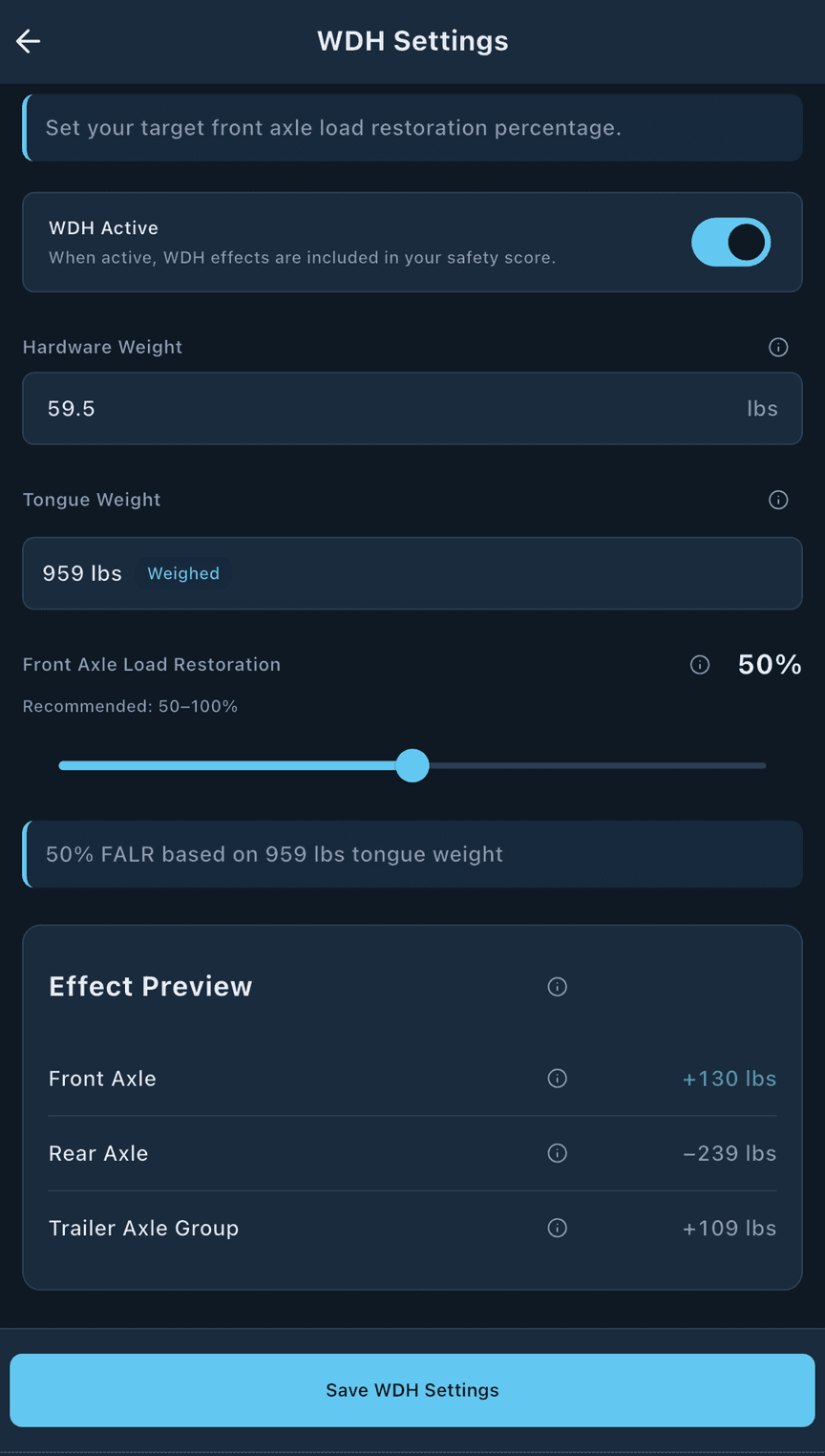
In loadmate, the WDH record belongs to the trailer and becomes active when hitched. You enter the hardware weight and setup through Spring Bars or FALR, the front-axle load restoration method. The preview also requires entered vehicle and trailer geometry, including wheelbase and hitch distances, to show front, rear and trailer-axle effects. Choosing the hardware and adjusting it on your Tahoe stays with the manufacturer's instructions and your hitch fitter.
Keep measured axle readings distinct from that entered setup. A scale record can hold a reference, date, rig configuration and axle measurements. Make the reference descriptive enough to preserve the hitch condition, such as “loaded Tahoe, before spring bars,” and keep the original ticket and setup notes. There's no dedicated bars-on/off field, and the app doesn't check GM's before-bars instruction for you, so the reference text is where that condition lives.
When you enter a changed trailer load or tongue weight, look again at how that setup affects the axles and get any physical recheck you need. The saved weigh-in history keeps the measured record and its selected baseline; a preview works from what you entered.
Keep the hitch condition with your axle readings
For your 2027 Tahoe, record the fitter-confirmed hitch setup with the trailer in loadmate and review the axle effects of the loads you enter as they change. Keep before-bars readings with their hitch condition; the app doesn't detect the bars or check GM's rule for you. Screen shown: another US example's WDH settings, not GM adjustment guidance or Tahoe results.


What should I take back to the hitch fitter?
Take the loaded readings with their hitch conditions, your vehicle labels and the exact fitted hardware information. Ask the fitter to identify what must change if the fully loaded rear axle exceeds its rating before the bars are applied, and to confirm the setup against GM's and the hitch maker's instructions.
Note the hardware fit too. In July 2025, a Michigan Tahoe owner described struggling to reach the required coupler height with a car hauler, even after trying a lower drawbar. That's one owner's fit problem, not an approved modification. Record your own installed receiver, drawbar, ball and WDH. Chevrolet requires the ball size to match the coupler, the shank to fit and the ball's rating to exceed the trailer's GVWR. 2027 towing supplement, p. 9.
The 2027 supplement contains conflicting front-height restoration wording within its general WDH adjustment instructions. Have GM and the hitch manufacturer resolve the applicable adjustment with a qualified fitter before using it; this guide doesn't pick a restoration percentage. The unambiguous rear-axle condition on page 7 still applies. 2027 towing supplement, pp. 7 and 10-11.
Before you leave the appointment, write down the confirmed setup and the load it was checked with, with the hitch condition beside each axle reading. When the trailer or its load changes, that record shows you which measurements to repeat.
Related guides
- What can I tow?: compare the complete loaded setup with its separate limits.
- US towing capacity chart: compare published configurations across SUVs and trucks.
Frequently asked questions
- How much can a Chevy Tahoe tow?
A civilian US 2027 Tahoe has published conventional-towing ratings of 7,600-8,400 lb. The 8,400 lb maximum requires the 5.3L V8, 2WD and NHT Max Trailering Package. Match your configuration, then check your labels, loaded weights and equipment limits. GM's 2027 trailering table.
- How much can a 5.3L V8 Tahoe tow?
The 2027 US 5.3L V8 Tahoe ranges from 7,700 lb for 4WD without NHT to 8,400 lb for 2WD with NHT. The other rows are 7,900 lb for 2WD without NHT and 8,200 lb for 4WD with NHT. Your loaded setup still needs its own checks. GM's 2027 trailering table.
- Do all Tahoes have a tow package?
The 2027 Tahoe has standard Z82 trailering equipment, including a receiver platform, 2-inch receiver and seven-way connection. NHT Max Trailering is a separate package. Check your build; a receiver alone doesn't mean NHT. GM's 2027 equipment list.
- Does a Tahoe need a weight-distribution hitch?
Chevrolet's 2027 supplement makes a weight-distributing hitch optional through 6,000 lb loaded trailer weight and required above 6,000 lb. Your hitch and trailer instructions apply too. Resolve the exact adjustment with GM, the hitch manufacturer and a qualified fitter. 2027 towing supplement, pp. 10-11.
- Which rear-axle reading do I compare with the rating?
For the 2027 Tahoe's stated condition, the fully loaded rear axle must be within its rating before the WDH spring bars are applied. Note the hitch condition with each measurement; a lower bars-applied reading can't satisfy the before-bars condition. 2027 towing supplement, p. 7.
- Does switching a 4WD Tahoe into 2HI give it the 2WD rating?
No. GM's 2027 trailering table lists separate 2WD and 4WD vehicle models. Changing the transfer-case setting does not change which model you own. Use the row for the actual vehicle, engine and NHT equipment. GM's 2027 trailering table.
- Can a Tahoe tow a 7,000 lb travel trailer?
The 2027 published tow ratings exceed 7,000 lb, but the loaded vehicle, axles, tongue and equipment must also meet their limits. In the example LS 5.3L 2WD NHT setup above, the before-bars rear axle is 150 lb over its 4,300 lb rating even though the trailer fits the 8,400 lb tow rating, so it needs a load or configuration change and fresh checks. 2027 towing supplement, pp. 5-8.